The Bat Segundo Show: Nam Le

Nam Le is the author of The Boat. He appeared on The Bat Segundo Show #222.

Condition of the Show: Attempting to find classification within the media industrial complex.

Author: Nam Le

Subjects Discussed: On writing about panna cotta before experiencing it, plausibility and aesthetics, subjectivity, the dangers of autobiographical connections and personal experience perceived by readers and critics, why fiction needs to be influenced by strangeness, place and topography, “Meeting Elise” as an inverted New Yorker story, when the bludgeon of language falls apart, Nam Le’s comic impulses, on not being published in the New Yorker, the relationship between artistic frustrations and the short story infrastructure, making stories succeed on their own terms, bouncing around the globe and using different tones, being perceived, writing without being restrained, political discourse and infantile reductionism, Nam Le’s concern for plant and tree life, getting things wrong, prioritizing descriptive details, the risks of not providing all geographic details, readers who don’t look things up, spelling things out vs. not holding a reader’s hand, elemental meaning within place names, fixed location vs. transitory location, the surrender of identity in relation to how people attach themselves to community, the natural topical limitations of a writer, smooth description, not trusting the veneer of the self, the many references to the body within the stories, the body as an epidermal buffer between the soul and the environment, authentic dialogue and ground rules established for vernacular, the decision to capitalize “Child,” the ethics of writing, and looking in sentences and paragraphs with a sense of aesthetics and ethics.

EXCERPT FROM SHOW:

Le: First of all, I think that place names are — I mean, you’d be a fool not to use them in many regards. Because they’re such charged and resonant words. Because they carry the connotation of all of the expectations and assumptions, and all of the misconceptions, as well as all of the history and culture of the place. So a word like Cartagena has such layers and meaning, and also has references to — for example, to be wanky again, Carthage. But there are elements that are simply embedded into a name like that. And with Hiroshima, for example, I mean, geez, can you think of a word or a place name that is more loaded?

Correspondent: Auschwitz maybe.

Le: Exactly.

Correspondent: I’m waiting for that story from you.

Le: (laughs) You know what I mean? I mean, that was a particularly calculated title.

Download BSS #222: Nam Le

This text will be replaced

The Bat Segundo Show: Mark Kurlansky

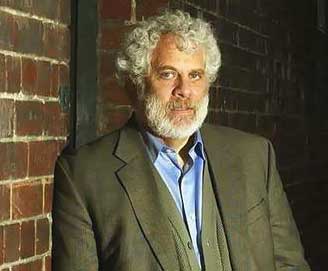
Mark Kurlansky appeared on The Bat Segundo Show #220. Kurlansky is most recently the author of The Last Fish Tale.

Condition of the Show: Moving forward after unexpected losses.

Author: Mark Kurlansky

Subjects Discussed: Mark Kurlansky’s wonderful dog, coming into Gloucester from an outsider’s perspective, possible solutions to global fishing problems, the close parallels between bottom dragging and the decline in fish stocks, ineffective methods of government subsidization, bycatch, intercontinental arguments over fishing, the problems with regulating fisheries, trying to find uses for excess fish stock, Gorton’s, bureaucracy and other political problems in Massachusetts, the clash between environmentalists and fishermen, the Elise vs. Bluenose race, downtown zoning and fishing, careful hotel development, chowder recipes, Moby Dick, Portuguese linguica, fishermen going out to sea without being able to predict the dangerous weather, the history of the schooner, various fishing technologies, oceanography, Howard Blackburn, Gloucester newcomers, ethnic groups and the granite industry, the Luminists and Fitz Henry Lane, Emile Gruppe, non-native Gloucester residents and art, Kurlansky’s illustrations, Motif Number 1, T.S. Eliot’s The Waste Land and Ezra Pound’s cut of Gloucester passages, balancing non-specific details about interviews with primary sources, and Kurlansky’s journalistic approach.

EXCERPT FROM SHOW:

Correspondent: I’m wondering if it’s a matter of this obdurate Gloucester character that you allude to many times throughout the book. In fact, I was curious about the whole Elsie vs. Bluenose race. You actually write that essentially, they didn’t have time to deal with this great defeat. That they were more concerned with fishing. And in a desperate effort to determine whether this was true, I was digging through the New York Times archive and I found this particular quote from Captain Marty Welch in a 1921 article. He basically says, “I’ve no excuses. The larger boat won. The Elsie is as good as the Bluenose is, only she’s smaller. Give me a vessel of that size and I’d like to race her every day in the week.” So this seems to me either a sense of Gloucester bluster or perhaps a notion of some kind of pride. What is this exactly?
Kurlansky: Well, in that particular case — and it was a different era — you have to remember that schooners were invented in Gloucester. And they were invented as fishing boats. And so fishermen had this tremendous pride that they were the masters of schooners. And they became yachts. Today, the only schooners around — except for in a few museums — are yachts and for racing. So fishermen — and it’s the same thing with the environmentalists. “These aren’t real men of the sea. These are just rich guys who are playing around on these boats. We’re the guys who know how to handle a schooner.”

Correspondent: And then, on top of everything else, the Canadians decide to put the Bluenose on their stamps, their dime….

Kurlansky: On everything.

Correspondent: My girlfriend’s Canadian and I asked her about the Bluenose. And she gave me a slight grin. So I’m like, “Come on. Give the Gloucester guys something.”

Kurlansky: Well, Bluenose visits Gloucester. There’s a new…

Correspondent: The Bluenose IV. Yeah, I saw that.

Kurlansky: But one of the unusual charms, I think, of Gloucester is that it is very determinedly a blue-collar place. And it takes a tremendous pride in its blue-collarness. And it’s a community in which there are a number of extremely wealthy people. And they all get along pretty well. At least, they socialize. In a way, it is the classless society. Except that there is this tremendous awareness of class and the ethos of working-class people. You have to be aware of that if you want to deal with Gloucester.

(Please note: Due to current incompatibility between PodPress and WP 2.6, I have had to institute a workaround. If the player button does not work, then try the direct link to the MP3 below.)

BSS #220: Mark Kurlansky

The Bat Segundo Show: Thomas M. Disch

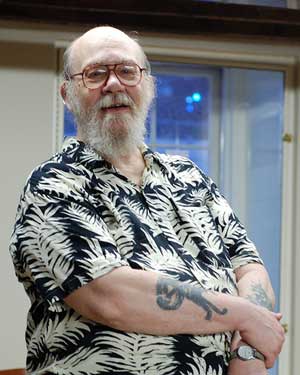
Thomas M. Disch appeared on The Bat Segundo Show #219.

The late, great author committed suicide on July 4, 2008. This was his last face-to-face interview before his death, conducted on June 25, 2008 at his apartment. For more on Disch, start here. His most recent book was The Word of God.

Condition of the Show: In memoriam.

Author: Thomas M. Disch

Subjects Discussed: The difficulties of declaring yourself a deity, truth and memoirs, authenticity, James Frey, Disch’s takedown of Whitley Streiber, Democrats and evangelism, Reverend James Dobson, the unexpected reaction to Disch declaring himself an atheist at a North Dakota convention, Clifford Irving, the fun of footnotes and annotation, fundamentalists, writing books in which the ground is always shifting, Emerson and the trinity, Algis Budrys, Thomas Mann, the taboos of simulacra and alternative realities, war and commandments, the fantasy of having different parents, griping about editors and agents, the American literary tradition of celebrating con artistry, L. Ron Hubbard, Disch’s religious acolytes, Michael Moorcock, asking for blurbs without any of the blurbers reading the book, Philip K. Dick’s 1972 letter to the FBI, Camp Concentration, pulp fiction and literary posterity, “A Visit from Saint Nicholas” and Clement Brown, whether or not literature (and civilization) will survive into the next century, maintaining a LiveJournal, on not submitting poems to magazines, Samuel Johnson’s maxim, poetry and the New Yorker, editors or critics who hate Disch’s guts, being ignored, being snubbed by Stephen Donaldson, ridiculing enemies, nonoverlapping magesteria, having Catholic friends, cowboys, literature as a religion, Disch’s efforts to read The Tale of Genji before death, the reading of “approved classics,” Samuel Richardson’s Clarissa and Jane Austen, Disch’s strong love of Patrick O’Brian’s Aubrey-Maturin novels, writing Amnesia and building a model of Manhattan within the text adventure game, literature as a constantly changing medium, inhabiting the now and obsolescence, silent film, and poetry as Disch’s “one good horse.”

EXCERPT FROM SHOW:

Correspondent: I wanted to also ask you about A.J. Budrys, who I know you — I saw your LiveJournal where there were many caustic remarks directed his way. But I should point out that when I received this galley well before June 9th, when he died, you referred to him as “the late Algis Budrys.”

Disch: (laughs) Yes!

Correspondent: I’m wondering if you had some inside dope or if this is another example of your divine powers.

Disch: I guess so. I mean, I never know what my divine powers are going to do often, until they’ve done it. And this is certainly a case where I had picked the right horse without even knowing.

Correspondent: Well, I mean, why did you type “the late” so early on? I mean…

Disch: (laughs) Well, for one thing, I didn’t know.

Correspondent: You didn’t know he was alive?

Disch: Yeah. I sort of figured it was likely that he was dead. And wishing it to be the case, I just wrote it that way.

Correspondent: Or he was dead to you in other words?

Disch: Yeah. Yeah. I mean, if I had my druthers, there he is.

Photo credit: Flickr

(Please note: Due to current incompatibility between PodPress and WP 2.6, I have had to institute a workaround. If the player button does not work, then try the direct link to the MP3 below.)

BSS #219: Thomas M. Disch

The Bat Segundo Show: Andre Dubus III

Andre Dubus III appeared on The Bat Segundo Show #218. Dubus is most recently the author of The Garden of Last Days.

Condition of the Show: Plagued by decaying verdure and intrusive catering managers.

Author: Andre Dubus III

Subjects Discussed: The propinquity of Roman numerals after surnames, Richard Flanagan’s The Unknown Terrorist, Heinrich Böll, books being categorized as post-9/11 novels, on letting a book go after publication, political novels, writing longhand in cars, Tobias Wolff, the car as shared confessional experience, Flannery O’Connor, writing as a dreamworld, verisimilitude, getting an approximation of an outsider’s character or experience, “White Trees, Hammer Moon,” prison, capitalism, serial description in a declarative sentence, considering the reader, realism vs. postmodernism, self-indulgence in writing, Blaise Pascal, the dangers of the author pleasing himself, taking twenty-five years to write a novel, Dubus’s beverage motif, whether or not specific details in a novel are symbolic, the advantages that come from confined and sustained narratives, sensuality, writing in short sustained bursts, vicarious moral outrage, poems and Books on Tape, T.S. Eliot’s The Waste Land, an interruption by a catering manager, Dubus’s early life bumping around, the responsibilities of a novelist, honesty, novelists who impose endings on books, fiction as a pack of lies vs. fiction as truth, Picasso, sincerity, characters who become truer than real people, and the absence of fathers and husbands in The Garden of Last Days.

EXCERPT FROM SHOW:

Correspondent: I had to remark on the beverage motif throughout this book. We open this book with, of course, April having a plastic coffee cup with her legs. And then two hundred, three hundred pages in, we see the cop with the #1 GRANDDAD mug. And then we also have Virginia heating a cold cup of coffee in the microwave. So…

Dubus: Ho ho! This is brilliant, man. (laughs)

Correspondent: But the concern for coffee in this is rather extraordinary! Because coffee is almost this life force of good versus the drinking one sees from the antagonists in this book. All the antagonists tend to drink. Or they resist drink in order to be good. And so…

Dubus: Oh, this is fascinating.

Correspondent: So there’s a certain coffee-alcohol axis I had to ask you about.

Dubus: Well, God, it just sounds like a weekend in my life.

Correspondent: (laughs)

Dubus: Drink Friday night, drink coffee on Saturday morning. Fascinating. Wow. I hadn’t even known that. Listen, I do believe that we live in our bodies. Even those of us who live very ethereally from the chin up. And I truly believe that these central details shape us and guide us. You know, I had this experience a few years ago where my wife and I had a little spat over money the first thing in the morning. My coffee was cold, gone cold during the fight. I get in the car. It hardly starts up. And I’m worried about money and can I fix this clutch. I drive off. A guy cuts me off in his truck. And I’m telling you. If that car could go fast, I’d go down the road, rip him off the truck, and beat on him.

The next day, my wife and I were fine. We weren’t having a spat. My coffee was delicious. It was the perfect cup of dark French roast. Black. That I like. And it was just the right temperature. I had a little cup, driving cup. And it wasn’t spilling. The car started up. I pull out into the word and another guy cuts me off. And this time, Ed, I said, “Go in peace, my brother. You should be careful. You might hurt someone or yourself.” I had all this good will. And it had to do with my coffee being good. (laughs)

Correspondent: But I’m wondering how this…

Dubus: This stuff isn’t unimportant?

Correspondent: It’s important. But I’m curious. You have to be aware — since there is so much coffee in this book — that you’re repeating this symbol over and over again. So readers like me say, “Well, coffee. Might be a symbol.” Or as we’re suggesting here, it may not be a symbol at all. It may just be some aspect of the world you’re drawing from that just happens to repeat itself.

Dubus: But, Ed, man, I really believe that the reader tends to know more than the writer. At least, certainly in my case.

The Bat Segundo Show: Rachel Shukert

Rachel Shukert appeared on The Bat Segundo Show #217. Shukert is the author of Have You No Shame? Incidentally, she’ll be appearing at the July 17th installment of the In the Flesh reading series.

Condition of the Show: Contending with tenuous widows and the mysterious circumstances of Mr. Segundo’s death.

Author: Rachel Shukert

Subjects Discussed: Whether Ms. Shukert is still on the Viacom blacklist, the soul-crushing aspects of temping, working odd jobs in Amsterdam, Anne Frank as a constant in life, the holy similarities between Northw__t and G_d, plane crashes vs. car crashes, airlines and gods, the legal system and divine repercussions, lawyers in Nebraska, talk show hosts who come from Nebraska, Montgomery Clift, the relationship between Jewish identity and location, Omaha vs. New York, the notion of stretching out time, writing truthfully about scatological topics, placing a parental advisory warning, expanding the limitations of personal experience, on being perceived by others, limits on confessional writing, room for the persona to grow within annotation, elevated prose, abandoned sets of footnotes left out of the book, David Foster Wallace’s “Tri-Stan: I Sold Sissee Nar to Ecko,” David Macaulay’s Motel of the Mysteries, Will Self’s The Book of Dave, Newt Gingrich, writing letters vs. email, using all caps in print vs. online, grouping people into taxonomies, Fred Savage and Jason Priestley, first crushes, being published as a paperback original, The Anorexic’s Cookbook vs. The Anarchist’s Cookbook, and performing pieces in front of a crowd.

EXCERPT FROM SHOW:

Shukert: Jason Priestly and Fred Savage were the two guys on TV who I had big crushes on as a child. I had a picture of Fred Savage in my locker that I cut out from the newspaper. I remember that he was holding a candy box. Like a Valentine’s heart box. And I would pretend that he was holding it for me. And then when I got a little older, I thought Jason Priestly was the handsomest man I had ever seen. I mean, when I say “a little older,” I mean ten. But I had a big poster of him in my room too.

Correspondent: Who was the first crush you had?

Shukert: Gene Kelly.

Correspondent: Really? And he’s not referenced in the book.

Shukert: No. That’s private. (laughs)

Correspondent: Not anymore. It’s public now. But this is an interesting distinction. Are you slightly ashamed of these crushes?

Shukert: No, I’m not ashamed. But there’s a difference between being ashamed of something and just having something close to your heart. (laughs)

Correspondent: Wow. Well, I’m curious. How much does a crush linger over the course of one’s life like this? I mean, you can be safe with Jason Priestly and Fred Savage, but…

Shukert: I don’t have crushes on them anymore.

Correspondent: But you still have a crush on Gene Kelly.

Shukert: Yes, but he’s dead.

Correspondent: He’s dead. The dead people are the ones to really lust after the best.

Shukert: Yeah, I think that that’s true.

Correspondent: Because there’s no way that you can possibly consummate it.

Shukert: I also loved Paul Newman as a child.

Correspondent: What are you going to do when he dies?

Shukert: I’ll be sad. I’ll mourn like a widow.