The Bat Segundo Show: Mort Walker

Mort Walker appeared on The Bat Segundo Show #216. Mort Walker is the creator of Beetle Bailey. A volume of the first two years of Beetle Bailey is now out.

Condition of the Show: Observing fifty years of development.

Author: Mort Walker

Subjects Discussed: Walker’s drawing pace, the Beetle Bailey production cycle, filtering through the gags, rejected strips sent to Sweden, Beetle’s early days as a slacker in college, the military as the common experience, Walker’s relationship with the syndicate, the curly hair look of Buzz and Lois, portrait-like illustrations of women, early attention to background, the shrinking space of newspaper comics, Berkeley Breathed and Bill Watterson’s fights for space, appealing to the greatest number of readers, the development of Sarge’s girth and teeth, Plato as the only other character carryover, covering the eyes of characters, Dik Browne, Beetle’s early square form and perpendicular limbs, Walker as Lt. Fuzz, Lt. Jack Flap, African-American characters in comic strips, being confronted by editors by Ebony, Colin Powell’s approval of Flap, code numbers associated with the comic strip, writing a military-based comic strip without reference to Iraq, General Halftrack’s skirt-chasing and later sensitivity training, the circumstances that will cause Walker to change his strip, why Walker hasn’t included women soldiers, aborted cliffhangers, and characters staying the same in the Beetle Bailey universe.

EXCERPT FROM SHOW:

Correspondent: Here we have a military strip. But there’s no reference to Iraq. And I wanted to ask you about this kind of balance.

Walker: I try to avoid anything controversial. Because if you do something pro-Bush, fifty percent of your readers are going to get mad, fifty percent of your readers might like it. But I’m after the whole broad spectrum. So I’m really avoid those things.

Correspondent: But to talk about the broader audience, I mean, Bush’s approval rating isn’t exactly the best in the world. It’s under 30%. So you have 70% of the audience if you were to play around with this kind of thing.

Walker: Yeah. Well, anyway, I try not to get too topical or controversial. That’s why I’ve avoided the war pretty much. I don’t mention Iraq very much. Very seldom.

Correspondent: Even though this war has lasted longer than World War II? I mean, doesn’t it seem…?

Walker: But there’s so many people that are angry about it that I’ve got to be really careful about how I treat it. Mostly, I just ignore it. People say, “Well, when is Beetle going to go to Iraq?” I said, “Jesus Christ. I hope never!” You know, I don’t want to send him there because it’s very difficult to deal with. I’m just keeping him in basic training. It’s the common experience that all soldiers have. If I take him out somewhere and specify into some particular kind of work, I’ll lose a lot of my readers there. They won’t be interested or they won’t understand it. But everybody understands basic training. That’s where I keep him.

Correspondent: I mean, you had this similar situation with Jack Flap. That’s why I present this as well. I mean, that didn’t hurt you. In fact, that got Beetle Bailey more attention, you know?

Walker: Yeah, but it was a common experience. Anyway, that hasn’t hurt me.

The Bat Segundo Show: Christian Bauman

Christian Bauman appeared on The Bat Segundo Show #215. Bauman is most recently the author of In Hoboken.

Condition of the Show: Contending with contentious Midtown diners.

Author: Christian Bauman

Subjects Discussed: Defining a rock and roll novel, writing an ensemble novel with Hoboken as a character, references to paper storms and 9/11, chronological foreshadowing, using real-life Hoboken locations vs. invented locations, the Hoboken-New York rivalry, playing the rube vs. genuine sincerity as a reflection of irony in the 1990s, balancing real-life incidents and invented narrative, the benefits of vaguely knowing someone, whether or not a particular city is important to a narrative, writing about the worker hierarchy, writing about characters who live cheaply, socioeconomics in literature, locative contexts that make novels different, trying not to anticipate the next novel, songwriting phrases, reconfiguring essays and other pieces into a novel, and the modified omniscient voice.

EXCERPT FROM SHOW:

Correspondent: You have this particular rock ‘n’ roll novel dwelling upon Hoboken, as well as Mona Smith, who is this Erica Jong-like figure, who is the mother of Thatcher. But I wanted to ask you about this. Because it’s very fascinating to me. I have the belief that if you write a rock ‘n’ roll novel, there needs to be some additional element. Some additional hook. Because if you dwell too much on rock ‘n’ roll music, well, it’s going to possibly be something of a circlejerk. So I wanted to ask you. Was this a consideration in setting this book in Hoboken? The Hoboken aspect came first? What happened here?

Bauman: Yeah, I think the Hoboken aspect came first. Well, first of all, I should point out that everyone keeps calling it a rock ‘n’ roll novel. It is actually a folk novel. So we should just be clear here. There’s a lot more Woody Guthrie here than anything else. But it’s a good point. You know, the whole thing I wanted to do, in as far as I wanted to anything and it didn’t just happen the way it happened — I was trying very hard this time to do two things. One was to write about a place. A very specific place to the point where the place became one of the characters in the book. And of those places where I’ve either lived or been alive in my life, Hoboken was one of them that stood out as a good place to go. And the other one was that I really wanted to try and write an ensemble novel to the best of my ability. And I kind of failed in that aspect.

The Bat Segundo Show: Steven Greenhouse

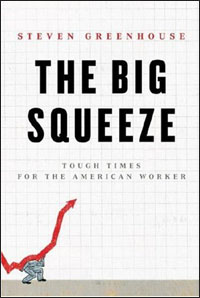
Steven Greenhouse appeared on The Bat Segundo Show #213. He is the New York Times labor reporter and the author of The Big Squeeze. My review of the book can be found here.

Condition of the Show: Reporting upon the darker truths of America.

Author: Steven Greenhouse

Subjects Discussed: Whether economic factors of the 1970s or Eleanor Roosevelt’s famous maxim caused the current strife between corporations and workers, the social contract that came from 20th century labor negotiations, why workers settle for less, temps exploited by HP, being treated like dirt, mock memos circulated to cope with downsizing, The Office, why workers aren’t revolting, Bowling Alone, The Pursuit of Loneliness, how what we do for fun has transformed in the past few decades, the worker-friendly company policies of Patagonia, prodigious cafeteria options for workers, the shocking disparity of parental leave policies in different nations, tracking the lunch hours of workers, computers vs. martinet managers, call center workers, workers who slack off vs. a robust economy, Cooperative Home Care Associates and the benefits of workers on the board of directors, independent contractors, job security, the New York Times hiring freeze, Neutron Jack Welch, The Disposable American, companies who display “too much loyalty” to workers, workers who “get used to” hard and immoral company tactics, climbing the Wal-Mart ladder, the workplace as a cult, unrealistic American dreams, billable hours, the allure of promotion, Greenhouse’s proposed solutions, and a living minimum wage.

EXCERPT FROM SHOW:

Correspondent: Look at Jennifer Miller, who is this woman who worked at HP for ten years. She didn’t have to work as a temp for that long. She could have easily cut out. She could have gone and demanded more from the HP managers. So I would argue that the workers who have allowed themselves to be placed in these particular conditions are perhaps just as responsible as these businesses and these corporations that are trying to squeeze out more profits and also trying to combat the influx of low-cost imports.


Greenhouse: Again, Ed, you ask a good question, and it’s hard to say. Jennifer Miller was a worker at HP. High school graduate. Very little college. She started as a McDonald’s worker. She became a McDonald’s manager. She got tired of that. Then she got a permanent job at HP. That job was sent overseas. So she was kind of bought out. Then a few months later, she was approached. “How would you like to return to HP as a temp?” She thought it was going to be a two-month gig. And as I explained in the book, she was there for ten years as a temp. She said that the job was good. It used a lot of advanced skills. She was often treated with respect, but she said the bad thing was she was a temp and didn’t get the same benefits as HP workers. She didn’t quite get the respect. So you ask why didn’t she quit?

Correspondent: And I should point out that she was even barred from the company parties. I mean, this is a key indicator. In my view, I would say, “Well to hell with this. I’m going to find someone who I can be on staff with.”

Greenhouse: It wasn’t just she. But all temps were barred from the company — you know, they might create a wonderful new piece of software, created a wonderful printer, and all the regular permanent employees could go to the party and celebrate and go for the two-day ski holiday to celebrate. But the temps who work alongside the regular workers in a crazy situation, they weren’t invited to the parties. So yeah, for someone like Jennifer, there was some eating humble pie there. So the question is why didn’t she quit? She said, “For me, Jennifer Miller, a mere high-school graduate living in Idaho, that was a terrific job. I was making $30 an hour. I was really using my brain. I was often working alongside terrific people. Sort of semi, somewhat treated as an equal. But on the other hand, no.” And she said, considering what else was out there, going back to McDonald’s working as a manager, which isn’t such a bad job, but she said working at HP as a temp was better. Her argument was HP was good in many ways, but there was this one big negative. That she was treated as a temp.

The Bat Segundo Show: Fiona Maazel

Fiona Maazel appeared on The Bat Segundo Show #212. Maazel is the author of Last, Last Chance.

[LISTENING NOTE! Please note that this show contains numerous grinding noises. We have endeavored to remove as many of these as possible, and reduce the noise where possible. Alas, SOME aural residue remains.]

Condition of the Show: Considering the niceties of superplagues.

Author: Fiona Maazel

Subjects Discussed: Being under observation, the relationship between kosher chickens and superplagues, rich WASPy girls, individual vs. societal ironies, keeping the protagonist’s name somewhat secret, Mary Shelley’s The Last Man, on not reading Camus for protective purposes, Panic in the Streets, the anxiety of influence, opting for a more realistic plague narrative, using humor to cantilever a dark narrative, devising multiple historical voices, pawing around in the dark, reincarnations, Groundhog Day as the essence of reincarnation, thongs and corporeal elliptical themes, the dangers of reading too fast, perceived titular homages to Nabokov, reviewers who are “certain” about books, auctorial intentions, moving around and setting a portion of the book in Texas, wanting to be T.S. Eliot, pursuing the grit, the pervasiveness of television, revolting against cultural media, Nordic tales, developing a conscious understanding of a deity, Stanley as a barometer, and agitprop.

EXCERPT FROM SHOW:

Correspondent: If one looks at more lower brow choices, like Stephen King’s The Stand or The Andromeda Strain, or any number of superplague television series, like The Survivors and things like that, one tends to find a narrative that begins with the decimation of humanity. Yours is not that particular book. Again, going back to this question of inversions, I’m wondering if you made a particular choice. You had to have known about The Stand.

Maazel: Sure, it’s true. But I didn’t think it was an inversion. I thought it was credible actually. I did a lot of research about plague and also about the CDC and bioterrorism. And just how unlikely the scenario I proposed is. It’s extraordinarily likely. This isn’t an alternate reality kind of novel. It didn’t seem likely that someone would unleash a plague and actually wipe out all of humanity. That’s just not credible. I wanted to come up with a credible scenario. So I guess from the perspective of someone writing fiction or reading fiction, one might expect something like a terrific slate wiper to come along, as we’ve seen in so many of these movies and books. But I actually wanted something that seemed really realistic. That only 3,000 people would die and the fact that they put a stop to it. For instance, when we had this little anthrax outbreak or even bird flu, people are dying, but they’re still containing it. I was more interested in the anxiety, the terror, the foreboding of what could happen. Might this thing wipe out a hundred million Americans or a hundred million people? That was more interesting to me than watching this disease tramp across the country and actually kill off half the United States.

The Bat Segundo Show: Ed Park

Ed Park appeared on The Bat Segundo Show #211. Park is most recently the author of Personal Days. His book was reviewed today in the NYTBR by Mark Sarvas.

Condition of the Show: Plagued by brutal downsizing.

Author: Ed Park

Subjects Discussed: Literary people named Ed, writing Personal Days and using vacation days while employed at the Voice, counting words written per day, B.S. Johnson, Jonathan Coe’s Like a Fiery Elephant, Harry Stephen Keeler, staying productive as a writer, the other Ed Park novels (The Dizzies, Chinese Whispers, The Diet of Worms, Dementia Americana, et al.), Stone Reader, lost books, writing within tight stylistic constraints, the section titles, “restructuring,” references to Hollywood and the quest for narrative, figuring out “Operation JASON,” waiting for the Eureka moment, making patterns emerge, patterns within character names and working within limitations, the use of italics, writing the third part without a period, having an affinity for exclamation points, Lester Bangs’s Psychotic Reactions and Carburetor Dung, Elizabeth Crane’s “My Life is Awesome! And Great!,” the office as a microcosm for New York, William Gaddis, Harry Matthews, Cigarettes and The Journalist, the relationship between the ability to calculate vs. the loss of the first person plural, consciousness in attrition, Joshua Ferris’s Then We Came to the End, The Office, avoiding the influence of other topical art, Crease in Personal Days vs. Creed in The Office, style vs. content, specific typographical symbols, voice recognition and gobbledygook, William Gibson’s Pattern Recognition and Gaddis’s The Recognitions, office detritus, paperclips that pierce, setting limitations when veering down dark and scatological territory, and the pathological corporate impulse.

EXCERPT FROM SHOW:

Park: It’s such a pleasure to talk to someone who’s also named Ed.

Correspondent: Yes, I know. I mean, it’s a hell of a first name. There needs to be a Society of Eds set up in the five boroughs.

Park: It’s pretty rare.

Correspondent: I know. I wanted to ask you a commonplace question and then get to the nitty-gritty of this book. I know that you wrote a good chunk of this book while you were working at the Voice. But the sense I got was that you didn’t write all of it at the Voice. So I’m curious as to how much of this was written in a Voice-less setting, so to speak.

Park: Well, if you mean by “at the Voice,” while I was still employed by them, that’s true. Most of it was written before I left the Voice. I was let go at, basically, Labor Day. Right before Labor Day Weekend of ’06. But by that time, I did actually have a draft. There were many changes that I knew were necessary. I wrote it though. In terms of physical space, I could never even write my articles at the Voice. Just in the Voice office. I was hired as an editor. Basically editing, sending emails, on the phone, stuff like that. So it wasn’t really a place where, ironically enough, I could get a lot of writing done. So all the writing took place in my apartment. I was living on 89th Street. A lot of it was the same as I’d done for my previous fictional projects, where I would just try to write in the morning before coming into work. What was a little bit different about this book was that, as things got more tense at the Voice, as things really looked like they were going in a bad way, I took some vacation days, personal days, and would really treat the book as my job in a way.