The Books I’ve Read in 2021

This is a running list of the books I’ve read in 2021 (I will update this over the course of the year):

1. Anka Radakovich, The Wild Girls Club
2. Pat Barker, Regeneration
3. Jane L. Mansbridge, Why We Lost the ERA
4. Michael Azzarad, Our Band Could Be Your Life
5. Renee Rosen, White Collar Girl
6. Anthony Haden-Guest, Studio 54, Disco, and the Culture of the Night
7. Jon Savage, England’s Dreaming
8. V.S. Naipaul, A House for Mr. Biswas
9. Siegfried Sassoon, Memoirs of an Infantry Officer
10. J.G. Ballard, Running Wild
11. J.G. Ballard, Empire of the Sun
12. Elaine Showalter, The Female Malady
13. Flannery O’Connor, The Complete Stories
14. Tim Lawrence, Love Saves the Day
15. Shirley Jackson, The Road Through the Wall
16. Martin Amis, Inside Story
17. Souvankham Thammavongsa, How to Pronounce Knife
18. Paul Fussell, The Great War and Modern Memory
19. Bryan Washington, Memorial
20. J.G. Ballard, The Kindness of Women
21. Rebecca West, The Return of the Soldier
22. Harvard Sitkoff, A New Deal for Blacks
23. Robert S. McElvaine, The Great Depression
24. Yaa Gyasi, Transcendent Kingdom
25. Sophie Ward, Love and Other Thought Experiments
26. Amity Shlaes, The Forgotten Man
27. Lynn Steger Strong, Want
28. Raven Leilani, Luster
29. J.G. Ballard, Concrete Island
30. Shirley Jackson, Hangsaman
31. Sylvia Plath, The Unabridged Journals of Sylvia Plath
32. Rachel Devlin, Relative Intimacy
33. Shirley Jackson, The Bird’s Nest
34. Rumaan Alam, Leave the World Behind
35. Mariko Tamaki, Laura Dean Keeps Breaking Up with Me
36. Gabrielle Bell, Inappropriate
37. J.G. Ballard, Hello America
38. J.G. Ballad, Millennium People
39. Adam Levin, Hot Pink
40. Catharine Arnold, Pandemic 1918
41. Matt Fraction, Big Hard Sex Criminals Volume 2
42. Bob Rosenthal, Cleaning Up New York
43. Gay Talese, Thy Neighbor’s Wife
44. J.G. Ballard, The Unlimited Dream Company
45. Richard Ford, Let Me Be Frank with You
46. The Best American Short Stories 2020
47. Vera Brittain, Testament of Youth
48. Lydia Millet, Omnivores
49. Peter Shapiro, Turn the Beat Around
50. Lydia Millet, George Bush, Dark Prince of Love
51. Don DeLillo, Great Jones Street
52. Lydia Millet, My Happy Life
53. China Mieville, October
54. Danielle Evans, The Office of Historical Corrections
55. Italo Calvino, The Baron in the Trees
56. Lydia Millet, Everyone Pretty
57. [Literary biography, title omitted for moral reasons]
58. Alison Bechdel, The Secret to Superhuman Strength
59. Jack Kerouac, The Dharma Bums
60. Tim O’Brien, Going After Cacciato
61. Lysley Tenorio, The Son of Good Fortune
62. Lydia Millet, How the Dead Dream
63. Tim O’Brien, If I Died in a Combat Zone
64. Tim O’Brien, Northern Lights
65. Nelson George, The Death of Rhythm and Blues
66. Richard Ford, Sorry for Your Trouble
67. Nelson George, Hip Hop America
68. Ernest R. May, The World War & American Isolation 1914-1917
69. Kazuo Ishiguro, Klara and the Sun
70. Tim O’Brien, The Nuclear Age
71. Lydia Millet, Love in Infant Monkeys
72. Richard Wright, Black Boy
73. Gay Talese, The Bridge
74. Lydia Millet, Ghost Lights
75. Gay Talese, Fame and Obscurity
76. Gay Talese, The Over Reachers
77. John D’Emilo and Estelle B. Freedman, Intimate Matters
78. Richard Wright, The Outsider
79. Richard Russo, Trajectory
80. Tim O’Brien, The Things They Carried
81. Jonathan Ames, A Man Named Doll
82. Gay Talese, Honor Thy Father
83. Lydia Millet, Magnificence
84. Alex Espinoza, Cruising
85. Mary Helen Washington, The Other Blacklist
86. Nelson George, Post-Soul Nation
87. J.G. Ballard, Rushing to Paradise
88. Darin Strauss, The Queen of Tuesday
89. Brett Harvey, The Fifties
90. Gayle E. Pitman, The Stonewall Riots: Coming Out in the Streets
91. Richard Russo, The Destiny Thief
92. Duncan Hannah, Twentieth Century Boy
93. Tove Ditlevsen, The Copenhagen Trilogy
94. Richard Russo, Everybody’s Fool
95. Langston Hughes, Not Without Laughter
96. Matt Fraction, Sex Criminals #5
97. Matt Fraction, Sex Criminals #6
98. Tim O’Brien, In the Lake of the Woods
99. Richard Wright, The Man Who Lived Underground
100. George Scuhlyer, Black No More
101. Paul Wilson, Center Square: The Paul Lynde Story
102. Ishamel Reed, The Terrible Twos
103. Rudolph Fisher, The Conjure-Man Dies
104. Lydia Davis, The Complete Short Stories of Lydia Davis
105. Ann Quin, Berg
106. Arna Bontremps, Black Thunder
107. A. Scott Berg, World War I and America
108. J.G. Ballard, Kingdom Come
109. Anna Kavan, I Am Lazarus
110. Joshua Cohen, The Netanyahus
111. Joshua Cohen, Four New Messages
112. Anna Kavin, Ice
113. Allan Berube, Coming Out Under Fire
114. Anna Kavan, Machines in the Head
115. Irwin Shaw, Five Decades
116. Ishamel Reed, Juice!
117. Martin Duberman, Stonewall
118. Lisa Wade, American Hookup
119. Moa Romanova, Goblin Girl
120. Ana Quin, Passages
121. Ishamael Reed, Mumbo Jumbo
122. Ben Passmore, Sports is Hell
123. Adrian Tomine, The Loneliness of the Long-Distance Cartoonist
124. Darin Strauss, Half a Life
125. Adrian Tomine, Killing and Dying
126. Anna Kavan, A Charmed Circle
127. Ishmael Reed, The Last Days of Louisiana Red
128. Joshua Cohen, Moving Kings
129. Ishmael Reed, Yellow Back Radio Brokedown
130. Ishamel Reed, Reckless Eyeballing
131. Anna Kavin, The Parson
132. Ishmael Reed, Flight to Canada
133. Ishmael Reed, The Freelance Pallbearers
134. Ishmael Reed, The Terrible Threes
135. Elizabeth Cobbs, The Hello Girls
136. Matt Fraction, Who Killed Jimmy Olsen?
137. Lindy West, Shit, Actually
138. Lauren Oyler, Fake Accounts
139. William T. Vollmann, No Immediate Danger
140. Ishmael Reed, Japanese by Spring
141. Patricia Lockwood, No One is Talking About This
142. Kristen Radtke, Seek You

(Image: Creative Commons via benuski)

Studies in Iconology (Modern Library Nonfiction #80)

(This is the twenty-first entry in The Modern Library Nonfiction Challenge, an ambitious project to read and write about the Modern Library Nonfiction books from #100 to #1. There is also The Modern Library Reading Challenge, a fiction-based counterpart to this list. Previous entry: The Face of Battle.)

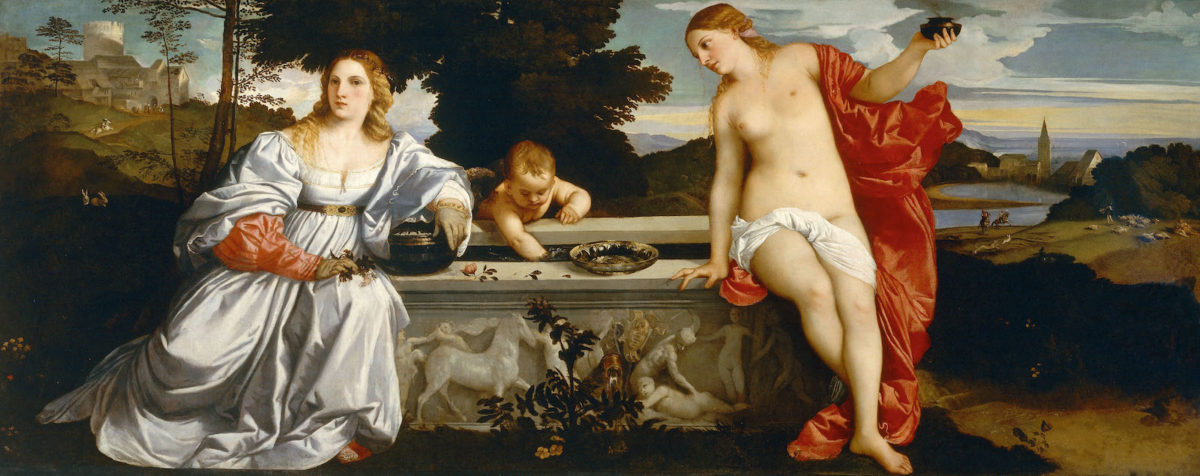
Titian’s Sacred and Profane Love (pictured above) is one of my favorite paintings of the 16th century, in large part because its unquestionable beauty is matched by its bountiful and alluring enigma. We see two versions of love at opposing ends of a fountain — one nearly naked without apology, but still partially clad in a windswept dark salmon pink robe and holding an urn of smoke as she languorously (and rebelliously?) leans on the edge of a fountain; meanwhile the other Love sits in a flowing white gown on the other end, decidedly more dignified, with concealed legs that are somehow stronger and more illustrious than her counterpart, and disguising a bowl that, much like the Kiss Me Deadly box or the Pulp Fiction suitcase, could contain anything.

We know that the Two Loves are meant to coexist because Titian is sly enough to imbue his masterpiece with a sartorial yin-yang. Profane Love matches Sacred with a coiled white cloth twisting around her waist and slipping down her left leg, while Sacred has been tinctured by Profane’s pink with the flowing sleeve on her right arm and the small slipper on her left foot. Meanwhile, Cupid serves as an oblivious and possibly mercenary middleman, his arm and his eyes deeply immersed in the water and seemingly unconcerned with the Two Loves. We see that the backdrops behind both Loves are promisingly bucolic, with happy rabbits suggesting prolific promiscuity and studly horsemen riding their steeds with forelegs in the air, undoubtedly presaging the stertorous activity to commence sometime around the third date.

Sacred’s backdrop involves a castle situated on higher ground, whereas Profane’s is a wider valley with a village, a tableau that gives one more freedom to roam. The equine motif carries further on Sacred’s side with a horse prancing from Sacred to Profane in the marble etching just in front of the fountain, while Profane’s side features equally ripe rapacity, a near Fifty Shades of Grey moment where a muscled Adonis lusts over a plump bottom, hopefully with consensual limits and safewords agreed upon in advance. Titian’s telling takeaway is that you have to accept both the sublime and the salacious when you’re in love: the noble respect and vibrant valor that you unfurl upon your better half with such gestures as smoothing a strand of hair from the face along with the ribald hunger for someone who is simultaneously desirable and who could very well inspire you to stock up on entirely unanticipated items that produce rather pleasurable vibrations.

There are few works of art that are so dedicated to such a dichotomous depiction of something we all long for. And Titian’s painting endures five centuries later because this Italian master was so committed to minute details that, rather incredibly, remain quite universal about the human condition.

But what the hell does it all mean? We can peer into the canvas for hours, becoming intoxicated by Titian’s fascinating ambiguities. But might there be more helpful semiotics to better grasp what’s going on? Until I read Panofsky’s Studies in Iconology, I truly had no clue that Titian had been influenced by Bembo’s Asolani or that the Two Loves were a riff on Cesare Ripa’s notion of Eternal Bliss and Transient Bliss, which was one of many efforts by the Neoplatonic movement to wrestle with a human state that occupied two modes of shared existence. Panofsky also helpfully points out that Cupid’s stirring of the fountain water was a representation of love as “a principle of cosmic ‘mixture,’ act[ing] as an intermediary between heaven and earth” and that the fountain can also be looked upon as a revived sarcophagus, meaning that we are also looking at life and love springing from a coffin. And this history added an additional context for me to expand my own quasi-smartypants, recklessly dilletantish, and exuberantly instinctive appreciation of Titian. In investigating iconology, I recalled my 2016 journey into The Golden Bough (ML NF #90), in which Frazer helpfully pointed to the symbolic commonality of myths and rituals throughout multiple cultures and across human history, and, as I examined how various symbolic figures morphed over time, I became quite obsessed with Father Time’s many likenesses (quite usefully unpacked by Waggish‘s David Auerbach).

Any art history student inevitably brushes up against the wise and influential yet somewhat convoluted views of Erwin Panofsky. Depending upon the degree to which the prof resembles Joseph Mengele in his teaching style, there is usually a pedagogical hazing in which the student is presented with “iconology” and “iconography.” The student winces at both words, nearly similar in look and sound, and wonders if the distinction might be better understood after several bong hits and unwise dives into late night snacks, followed by desperate texts to fellow young scholars that usually culminate in more debauchery which strays from understanding the text. Well, I’m going to do my best to explicate the difference right now.

The best way to nail down what iconography entails is to think of a painting purely in terms of its visuals and what each of these elements means. Some obvious examples of iconography in action is the considerable classroom time devoted to interpreting the green light at the end of The Great Gatsby or the endless possibilities contained within the Mona Lisa‘s smile. It is, in short, being that vociferous museum enthusiast pointing at bowls and halos buried in oil and doing his best to impress with his alternately entertaining and infuriating interpretations. All this is, of course, fair game. But Panofsky is calling for us to think bigger and do better.

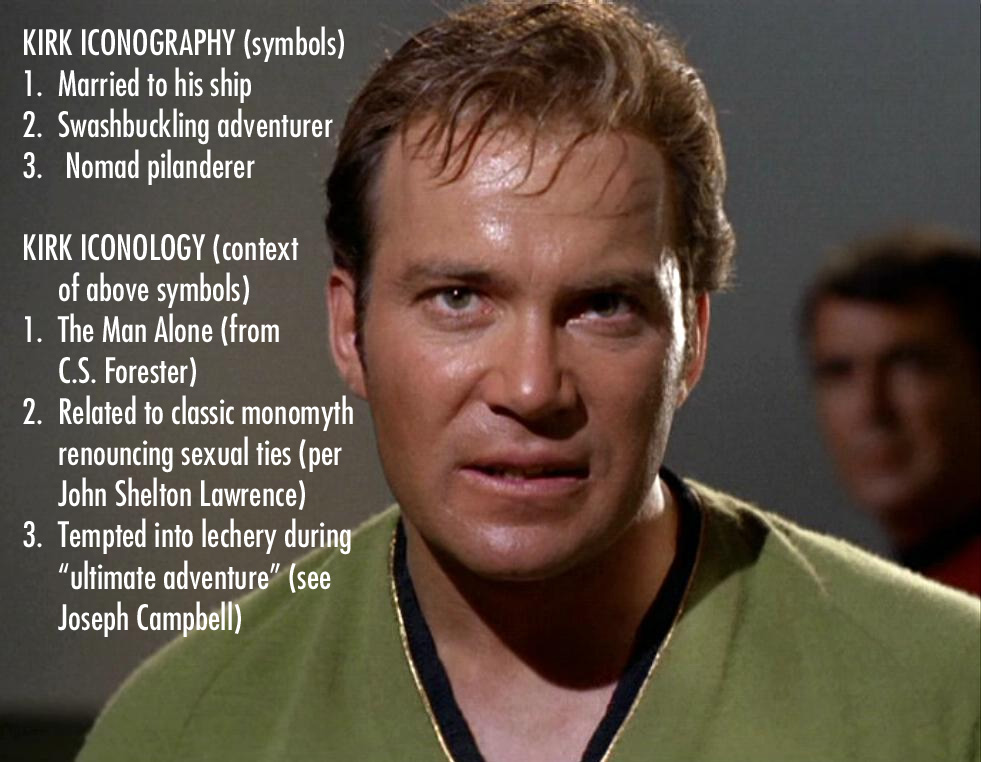
Enter iconology, which is more specifically concerned with the context of this symbolism and the precise technical circumstances and historical influences that created it. Let me illustrate the differences between iconography and iconology using Captain James T. Kirk from Star Trek.

Here are the details everyone knows about Kirk. He is married to his ship. He is a swashbuckling adventurer who gets into numerous fights and is frequently seen in a torn shirt. He is also a nomadic philanderer, known to swipe right and hookup with nearly every alien he encounters. (In the episode “Wink of an Eye,” there is a moment that somehow avoided the censors in which Kirk was seen putting on his boots while Deela brushes her hair.) This is the iconography of Kirk that everyone recognizes.

But when we begin to examine the origins of these underlying iconographic qualities, we begin to see that there is a great deal more than a role popularized by William Shatner through booming vocal delivery, spastic gestures, and an unusual Canadian hubris. When Gene Roddenberry created Star Trek, he perceived Captain Kirk as “Horatio Hornblower in Space.” We know that C.S. Forester, author of the Hornblower novels, was inspired by Admiral Lord Nelson and a number of heroic British authors who fought during the Napoleonic Wars. According to Bryan Perrett’s The Real Hornblower, Forester read three volumes of The Naval Chronicle over and over. But Forester eventually hit upon a trope that he identified as the Man Alone — a solitary individual who relies exclusively on his own resources to solve problems and who carries out his swashbuckling, but who is wedded to this predicament.

Perhaps because the free love movement of the 1960s made the expression of sexuality more open, Captain Kirk was both a Man Alone and a prolific philanderer. But Kirk was fundamentally married to his ship, the Enterprise. In an essay collected in Star Trek as Myth, John Shelton Lawrence ties this all into a classic American monomyth, suggesting that Kirk also represented

…sexual renunciation, a norm that reflects some distinctly religious aversions to intimacy. The protagonist in some mythical sagas must renounce previous sexual ties for the sake of their trials. They must avoid entanglements and temptations that inevitably arise from satyrs, sirens, or Loreleis in the course of their travels…The protagonist may encounter sexual temptation symbolizing ‘that pushing, self-protective, malodorous, carnivorous, lecherous fever which is the very nature of the organic cell,’ as Campbell points out. Yet the ‘ultimate adventure’ is the ‘mystical marriage…of the triumphant hero-soul with the Queen Goddess” of knowledge.

All of a sudden, Captain Kirk has become a lot more interesting! And moments such as Kirk eating the apple in Star Trek II: The Wrath of Khan suddenly make more sense beyond the belabored Project Genesis metaphor. We now see how Roddenberry’s idea of a nomad philanderer and Forester’s notion of the Man Alone actually takes us to a common theme of marriage with the Queen Goddess of the World. One could very well dive into the Kirk/Hornblower archetype at length. But thanks to iconology, we now have enough information here to launch a thoughtful discussion — ideally with each of the participants offering vivacious impersonations of William Shatner — with the assembled brainiacs discussing why the “ultimate adventure” continues to crop up in various cultures and how Star Trek itself was a prominent popularizer of this idea.

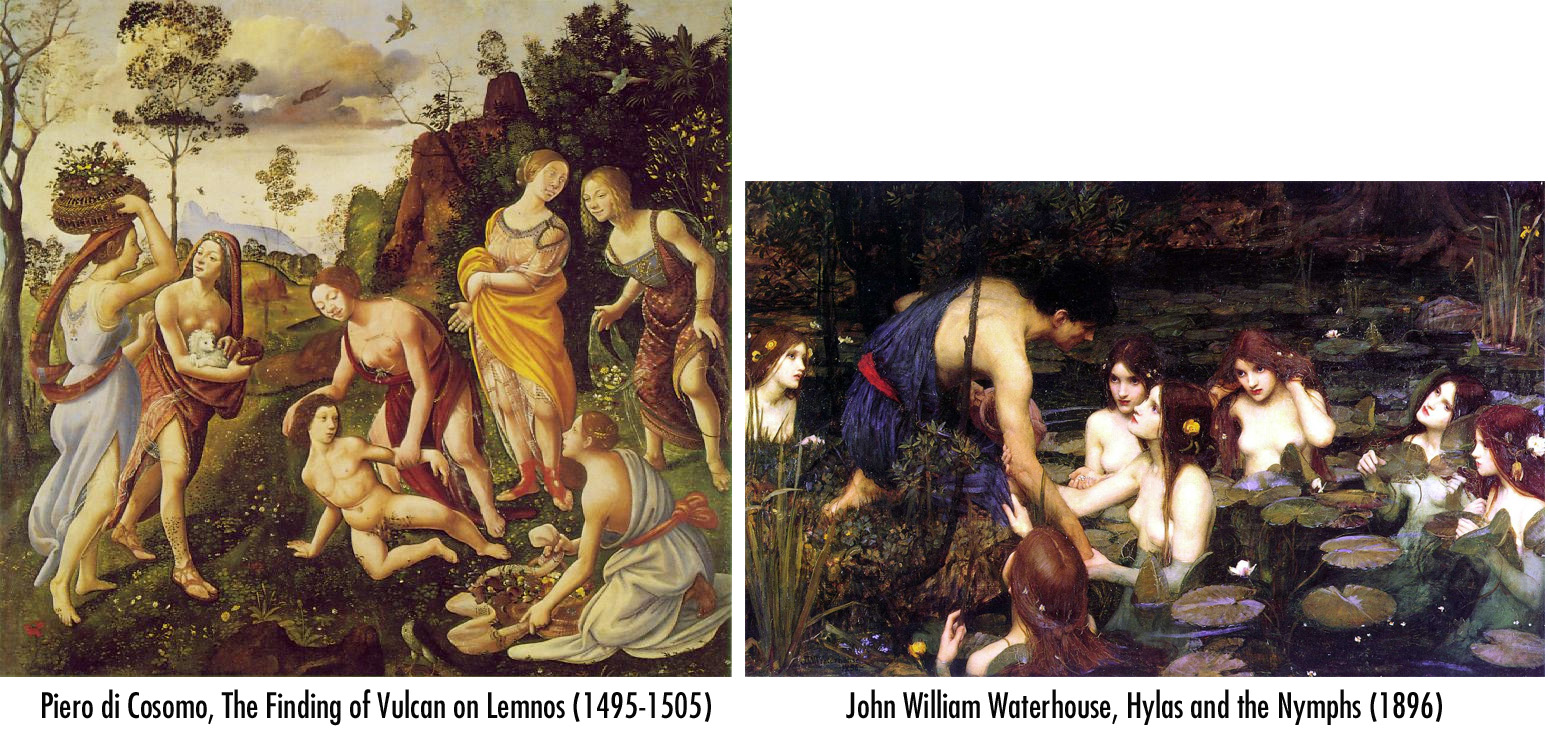
Now that we know what iconology is, we can use it — much as Panofsky does in Studies in Iconology — to understand why Piero di Cosimo was wilder and more imaginative than many of his peers. (And for more on this neglected painter, who was so original that he even inspired a poem from Auden, I recommend Peter Schjeldahl’s 2015 New Yorker essay.) Panofsky points out how Piero’s The Finding of Vulcan on Lemnos (pictured above) differs in the way that it portrays the Hylas myth, whereby Hylas went down to the river Ascunius to fetch some water and was ensnared by the naiads who fell in love with his beauty. (I’ve juxtaposed John William Waterhouse’s Hylas and the Nymphs with Piero so that you can see the differences. For my money, Piero edges out Waterhouse’s blunter version of the tale. But I also chose the Waterhouse painting to protest the Manchester Art Gallery’s passive-aggressive censorship from last year. You can click on the above image to see a larger version of both paintings.) For one thing, Piero’s painting features no vase or vessel. There is also no water or river. The naiads are not seductive charmers at all, but more in the Mean Girls camp. And Hylas himself is quite helpless. (The naiad patting Hylas on the head is almost condescending, which adds a macabre wit to this landlocked riff.) Piero is almost the #metoo version of Hylas to Waterhouse’s more straightforward patriarchal approach. And it’s largely because not only did Piero have a beautifully warped imagination, but he was relying, like many Renaissance painters, upon post-classical commentaries rather than the direct source of the myths themselves. And we are able to see how a slight shift in an artist’s inspiration can produce a sui generis work of art.

Panofsky is on less firm footing when he attempts to apply iconology to sculptures and architecture. His attempts to ramrod Michelangelo into the Neoplatonic school were unpersuasive to me. In analyzing the rough outlines of a monkey just behind two of Michelangelo’s Slaves (the “dying” and the “rebellious” ones) in the Louvre, Panofsky rather simplistically ropes the two slaves into a subhuman class and then attempts to suggest that Ficino’s concept of the Lower Soul — which is a quite sophisticated concept — represents the interpretive smoking gun. This demonstrates the double-edged sword of iconology. It may provide you a highly specific framework for which to reconsider a great work of art, but it can be just as clumsily mistaken for the absolute truth as any lumbering ideology.

Then again, unless you’re an insufferable narcissist who needs to be constantly reminded how “right” you are, it’s never any fun to discuss art and ideas with people who you completely agree with. Panofsky’s impact on art analysis reminds us that iconology is one method of identifying the nitty-gritty and arguing about it profusely and jocularly for hours, if not decades or centuries.

Next Up: Edmund Morris’s The Rise of Theodore Roosevelt!

Scoop (Modern Library #75)

(This is the twenty-sixth entry in the The Modern Library Reading Challenge, an ambitious project to read the entire Modern Library from #100 to #1. Previous entry: The Prime of Miss Jean Brodie.)

When I last dived into Evelyn Waugh’s exquisite comic fiction for this crazy project nearly six years ago, I wrote a sour essay in which I permitted my hostility towards Waugh’s pugnacious life and his reactionary politics to overshadow my appreciation for his art. Perhaps the way I read fiction has changed or the idea of completely discounting a writer’s achievements with the histrionic tone of an upbraiding Pollyanna who doesn’t possess a scintilla of self-awareness fills me with a dread I usually associate with wincing at a tax bill or standing in a needlessly long line for a pizza slice. Whatever the case, I allowed myself to zero in on Brideshead Revisited‘s weaker elements (namely, the deplorable gay stereotype Anthony Blanche) without possessing the decency to praise that novel’s excellent prose in any way. This was decidedly uncharitable of me. For Waugh was, for all of his faults, a master stylist. That I was also bold enough to rank Wodehouse over Waugh was likewise problematic (although I would still rather read Pip and I have never been able to get into the Sword of Honour trilogy and I still feel that Waugh was more or less finished as an author after The Loved One; incidentally, Waugh himself called Wodehouse “the Master”). At the time, the eminently reasonable Cynthia Haven offered what I now deem to be appropriate pushback, observing that I brought a lot of “post-modern baggage” into my reading. My “take” on that novel’s Catholic dialogue was, I now realize after diving into Waugh again, driven by a cocky yahooism that is perhaps better deployed while knocking back pints in a sports bar and claiming that you’re a big fan of the team everybody else is cheering for. Never mind that the names of the players are only lodged in your memory by the blinding Chryon reminders and the bellowing cries of histrionic announcers that work together to perfect a sense-deadening television experience.

Anyway, I’ll leave cloud cuckoos like Dave Eggers to remain dishonest and pretend they never despised great novels. I’d rather be candid about where I may have strayed in my literary judgement and how I have tried to reckon with it. In a literary climate of “No haters” (and thus no chances), we are apparently no longer allowed to (a) voice dissenting opinions or (b) take the time to reassess our youthful follies and better appreciate a novel that rubbed us the wrong way on the first read. Wrestling with fiction should involve expressing our hesitations and confessing our evolving sensibilities and perceiving what a problematic author did right. And so here we are. It has taken many months to get here, but it does take time to articulate a personal contradiction.

So here goes: As much as I appreciate Scoop‘s considerable merits (particularly the fine and often hilarious satire when the book takes place on Waugh’s home turf), I cannot find it within me to endorse this novel’s abysmally tone-deaf observations on a fictitious Abyssinia — here, Ishmaelia. There are unsophisticated thoughts cloaked beneath the light fluidity of Waugh’s exacting pen that many of his acolytes — including The Observer‘s Robert McCrum and NPR’s Alexander Nazaryan — refuse to acknowledge. There’s no other way to say this, but Waugh is more nimble with his gifts when he bakes his pies with an anglophonic upper crust. And that ugly truth should give any reader or admirer great pause. (Even Selina Hastings, one of his biographers, was forced to concede this. And McCrum, to his credit, does at least write that “Scoop derives less inspiration from Ethiopia,” although this is a bit like stating that Paul Manafort merely muttered a little white lie.) Waugh’s limitations in Scoop are not as scabrous as Black Mischief — a novel so packed with racism that it’s almost the literary equivalent to Louis C.K.’s recent attempts at a comeback. But his “insights” into Africa are still very bad, despite all the other rich wit contained within the book. Waugh cannot see anyone who does not share his lily-white complexion as human. His creatively bankrupt view of Africans as bloodthirsty cannibals or “crapulous black servants” or “a natty young Negro smoking from a long cigarette holder” carries over from Black Mischief. “A pious old darky named Mr. Samuel Smiles Jackson” is installed President. I was rankled by the constant cries of “Boy!” from the assorted journos, late risers who complain about not getting swift servitude with a smile. (“Six bloody black servants and no breakfast,” sneers the entitled Corker at one point.) Even the potentially interesting politics behind Ishmaelia’s upheaval are coarse and general, with the arrival of Dr. Benito at a press conference described in one paragraph with a contrast of “blacks” and “whites” that show the force and timing of a man determined to be vituperative, but without substantive subtlety. One of the book’s jokes involves a nonexistent city on the nation’s map identified as “Laku,” which is Ishmaelite for “I don’t know.” And while it does allow for a decent setup in which numerous journalists expend lavish resources to find Laku for their stories, I suspect that this is really Waugh confessing he doesn’t know and can’t know because he doesn’t want to.

Still, in approaching Scoop, I was determined to give this book more care than what I doled out to Brideshead. Not only did I spend a few months rereading all of Waugh’s novels up through Brideshead, finding them considerably richer than I did on my first two canon reads, but I also dived into the Selina Hastings and Martin Stannard biographies, along with numerous other texts pertaining to Scoop. And one cannot completely invalidate Waugh’s talent:

“Why, once Jakes went out to cover a revolution in one of the Balkan capitals. He overslept in a carriage, woke up at the wrong station, didn’t know any different, got out, went straight to a hotel, and cabled off a thousand-word story about barricades in the streets, flaming churches, machine guns answering the rattle of his typewriter as he wrote, a dead child, like a broken doll, spreadeagled in the deserted roadway below his window — you know. Well, they were pretty surprised at his office, getting a story like that from the wrong country, but they trusted Jakes and splashed it in six national newspapers. That day every special in Europe got orders to rush to the new revolution.”

This is pitch-perfect Waugh. Sadly, the wanton laziness of journalists and willful opportunism of newspaper publishers remain very applicable eighty-one years after Scoop‘s publication. In 2015, a Hardin County newspaper misreported that the local sheriff had said that “those who go into the law enforcement profession typically do it because they have a desire to shoot minorities.” And this was before The New York Times became an apologist outlet for Nazis (the original title of that linked article was “In America’s Heartland, the Nazi Sympathizer Next Door”) and didn’t even bother to fact-check an infamous climate change denial article from Bret Stephens published on April 28, 2017.

So Scoop does deserve our attention in an age devoted to “alternative facts” and a vulgar leader who routinely squeezes savage whoppers through his soulless teeth. Waugh uses a familiar but extremely effective series of misunderstandings to kickstart his often razor-sharp sendup, whereby a hot writer by the name of John Courtney Boot is considered to be the ideal candidate to cover a war in Ishamelia for The Daily Beast (not to be confused with the present Daily Beast founded by Tina Brown, who took the name from Waugh — and, while we’re on the subject of contemporary parallels, Scoop also features a character by the name of Nannie Bloggs, quite fitting in an epoch populated with dozens of nanny blogs). John Boot is confused with William Boot, a bucolic man who writes a nature column known as Lush Places and believes himself to be in trouble with the top brass for substituting “beaver” with “great crested grebe” in a recent installment. He is sent to cover a war that nobody understands.

The novel is funny and thrilling in its first one hundred pages, with Waugh deftly balancing his keen eye for decor (he did study architecture) with these goofy mixups. Rather tellingly, however, Waugh does spend a lot of time with William Boot in transit to Ishamelia, almost as if Waugh is reluctant to get to the country and write about the adventure. And it is within the regions of East Africa that Waugh is on less firm footing, especially when he strays from the journalists. Stannard has helpfully observed that, of all Waugh’s pre-war novels, Scoop was the most heavily edited and that it was the “political” sections with which Waugh had “structural problems.” But Scoop‘s problems really amount to tonal ones. Where Erskine Caldwell’s Tobacco Road (ML #91) brilliantly holds up a mirror to expose the audience’s assumptions about people (with the novel’s Broadway adaptation inspiring a tremendously interesting Ralph Ellison essay called “An Extravagance of Laughter,” which many of today’s self-righteous vigilantes should read), Scoop seems more content to revel in its atavistic prejudices.

In 2003, Christopher Hitchens gently bemoaned the “rank crudity” of Waugh’s childish names for side characters. And I think he was right to pinpoint Waugh’s declining powers of invention. For all of Scoop‘s blazing panoramas and descriptive sheen (the prose committed to the Megalopilitan offices is brilliant), the ultimate weakness of the book is that Waugh seems incapable of imbuing Ishamelia with the same inventive life with which he devotes to England. When one looks at the travel writing that came before this, even the high points of Waugh in Abyssinia are the sections where he bitches about his boredom.

Waugh’s writing was often fueled by a vicious need for revenge and an inability to let things go. Take the case of Charles Crutwell, the Hertford dean who praised Waugh on his writing and awarded him an Oxford scholarship as a young man. Waugh proceeded to be incredibly lazy about his studies, deciding that he had earned this financial reward, that he no longer needed to exert himself in any way, and that he would spend his time boozing it up and getting tight with his mates. Crutwell told Waugh that he needed to take his research more seriously. He could have had Waugh expelled, but he didn’t. And for this, Crutwell became the target of Waugh’s savage barbs throughout much of his early writing and many of his novels. In Decline and Fall, you’ll find Toby Crutwell as an insane burglar turned MP. In Vile Bodies, a “Captain Crutwell” is the snobby member of the Committee of the Ladies’ Conservative Association at Chesham Bois. There’s a Crutwell in Black Mischief and A Handful of Dust. Waugh’s story “Mr. Loveday’s Little Outing” was originally titled “Mr. Crutwell’s Little Outing.” And in one of Scoop‘s supererogatory chapters, William Boot meets a General Crutwell who has had numerous landmarks named after him. Keep in mind that this is sixteen years after the events in Hertford. You want to take Waugh aside, buy him a beer, and say, “Bro, walk away.”

Now I have to confess that this type of brutal targeted satire was catnip for me at a certain impressionable age that lingered embarrassingly long into my late thirties. The very kind George Saunders tried to get me to understand this twelve years ago during an episode of my old literary podcast, The Bat Segundo Show, in which we were discussing the way Sacha Baron Cohen singled out people with total malice. Cohen’s recent television series Who is America certainly upheld Saunders’s point. Of course, I stubbornly pushed back. Because ridicule is a hell of a drug. Just ask anyone with a Twitter account. But I now understand, especially after contending with Waugh again, that effective satire needs to be more concerned with exposing and virulently denouncing those in actual power, railing against the tyrannical institutions that diminish individual lives, and, of course, exposing the follies of human behavior. Waugh does this to a large extent in Scoop and his observations about newspapermen running up large tabs on their expense accounts and manipulating the competition are both funny and beautiful, but he also appears to have been operating from an inferiority complex, an intense need for victory against his perceived oppressors and something that, truth be told, represents a minor but nevertheless troubling trait I recognize in myself and that has caused much of my own writing and communications with people to be vehemently misunderstood, if not outright distorted into libelous and untrue allegations. When your motivation to write involves the expression of childish snubs and pedantic rage without a corresponding set of virtues, it is, from my standpoint, failed satire. And I don’t know about you, but my feeling is that, if you’re still holding a grudge against someone after five or six years, then the issue is no longer about the person who wronged you, but about a petty and enduring narcissism on behalf of the grudgeholder. What precisely do these many Crutwells add to Waugh’s writing? Not much, to tell you the truth.

We do know that, when Waugh covered Abyssinia, he wrote in a letter to Penelope Betjeman, “I am a very bad journalist, well only a shit could be good on this particular job.” So perhaps there was a part of Waugh that needed to construct a biting novel from his own toxic combination of arrogance and self-loathing.

But Waugh’s biggest flaw as a writer, however great his talent, was his inability to summon empathy or a humanistic vision throughout his work, even if it is there in spurts in Brideshead and perhaps best realized in his finest novel, A Handful of Dust. When William Boot foot falls in love with Kätchen, a poorly realized character at best, Waugh has no interest in portraying Boot’s feelings as anything more than that of a dopey cipher who deserves our contempt: “For twenty-three years he had remained celibate and and heart-whole; landbound. Now for the first time he was far from sure, submerged among deep waters, below wind and tide, where huge trees raised their spongy flowers and monstrous things without fur or feather, wing or foot, passed silently in submarine twilight. A lush place.” It is one thing to present Boot clumsily setting up an unnecessary canoe or showing the way he gets hoodwinked over a heavy package of stones or not understanding basic journalism jargon and to let Boot’s bumbling behavior (or, for that matter, the apposite metaphor of a three-legged dog barking in a barrel just outside Kätchen’s home) speak for itself. It is quite another thing to stack the deck against your protagonist with a passage like this, however eloquently condemned. What Waugh had not learned from Wodehouse was that there was a way of both recognizing the ineptitude of a dunderhead while also humanizing his feelings. You can lay down as many barbs as you like in art, but, at a certain point, if you’re any good, the artistic expression itself has to evolve beyond mere virtuosic style. This, in my view, is the main reason why Waugh crumbled and why I think his standing should be reassessed. The vindictiveness in Black Mischief, however crucially transgressive at the time, still represented a failure of creative powers. All Waugh had left at the end was a bitter nostalgia for a lost Britannia and a fear of modernity, which amounted to little more than an old man pining for the good old days by the time Waugh got to his wildly overrated Sword of Honour trilogy (and by the time Louis C.K. returned on stage with his first full set littered with racism, transphobia, and scorn for the young generation). If Waugh had learned to see the marvel of a changing world and if he had embraced human progress rather than fleeing from it, he might have produced more substantive work. But, hey, here I am talking about the guy nearly a century later, largely because he’s on a list. Still, even today, young conservative men have adopted the tweedy analog look of a “better time.” So maybe the joke’s on me. Thankfully the next Waugh novel book I have to write about, A Handful of Dust (ML #34), is a legitimate masterpiece. So I will try to give Waugh a more generous hearing when we get there in a few years. For now, I’m trying to shake off his seductive spite as well as the few remaining dregs of my own.

Next Up: Ernest Hemingway’s A Farewell to Arms!

The Prime of Miss Jean Brodie (Modern Library #76)

(This is the twenty-fifth entry in the The Modern Library Reading Challenge, an ambitious project to read the entire Modern Library from #100 to #1. Previous entry: Finnegans Wake.)

We are two days away from the great Muriel Spark’s 100th birthday. Yet, despite New Directions’s valiant reissue of her remarkable work only a few years ago (along with a quiet event planned on Thursday at the 92nd Street Y, which stands incommensurately like a shaking child in the vast shadow of Edinburgh’s impressive celebratory blowout), we are no closer to literary people universally singing her praises on this side of the Atlantic than we are in stopping men from wearing black socks to bed. And that’s a shame. Because Muriel Spark was truly one of the most innovative writers of the 20th century. She was a bold and an economical stylist who packed far more attentive detail and character speculation into one paragraph than most contemporary writers wrangle into a chapter, and she did so with high style, grace, and ferocious wit. The Prime of Miss Jean Brodie, her most enduring and popular novel (and, through a magical twist of fate, the next volume in the Modern Library Reading Challenge), certainly sees Spark’s great gifts on full display, but it is also a book that demands constant and even obsessive study.

I have read Brodie four times within the last two years. It is very possible I will read it four more times within the next two. I am inclined to press this richly entertaining book, no more than a hundred pages, into the hands of anyone who purports to take literature seriously, but who has somehow ignored Spark to hold up some bland offering from one of those “Most Anticipated” lists published at The Millions that nobody will remember or quote from in a decade.

Brodie is both a portrait of an exuberant teacher determined to educate a carefully selected group of girls so that they may be better equipped when “in their prime” and an incredible tableau of 1930s Edinburgh, such as the “wind-swept hockey fields which lay like the graves of the martyrs exposed to the weather in an outer suburb.” Miss Brodie may or may not be a tyrant. (She is fond of Mussolini and Italian culture.) One can read the book anew and come away with an entirely different opinion of the title character. The novel tantalizes us with flash-forwards (which can also be found in many of Spark’s later novels, such as The Driver’s Seat and Territorial Rights, which are also well worth your time) revealing the fates of the schoolgirls in adult life, leaving us with impressions of how formative life and education influences unknowingly in later years. One reads little snippets of the six girls under Miss Brodie’s tutelage from the present and the future– Rose “pulling threads from the girdle of her gym tunic” in class or Jenny not experiencing any sexual awe “until suddenly one day when she was nearly forty, an actress of moderate reputation married to a theatrical manager” — and asks how much Miss Brodie is responsible for corrupting fate, with Spark slyly implicating us as we become more curious.

Muriel Spark wrote this masterpiece in less than a month. This is especially amazing because, much like the magnetic properties contained within the glowing amber necklace Miss Brodie wears when off-screen romance inspires a new step in her exacting stride, this short novel reads as if an exquisite jeweler had painstakingly ensured that not a single element could ever fall out of alignment. And Spark sculpts many glistening carats along the way: the fictitious letters that two girls write after imagining Miss Spark’s love life, the creepy, one-armed artist Teddy Lloyd who also teaches at the school and disguises his true pedophilc nature through the sham panacea of Catholicism and family life, and the lingering question of which schoolgirl betrays Miss Brodie and causes her to lose her job. The novel presents us with many hints and details that hide in plain sight, but that all contribute to an atmosphere in which the girls end up coming up with explanations (often fictitious and sometimes apostate) for what is both seen and not seen. Miss Brodie’s careful lessons, which include a field trip into a rougher part of Edingburgh and often involve knowing the roots of words to better understand them, are perhaps being applied in dangerous ways. And in an age where people judge people who they haven’t met based on what they think they know from a social media profile, The Prime of Miss Jean Brodie remains potent and necessary reading.

Spark’s lecture “The Desegregation of Art,” delivered before a crowd of New York literati on May 26, 1970, offers useful insights into the ambitious gauntlet she felt obliged to throw down as an artist and gives us a sense of what is very much at stake in Brodie. She firmly believed that literature existed to infiltrate and fertilize the mind and denounced any fiction that stood in the way of this lofty artistic goal. If that meant tossing out socially conscious art that was not “achieving its end or illuminating our lives any more,” then this was the price to pay for better art that reflected the depths and thorny hurdles of life. She insisted that “ridicule is the only honourable weapon we have left” and believed that addressing wrongs emerged not so much from instant outrage, but through “a more deliberate cunning, a more derisive undermining of what is wrong. I would like to see less emotion and more intelligence in these efforts to impress our minds and hearts.” Much as Spark detested being a victim in her life, she believed that art reveling in victimhood turned readers into oppressors.

So we are left with Brodie as a remarkable volume that fertilizes our minds even as it challenges our own interpretations. Spark’s honorable ridicule in Brodie may very well lie with the way she shrewdly sends up how people are perceived for their failings based on superficial shorthand. And this extends even to the hypnotic allure of Miss Brodie’s own teaching. At one point, Miss Brodie observes that “John Stuart Mill used to rise at dawn to learn Greek at the age of five” and that the teacher herself learned from this lesson. Mill is a particularly funny choice, given that this philosopher was known for utilitarianism and that we are seemingly experiencing a short “utilitarian” novel when we read Brodie. But, of course, we aren’t. For one wants to reread it yet again.

The intrepid literary adventurer plunging forward on a bold bender for real-life inspiration is often viewed with contempt by any practitioner transforming bits of his life into analeptic artistic truth withstanding the test of time. The adventurer shakily balances the author’s complete works like vertiginous trays stacked tall enough to scrape plaster flakes off the ceiling as the letters and the collected marginalia and the autobiographical tidbits are swirled into a overflowing flute by a jittery finger serving as a makeshift cocktail straw. If not written off as a slightly smarter TMZ reporter who has somehow retained the ability to read despite being barraged daily by Harvey Levin’s soul-destroying smile, such an apparent gossipmonger, even if she is cogent enough to know that fictional characters rarely spring from a singular source, is still tarnished as that rakish yenta who reads fiction for the wrong reasons.

As I have ventured further into this years-long Modern Library project, I’ve come around to the daring idea that, for certain sui generis authors (and Muriel Spark is certainly one of them), one may indeed find deeper appreciation in the way they forge art from the people surrounding them. It isn’t so much the schema of who matches up with whom that should concern us, but rather the fascinating way in which characters defy an easily identifiable origin, turning into a form of fictionalized life that feels just as real on the page as any spellbinding life experience. There is a fundamental difference between the novelist who runs out of raw biographical material mid-career, her limited inventive faculties and inherent disconnection with humanity dishearteningly revealed with mediocre and unconvincing and blandly repetitive offerings in late career (see, for example, the wildly overrated Joyce Carol Oates, surely one of the great living literary embarrassments in the early 21st century), and the novelist who seizes the reins of an indefatigable spirit that runs quite giddily to the very end.

For someone like Muriel Spark, who was fiercely protective of her privacy and her public image, this is not necessarily a slam-dunk proposition even when many of the real life details match up. The formidable literary biographer Martin Stannard secured Spark’s reluctant blessing to get his hands dirty on details occluded in Spark’s remarkably opaque autobiography, Curriculum Vitae. Stannard, like many before him, pegged Christina Kay, the schoolteacher who taught Spark at the age of twelve, as the predominant inspiration for “the real Miss Jean Brodie.” Both Kay and Brodie insisted that their girls were the “crème de la crème.” Miss Kay also took Spark and her fellow students on great cultural adventures into Edinburgh. Both were keen on Italy and shared a rather clueless interest in Mussolini. (As late as 1979, Spark would insist that Miss Brodie was not a fascist and that Brodie’s admiration for Il Duce had more to do with Benito’s powerful masculinity, as it was perceived in 1930, which leads one to ponder the 53 percent of white women voted for Trump in 2016. Some weaknesses in human perception regrettably endure, despite the best history lessons.)

But much as the great Iris Murdoch regularly transcended reality to achieve jaw-droppingly marvelous art, which she defined as that which “invigorates without consoling,” one finds a similarly spellbinding spirit within Spark’s equally incredible novels. Once you read The Girls of Slender Means, The Prime of Miss Jean Brodie, Memento Mori, The Driver’s Seat, or A Far Cry from Kensington, if you have even the faintest desire of wanting to know how art works, you may find yourself obsessing over just how she was able to put so much into her novels. Ian Rankin, writer of the rightfully well-regarded Rebus novels, found himself precisely in this very position, reading The Prime of Miss Jean Brodie over and over again over the course of thirty years and always finding new details, even wondering if the titular character was the hero or the villain. (Some of Rankin’s work on Spark when he was pursuing a Ph.D is available online behind a paywall.)

And if you read Brodie, you may very well join us on this pleasantly fanatical quest. We are told at the end, with one of the characters hiding from the truth of how her life has been altered, “There was a Miss Jean Brodie in her prime.” And that seemingly innocent notion, in Spark’s nimble hands, is the white whale that turns any reader into Ahab.

Next Up: Evelyn Waugh’s Scoop!

A Mathematician’s Apology (Modern Library Nonfiction #87)

(This is the fourteenth entry in The Modern Library Nonfiction Challenge, an ambitious project to read and write about the Modern Library Nonfiction books from #100 to #1. There is also The Modern Library Reading Challenge, a fiction-based counterpart to this list. Previous entry: Six Easy Pieces.)

mlnf87Clocking in at a mere ninety pages in very large type, G.H. Hardy’s A Mathematician’s Apology is that rare canapé plucked from a small salver between all the other three-course meals and marathon banquets in the Modern Library series. It is a book so modest that you could probably read it in its entirety while waiting for the latest Windows 10 update to install. And what a bleak and despondent volume it turned out to be! I read the book twice and, each time I finished the book, I wanted to seek out some chalk-scrawling magician and offer a hug.

G.H. Hardy was a robust mathematician just over the age of sixty who had made some serious contributions to number theory and population genetics. He was a cricket-loving man who had brought the Indian autodidact Srinivasa Ramanujan to academic prominence by personally vouching for and mentoring him. You would think that a highly accomplished dude who went about the world with such bountiful and generous energies would be able to ride out his eccentric enthusiasm into his autumn years. But in 1939, Hardy survived a heart attack and felt that he was as useless as an ashtray on a motorcycle, possessing nothing much in the way of nimble acumen or originality. So he decided to memorialize his depressing thoughts about “useful” contributions to knowledge in A Mathematician’s Apology (in one of the book’s most stupendous understatements, Hardy observed that “my apology is bound to be to some extent egotistical”), and asked whether mathematics, the field that he had entered into because he “wanted to beat other boys, and this seemed to be the way in which I could do so most decisively,” was worthwhile.

You can probably guess how it all turned out:

It is indeed rather astonishing how little practical value scientific knowledge has for ordinary man, how dull and commonplace such of it as has value is, and how its value seems almost to vary inversely to reputed utility….We live either by rule of thumb or other people’s professional knowledge.

If only Hardy could have lived about sixty more years to discover the 21st century thinker’s parasitic relationship to Google and Wikipedia! The question is whether Hardy is right to be this cynical. While snidely observing “It is quite true that most people can do nothing well,” he isn’t a total sourpuss. He writes, “A man’s first duty, a young man’s at any rate, is to be ambitious,” and points out that ambition has been “the driving force behind nearly all the best work of the world.” What he fails to see, however, is that youthful ambition, whether in a writer or a scientist, often morphs into a set of routines that become second-nature. At a certain point, a person becomes comfortable enough with himself to simply go on with his work, quietly evolving, where the ambition becomes more covert and subconscious and mysterious.

Hardy never quite confronts what it is about youth that frightens him, but he is driven by a need to justify his work and his existence, pointing to two reasons for why people do what they do: (1) they work at something because they know they can do it well and (2) they work at something because a particular vocation or specialty came their way. But this seems too pat and Gladwellian to be a persuasive dichotomy. It doesn’t really account for the journey we all must face over why one does something, which generally includes the vital people you meet at certain places in your life who point you down certain directions. Either they recognize some talent in you and give you a leg up or they are smart and generous enough to recognize that one essential part of human duty is to help others find their way, to seek out your people — ideally a group of eclectic and vastly differing perspectives — and to work with each other to do the best damn work and live the best damn lives you can. Because what’s the point of geeking out about Fermat’s “two squares” theorem, which really is, as Hardy observes, a nifty mathematical axiom of pure beauty, if you can’t share it with others?

But let’s return to Hardy’s fixation on youth. Hardy makes the claim that “mathematics, more than any other art or science, is a young man’s game,” yet this staggering statement is easily debunked by such late bloomers as prime number ninja Zhang Yitang and Andrew Wiles solving Fermat’s Last Theorem at the age of 41. Even in Hardy’s own time, Henri Poincaré was making innovations to topology and Lorentz transformations well into middle age. (And Hardy explicitly references Poincaré in § 26 of his Apology. So it’s not like he didn’t know!) Perhaps some of the more recent late life contributions have much to do with forty now being the new thirty (or even the new twenty among a certain Jaguar-buying midlife crisis type) and many men in Hardy’s time believing themselves to be superannuated in body and soul around the age of thirty-five, but it does point to the likelihood that Hardy’s sentiments were less the result of serious thinking and more the result of crippling depression.

Where Richard Feynman saw chess as a happy metaphor for the universe, “a great game played by the gods” in which we humans are mere observers who “do not know what the rules of the game are,” merely allowed to watch the playing (and yet find marvel in this all the same), Hardy believed that any chess problem was “simply an exercise in pure mathematics…and everyone who calls a problem ‘beautiful’ is applauding mathematical beauty, even if is a beauty of a comparatively lowly kind.” Hardy was so sour that he compared a chess problem to a newspaper puzzle, claiming that it merely offered an “intellectual kick” for the clueless educated rabble. As someone who enjoys solving the Sunday New York Times crossword in full and a good chess game (it’s the street players I have learned the most from; for they often have the boldest and most original moves), I can’t really argue against Hardy’s claim that such pastimes are “trivial” or “unimportant” in the grand scheme of things. But Hardy seems unable to remember the possibly apocryphal tale of Archimedes discovering gradual displacement while in the bathtub or the more reliable story of Otto Loewi’s dream leading the great Nobel-winning physiologist to discover that nervous impulses arose from electrical transmissions. Great minds often need to be restfully thinking or active on other fronts in order to come up with significant innovations. And while Hardy may claim that “no chess problem has ever affected the development of scientific thought,” I feel compelled to note Pythagoras played the lyre (and even inspired a form of tuning), Newton had his meandering apple moment, and Einstein enjoyed hiking and sailing. These were undoubtedly “trivial” practices by Hardy’s austere standards, but would these great men have given us their contributions if they hadn’t had such downtime?

It’s a bit gobsmacking that Hardy never mentions how Loewi was fired up by his dreams. He seems only to see value in Morpheus’s prophecies if they are dark and melancholic:

I can remember Bertrand Russell telling me of a horrible dream. He was in the top floor of the University Library, about A.D. 2100. A library assistant was going round the shelves carrying an enormous bucket, taking down book after book, glancing at them, restoring them to the shelves or dumping them into the bucket. At last he came to three large volumes which Russell could recognize as the last surviving copy of Principia mathematica. He took down one of the volumes, turned over a few pages, seemed puzzled for a moment by the curious symbolism, closed the volume, balanced it in his hand and hesitated….

One of an author’s worst nightmares is to have his work rendered instantly obsolescent not long after his death, even though there is a very strong likelihood that, in about 150 years, few people will care about the majority of books published today. (Hell, few people care about anything I have to write today, much less this insane Modern Library project. There is a high probability that I will be dead in five decades and that nobody will read the many millions of words or listen to the countless hours of radio I have put out into the universe. It may seem pessimistic to consider this salient truth, but, if anything, it motivates me to make as much as I can in the time I have, which I suppose is an egotistical and foolishly optimistic approach. But what else can one do? Deposit one’s head in the sand, smoke endless bowls of pot, wolf down giant bags of Cheetos, and binge-watch insipid television that will also not be remembered?) You can either accept this reality and reach the few people you can and find happiness and gratitude in doing so. Or you can deny the clear fact that your ego is getting in the way of your achievements, embracing supererogatory anxieties and forcing you to spend too much time feeling needlessly morose.

I suppose that in articulating this common neurosis, Hardy is performing a service. He seems to relish “mathematical fame,” which he calls “one of the soundest and steadiest of investments.” Yet fame is a piss-poor reason to go about making art or formulating theorems. Most of the contributions to human advancement are rendered invisible. These are often small yet subtly influential rivulets that unknowingly pass into the great river that future generations will wade in. We fight for virtues and rigor and intelligence and truth and justice and fairness and equality because this will be the legacy that our children and grandchildren will latch onto. And we often make unknowing waves. Would we, for example, be enjoying Hamilton today if Lin-Manuel Miranda’s school bus driver had not drilled him with Geto Boys lyrics? And if we capitulate those standards, if we gainsay the “trivial” inspirations that cause others to offer their greatness, then we say to the next generation, who are probably not going to be listening to us, that fat, drunk, and stupid is the absolute way to go through life, son.

A chair may be a collection of whirling electrons, or an idea in the mind of God: each of these accounts of it may have its merits, but neither conforms at all closely to the suggestions of common sense.

This is Hardy suggesting some church and state-like separation between pure and applied mathematics. He sees physics as fitting into some idealistic philosophy while identifying pure mathematics as “a rock on which all idealism flounders.” But might not one fully inhabit common sense if the chair exists in some continuum beyond this either-or proposition? Is not the chair’s perceptive totality worth pursuing?

It is at this point in the book where Hardy’s argument really heads south and he makes an astonishingly wrongheaded claim, one that he could not have entirely foreseen, noting that “Real mathematics has no effects on war.” This was only a few years before Los Alamos was to prove him wrong. And that’s not all:

It can be maintained that modern warfare is less horrible than the warfare of pre-scientific times; that bombs are probably more merciful than bayonets; that lachrymatory gas and mustard gas are perhaps the most humane weapons yet devised by military science; and that the orthodox view rests solely on loose-thinking sentimentalism.

Oh Hardy! Hiroshima, Nagasaki, Agent Orange, Nick Ut’s famous napalm girl photo from Vietnam, Saddam Hussein’s chemical gas massacre in Halabja, the use of Sarin-spreading rockets in Syria. Not merciful. Not humane. And nothing to be sentimental about!

Nevertheless, I was grateful to argue with this book on my second read, which occurred a little more than two weeks after the shocking 2016 presidential election. I had thought myself largely divested of hope and optimism, with the barrage of headlines and frightening appointments (and even Trump’s most recent Taiwan call) doing nothing to summon my natural spirits. But Hardy did force me to engage with his points. And his book, while possessing many flawed arguments, is nevertheless a fascinating insight into a man who gave up: a worthwhile and emotionally true Rorschach test you may wish to try if you need to remind yourself why you’re still doing what you’re doing.

Next Up: Tobias Wolff’s This Boy’s Life!