A Sense of Proportion

A SENSE OF PROPORTION
A Memoir by Edward Champion
Word count: 8

I like going to the zoo.

THE END

* * *

Acknowledgments

After twelve years of careful writing, revising, deleting, setting random pages of my manuscript on fire during intermittent moments of neurosis and depression, contending with the third-degree burns that came from manuscript conflagrations, dealing with various hard drives bricking on me, long phone calls with Tom Bissell, having my attorney deal with a subsequent restraining order from Tom Bissell, harassing agents, rebuking editors, attempting to persuade that unpaid intern at Penguin that I was a published author of some note and that she should take me home to meet her parents (and dealing with a restraining order from her too), losing six laptops and attempting to recreate my painstaking commitment to American memoir more than 364 times, I have at long last finished my eight word book, A Sense of Proportion, to be published by Riverhead and available in stores later this year, which was expanded from an original two word draft that was whittled down from the 400,000 painstaking words from my first draft. I have even added a hyphen to my name and, dear readers, you can refer to me as “Edward Cham-Peon.” However, I would appreciate it if you could place more emphasis on the first part (because it connotes champagne) rather than the second one (which has a regrettable association with certain low-class types). Because I do not want to run away from the publishing industry and weep angry tears. All this, of course, if are worthy enough to touch the hem of my glorious garment, which I recently purchased at an army navy surplus store.

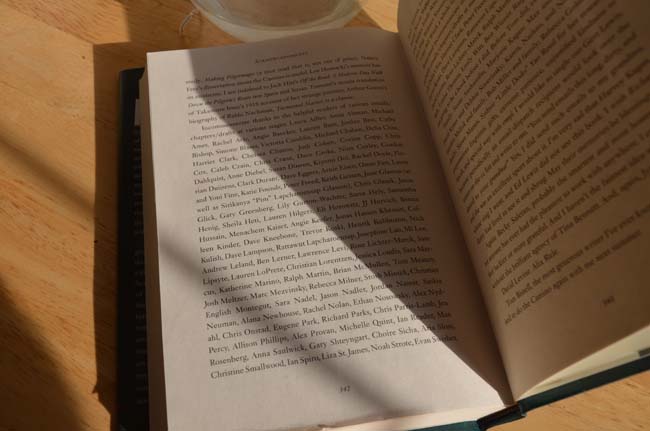
Incommensurate thanks to the helpful readers of various emails/chapters/drafts/suicide notes/pleas for money/confessions of my ever fluctuating self-esteem/notes passed in class/Ponzi scams/invitations to parties I held which nobody attended at various stages: Al Fresco, Alfred Pennyworth, Ali E T’sol, Alice N. Head, Amanda Waller, Amir Amir Enthawall, Amy Fitzpatrick, Anders Kelto, Andrea Beaumont, Angela Davis, Angie Dickinson, Angie Gladididntsaybanana, Anna Akhmatova, Ashley Dustgrant, Ava Vavoom, Barbara Gordon, Barry Julien, Ben Charles Padilla, Bill in Tel Aviv (he never told me his last name), Bison Dele, Bob Apple, Bob Blaisdel, Bruno Manser, Bugs Hardaway, Charlotte Webb, Cheryl Weirspants, Chloe N. Afternoon, Choire Sicha, Clarence Bullwinkel, Clark Kent, Claudia Lawrence, Cree Summer, Dan Gutemann,Dan McCoy, Daniel Barbosa (72 looks at the manuscript), Daniel Radosh, Dave at Wendy’s, Dave Half a Dozen or the Other Eggs, Deborah Amos, Dick Grayson, Dick Wither, Dr. Hugo Strange, Earl E. Birdgits, Edward and Austin Bryant, Elliot Kalan,Emma Culette, Eric Drysdale, Ethan F, Ethan Iverson, Fiona Banana, Frank Bures, Frank Drebin, Frank Lesser, Frank O. Phile, Fryderyk Frontier, George Allen Smith, Glenn Eichler, Gwen Stacy, H.A.R.D.A.C., Hailey S. Ajax, Hallie Haglund, Holly Hobbie, Ian Peek, Inspector Clouseau, Isabella Isabrutta, Isobel Campanile, J.R. Havlan, J’onn J’onzz, Jacob Silverman, James Campbell, James Garfield Davis, Jason Blood, Jason Jolkowski, Jason Ross, Jay Katsir, Jeff Fischer, Jennifer Kesse, Jeronimo Leonard, Jim Gray, Jimmy So, Jo Miller, Joe Camp, Joe Pichler, John Barnett, John Bigboote, John Camp, John Careful Walker, John Chief Crier, John Cooper, John Coyote, John Edwards, John Fish, John Fledgling, John Gomez, John Grim, John Guardian, John Icicle Boy, John Jones, John Joseph, John Kim Chi, John Lee, John Littelejohn, my good friend Buck and the boys at Yoyodyne, John Oliver, John Stewart, Jon Stewart, Jonathan Names Jr., Jonathan Names, Jorge Julio López, Jure Šterk, Kairi Tanaga, Kaz Il, Kevin Bleyer, Kyodai Ken, Kyron Horman, Laura Adderall, Leonid Rozhetskin, Les S. Moore, Leslie Thompkins, Lewis Gidon-Krauss, Lewis Krauss-Gideon, Lewis Lewis-Krauss, Liam A. Meliorate, Lois Amster, Lois Lane, Louie Schmitt, Luis Alfredo Garavito (138 looks at the manuscript), Madeleine McCann, Madison Iratadotter, Manuel Transmission, Margie Profet, Mariam Divorce, Mark Chand-Mercier, Maura Murray, Max Engout, Max Werner, Maxine Gibson, Meredith Scardino, Mia Mama, Michael Brumm, Michael Dukakis, Michael H. Miller, Miracle Jones, Mohammed Comté Mountain, Natalee Holloway, Olympia Dukakis, Opus Moreschi, Patricia Treat, Paul Dinello, Pedro Alonso López (110 looks at the manuscript), Pedro Rodrigues Filho (71 looks at the manuscript), Pepe Roni, Peter Falconio, Peter Gwinn, Ra’s al Ghul, Rachel Martin, Raj Kiran, Raj Kiran, Randa Duane, Ray Gricar, Rebecca Coriam, Reem Hard, Rich Dahm, Richard Stark, Rick Havoc, Riley Lifer, Rob Dubbin, Rory Albanese, Ruby Tuesday, Sal Vertong, Sara Benincasa, Scott Sherman, Shayera Hol, Shem, Shaun, and Issy, Shinji Higuchi, Sienna Years O’Solitude, Simon Pure, Sivasubramaniam Raveendranath, Snidely Whiplash, Somchai Neelapaijit, Soon-Rise Sunset, Sophia Throw, Steve Bodow, Susan Powell, Talia, Tao Lin, Taylor O’Thadance, Terry McGinnis, The Pope (if I die, he dies), the Presidents I have on speed dial (Jimmy Carter, Bill Clinton, Barack Obama), Tim Anykooks, Tim Carvell, Tim Drake, Timmy Hartman, Tom Dickenhair, Tom Purcell, Trevor Deely, Trudy Stranger, Valentina Massacre, Virgil Hawkins, Virginia Slims, Wally West, Walt W. Batedbreath, Wyatt Cenac, Zatanna, Zhubin Parang…

And, of course, my good friend Gideon Lewis-Kraus.
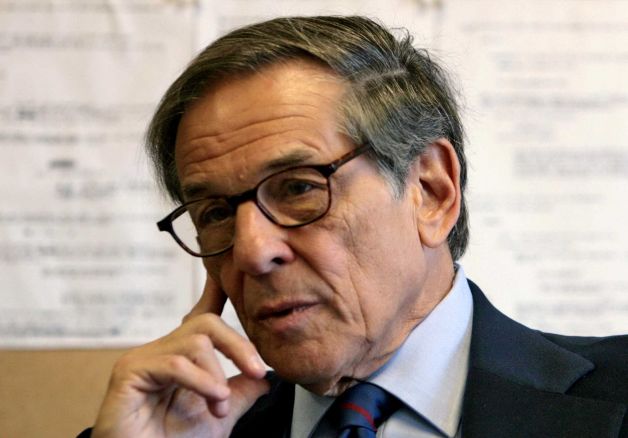
The Bat Segundo Show: Robert A. Caro

Robert A. Caro appeared on The Bat Segundo Show #455. He is most recently the author of The Passage of Power.

Condition of Mr. Segundo: Expressing his determination to keep the forward thrust of America began with notable historians.

Author: Robert A. Caro

Subjects Discussed: Lyndon B. Johnson as a great reader of men, Horace Busby, Johnson talking with people until he got what he wanted, Johnson’s misread of John F. Kennedy, the 1960 Presidential Election and Johnson’s self-sabotage streak in seeking the nomination, Emmett Till and Autherine Lucy, passing the 1957 Civil Rights Act, Jack Kennedy’s use of television, Johnson having his staff calculate the odds of a U.S. President dying in office, “power is where power goes,” Sam Rayburn, Johnson’s mode of desperation vs. Steve Jobs’s “reality distortion field,” Southerners as Presidents, Johnson’s decisiveness in the Senate, John Connally, Johnson’s fear of failure, Sam Houston, Johnson not wanting to be like his father, Johnson’s inability to stare physical reality in the face, smoking and fluctuating weight, challenging Arthur Schlesinger, Johnson being shut out from many of the key Kennedy meetings as Vice President, Johnson’s humiliations, LBJ being reduced to a “salesman for the administration,” the spiteful rivalry between Robert Kennedy and LBJ, character being a defining quality of politics, the importance of vote counting in Washington, Johnson as Senate Majority Leader, Johnson’s preying upon the loneliness of old men, Richard Russell, the Armed Service Committee, Johnson’s manipulation of Russell on civil rights and the Warren Commission, how Southern Senators were duped into believing that Johnson was against civil rights, the phone call in which Johnson forced Russell into the Warren Commission, how Johnson preyed on older men to get what he wanted, Kennedy’s tax bill, how Johnson worked on Harry Byrd, how Johnson dealt with human beings, the impact of personality on policy, Johnson’s terrible treatment of Pierre Salinger, Johnson bullying his subordinates, what Caro found the hardest to write about, triumphs of willpower, Johnson’s involvement with Bobby Baker, the Bobby Baker scandal, the surprising sensitivity with which the media handled Johnson’s corruption after the Kennedy assassination, the Life investigative team on Johnson (as well as Senate investigation), the lowering of the Presidency because of Johnson, some hints about Volume V, and Johnson’s legacy.

EXCERPT FROM SHOW:

Correspondent: You challenge in this book Arthur Schlesigner’s long-standing notion about the relation between Kennedy and Johnson. Now Johnson is in the vice presidential seat. Schelsinger’s idea was that, well, Kennedy was absolutely fond, genial, and generous. The vice president was included in most of the major meetings. And then, of course, we read this chapter “Genuine Warmth” and we find out, well, wait a minute! That’s not always the case. According to Ted Sorenson, Johnson was shut out from a pivotal ExCom decision, a decision meeting relating to the Cuban Missile Crisis. And that also is in large part because Johnson is a bit hawkish to say the least. So my question is: why has the lens of history been so keen to favor the Schlesigner viewpoint? And what was the first key fact that you uncovered that made you say to yourself, “Well, this isn’t exactly true”? What caused you to start prying further and further? That caused you to think, well, things are not all wine and roses.

Caro: Well, you know, part of it was that as soon as you start to look at Johnson and the Kennedys, you hear about the nickname that the Kennedy people called him. “Rufus Cornpone.”

Correspondent: That’s right.

Caro: “Uncle Cornpone.” “Uncle Rufus.” You know, they coined phrases for Lyndon Johnson and Lady Bird. They used to call them “Uncle Cornpone and His Little Pork Chop.” Then you ask someone like Ted Sorensen, who helped me immensely. He was the person probably closest to Kennedy in the administration.

Correspondent: You spent a lot of time with him.

Caro: I spent a lot of time with Ted. And he said, yes, as has previously been said, Johnson was included in all the big meetings, the Cabinet meetings, the National Security meetings. But in the Kennedy government, those weren’t the meetings that mattered. The meetings that mattered were the small little groups that Kennedy would convene. And Johnson wasn’t invited to those. You know, when the 1963 Civil Rights Act is introduced by the Kennedys and Johnson has to say to Ted Sorensen — we happen to have a recording — “You know, I don’t know what’s in this act. I have to read about it in The New York Times.” The greatest legislator possibly of the century, the greatest legislator of the 20th century is not consulted on Kennedy’s legislation.

Correspondent: Why then has the Schlesinger lens been allowed to proliferate for so long? That’s the real question.

Caro: Well, I don’t know that it’s just the Schlesinger lens.

Correspondent: Or this idea.

Caro: I really can’t answer that question. But when you talk to the surviving Kennedy people — like Sorensen — when you read their oral histories, you see it’s simply not true. I mean, Horace Busby talks basically about going to see Sorensen one day and asking, “Well, what role do you want Lyndon Johnson to play in this administration?” And Sorensen says, “Salesman for the administration.” I mean, this is Lyndon Johnson, who is to be the salesman for the administration. Johnson says to an aide, Harry McPherson — you know, they’ve turned the legislative duties over to Larry O’Brien. Johnson says, “You know, O’Brien hasn’t been to see me to ask advice once in two years.” So it’s undeniable that Johnson was shut out from Kennedy’s legislative processes and from the Cuban Missile Crisis — the key meeting of the Cuban Missile Crisis. He’s not invited to it.

Correspondent: I know. It’s really amazing. One of the other great showdowns in this book — the great clash is between Bobby Kennedy and Johnson. I mean, you want to talk about cats and dogs, these two guys were it. You have their first meeting in the Senate cafeteria in 1953 where Kennedy was glowering at Johnson and forced to shake his hand. Then years later, Johnson is Vice President. And he’s largely powerless as we’ve been establishing here. He serves on the Committee on Equal Employment Opportunity. And Bobby Kennedy shows up late, humiliates him over two meetings.

Caro: Yeah.

Correspondent: And then on the Saturday after the Kennedy assassination, there’s this misunderstanding over how the West Wing is going to be cleared out and ready for Johnson. There’s this very tense meeting not long after. But Johnson is in this interesting predicament of having to maintain the Kennedy faction all through Election Day in 1964. Yet he also tests the waters a bit with the Thomas Mann nomination. So my question is: was there any hope of Bobby Kennedy and Johnson putting aside their differences? What factors do you think caused Bobby to acquiesce to Johnson for the good of the nation while Johnson was President?

Caro: Well, he doesn’t always acquiesce.

Correspondent: Sure.

Caro: We see him breaking with him strongly over Vietnam in 1967 and 1968 and running for the nomination. I mean, when Bobby Kennedy enters the race, Lyndon Johnson bows out basically. You know, people don’t understand, in my opinion, enough. And I try to explain in my books how personality, how character, has so much to do with politics and government. And with Robert Kennedy and Lyndon Johnson, whatever the reasons are, at bottom you have this personal hostility. You talked about the first meeting. You know, this first meeting is when Lyndon Johnson is the Leader. He is the mighty Leader. Bobby Kennedy — I think he’s 27. And he’s just gone to work for Senator Joe McCarthy as a staffer. So Joe McCarthy — the Senate cafeteria is on the second floor of the Senate Office Building. And every morning, Johnson goes in there to have breakfast with his aides. And Joe McCarthy is sitting every morning at this big round table near the cashier with four or five or six of his aides, you know. And every time Johnson comes in, McCarthy jumps up as everyone does to Johnson and says, “Hello, Mister Leader. Can I have a few moments of your time, Mr. Leader? Good work yesterday, Mr. Leader.” One morning, there’s a new staffer there. It’s Robert Kennedy. Johnson walked over. Senator McCarthy jumps up. And so, as always, do all his staffers. Except one. Robert Kennedy, his 27-year-old staffer, sits there glaring at Johnson. Johnson knows how to handle situations like this. He holds out his hand to everybody sort of halfway out and forces Bobby Kennedy to stand up and take his hand. And George Reedy said to me — I said, “What was behind that?” George Reedy said, “You know, you ever see two dogs come into a room that never met each other and the hair rises on the back of their neck immediately and there’s a low growl?” That was the relationship between Bobby Kennedy and Lyndon Johnson. Of course, there were other reasons. Robert Kennedy was very attached and devoted to his father, Joseph Kennedy.

Correspondent: Sure.

Caro: And Johnson, who was close to Roosevelt, was always repeating these stories about Roosevelt firing Joe Kennedy, tricking him into coming back to Washington from England, and then firing him. Making him look bad. So I think that Robert Kennedy hated him for that. But it’s not too strong a word to use hatred for what was going on between Bobby Kennedy and Lyndon Johnson. And, you know, at the convention, one of Johnson’s assistants, Bobby Baker, he thinks everything’s just politics. So he’s having breakfast in a coffee shop in Los Angeles at the convention. He sees Bobby Kennedy come in and says, “How about sitting down?” He’s Bobby Baker, sitting with his wife, having breakfast. Bobby Kennedy sits down. But within two minutes, he’s up. And he throws money on the table. And he says to Baker, “Don’t worry. You’ll get yours when the time comes.” Well, the time came. Johnson was Jack Kennedy’s Vice President. Bobby Kennedy has, in effect, power over him. And he makes life miserable for Lyndon Johnson.

Correspondent: What you said at the beginning of this, about character being a defining quality of politics. I mean, Johnson, as you establish in this book and in Master of the Senate, is a master vote counter. He has his tally sheets when he’s in the Senate. He’s going ahead and making sure he knows exactly how things line up. In this book, you point out during the wheat bill that not only does he want enough votes to make the wheat bill [an amendment from Sen. Karl Mundt banning sale of surplus wheat from Russia] die. He wants it murdered, as he says. So the question I have. He may have been a master vote counter. But how much character did he need to go along with that? Was vote counting enough for him? Was that relentless drive just as much of a quality as the sheer statistician approach that he had?

Caro: It was never a sheer statistician, of course.

Correspondent: Of course.

Caro: He was a great legislator. Listen. A key thing in politics is the ability to count. And Johnson was the great counter. He’d send aides to find out how senators were going to vote. So sometimes someone would come back. Usually they didn’t do this more. They said, “I think Senator X is going to vote this way.” Johnson would say, “What good is thinking to me? I need to know.” He never wanted to lose a vote. So vote counting. He was the great vote counter. He’s a young Congressman. He comes to Washington. He’s 29 years old. He falls in with this group of New Dealers, who later become famous. Abe Fortas. Jim Rowe. “Tommy the Cork” Corcoran. These are guys who live and breathe politics. And do you know what they do when they have a dinner party on Saturday night? They get together for dinner. They count votes. They say, “How is Roosevelt’s bill on this going to be?” And Johnson, they said, was always right. We might think this Senator was going to vote this way. Johnson always knew. He was the greatest vote counter. And when he was in the Senate, he was the greatest vote counter of them all. But that’s not all of why Johnson was great. Johnson was this master on the Senate floor. He got through amendments. And there’s the base. And there’s shouting back and forth. He can seize the moment. He sees the moment where he can win. And he acts decisively. He says, “Call the vote.” And he’s Majority Leader. And he would stand there at the Majority Leader’s desk. So he’s towering over everybody else’s front row center desk. He’s got this big arm in the air. And if he’s got the votes, he wants the vote fast before anyone can change. Or maybe some other people on the other side are absent and not there. He makes little circles on his hands, like someone revving up an airplane, to get the clerk to call the rolls faster. And if one of his votes wasn’t there, and he was being rushed from somewhere in a car across Washington, he would make a stretching motion with his hands. He ran this. There were a lot of things that went into Johnson’s dominance of the Senate.

The Bat Segundo Show #455: Robert A. Caro (Download MP3)

This text will be replaced

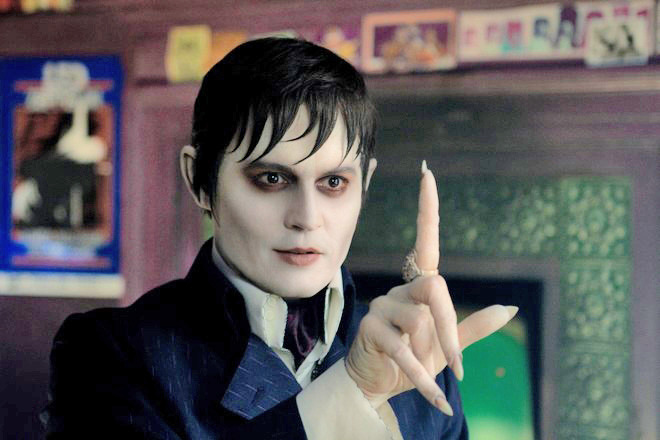
Review: Dark Shadows (2012)

Tim Burton is little more than a soulless businessman who makes movies as cutting-edge as crucible steel. His films haven’t been fun or worthwhile in quite some time, an especially astonishing accomplishment considering the eye-popping work that came before. He’s been lurching around like a creatively bankrupt whore for at least sixteen years and his chief skill seems to be taking very fun films from decades past (Planet of the Apes, Willy Wonka & the Chocolate Factory, et al.) and adulterating them into tepid remakes which rival Sátántangó in sheer soporificity. Tim Burton is not a man who dazzles, but he is very keen on taking your money and boring you to tears.

With his latest disaster, Dark Shadows, Burton has once again butchered an engaging antecedent. He has hired Seth Grahame-Smith, an in-it-for-the-money mashup charlatan who wasn’t even alive when the first Dark Shadows series aired, to write a porous screenplay built upon gags so bad that even a Marmaduke fan is likely to go postal.

Instead of establishing Barnabas Collins’s striking qualities as a tormented vampire, Burton and Grahame-Smith cheapen him by having Barnabas react to cultural developments (“They tried stoning me. It did not work,” replies Barnabas when someone asks if he is stoned: no one in the theater laughed), having Dr. Julia Hoffman (played here as a clueless chain-smoking drunk by Helena Bonham Carter) go down on Barnabas because Burton and Grahame-Smith couldn’t ken the character (played by Burton’s real-life wife!) in any other way*, and having Barnabas quote from The Steve Miller Band’s “The Joker” (which actually came out in 1973, one year after the movie’s setting) and Erich Segal’s Love Story in an effort to relate to hippies.

This is Dark Shadows‘s idea of character development, and it extends to the acting. A distressingly plastic Michelle Pfeiffer, unable to express anything with her face, resorts to eye blinking in her role as the Collins matriarch (and cannot compare to the classy Joan Bennett from the original). For some inexplicable reason, Burton has directed nearly every woman to talk with a gravely two-packs-a-day timbre. And this became so distracting that I had to do a double take to make sure that Eva Green (who plays Angelique, the witch who ensnares Barnabas) wasn’t Helena Bonham Carter. Bella Heathcote tries her best (and is an excellent Kathryn Leigh Scott mimic) as Victoria Winters, the woman who looks like Barnabas’s lost love, Josette du Pres. But with such a middling script (and a really awkward backstory about being institutionalized as a child reflecting the desperation of artistic cretins sandwiching Maggie Evans and Victoria Winters into one character), Heathcote’s talents fizzle before they are allowed to catch fire. As for Johnny Depp, he’s in full paycheck role somnambulism here, offering little more than a not particularly precise Liverpudlian dialect and spastic presence. It is now clear that Johnny Depp, who was once one of our more interesting and daring actors, can no longer be trusted to put his name to anything even remotely daring. (His next film is The Lone Ranger.)

And I put forth to any self-respecting moviegoer that when a character is forced to exclaim “You’re way too weird!” to another in a movie, as one does to Barnabas, this is probably happening because the writer and the director are incapable of establishing the weirdness through action.

The Jonathan Frid and Ben Cross incarnations of Barnabas Collins didn’t require external prodding from others to establish their on-screen gravitas. Producer Dan Curtis, faced with a miniscule budget for his daily soap opera, relied on two dependable qualities that have escaped Burton’s feeble attentions: (1) go-for-broke writing and (2) theatrical acting. So he had his writers scavenge ideas and narrative angles from Poe, Lovecraft, Wilde, Stoker, Shelley, and countless other classics to create what was surely one of the most ambitious and quirky daytime shows ever produced on television, including everything from vampires to werewolves to gripping court trials to a wealthy family to parallel universes to immortal figures to Gothic intrigue. It proved so strangely addictive — almost the American answer to old school Doctor Who‘s endearing combination of wobbly sets and high concept — that I ended up renting the first 52 volumes on VHS at a Sacramento video store around 1990, managing to hook a number of friends and family members into my surprise find, and was crushed when I learned that there was no 53rd volume. (Later, I discovered that the Sci-Fi Channel was broadcasting Dark Shadows every morning, and I waited patiently for the series to catch up to where I had left off.)

So if you’re going to compress a series this complicated and this distinct into a two hour movie, you need dedication and finesse, especially if you hope to attract a new audience.

But Burton and Grahame-Smith are so laughably amateurish that Barnabas walks around town in open daylight with little more than a hat and an umbrella to protect him. (Indeed, after the fifteenth time I noticed some stream of sunlight that should have killed Barnabas, I stopped counting.) And unlike the Frid or Cross exemplars, who both used their innate charisma to persuade, Barnabas relies mostly on his hypnotic powers to coax others to do his bidding. As the wonderful bar scene from Near Dark demonstrated, a vampire is only as badass as his actions. Tim Burton’s Barnabas comes from a soft, privileged, and unlived place.

In addition, the movie is needlessly aggressive in its use of obvious music cues — The Carpenters’s “Top of the World,” The Moody Blues’s “Nights in White Satin,” Barry White’s “You’re the First, My Last, My Everything,” many others — to telegraph its hackneyed moments. One almost expects Casey Kasem to show up. Instead, we get Alice Cooper performing at Collinwood, the Collins family manse that was so enticingly mysterious in its two television incarnations. For Burton, Collinwood is merely a place where you stash your badminton and macramé supplies in the secret rooms.

If turning a secret room into storage space for a Veblenian haul is Burton’s idea of imagination, then it’s clear that this rabid bore should be taken to the woodshed. The man contributes nothing of value to the American cultural landscape. He may look like Ichabod Crane, but he lost his head for fun a long, long time ago.

* — To give you a sense of how Burton and Grahame-Smith have diminished Dr. Julia Hoffman, here’s an extremely abbreviated character history from the original series. She was the head of a sanitarium, pretended to be a historian to infiltrate her way into the Collins family, and discovered Barnabas to be a vampire through her own initiative. Barnabas and Julia developed an interesting relationship that was built on trust, hypnosis, blackmail, and near murder. Should such an intriguing character really be little more than a drunk?

Wayne Shannon: A Video Tribute

A few days ago, I reported the death of Wayne Shannon, whose legacy as a broadcasting innovator and precursor to Jon Stewart, Stephen Colbert, and and Michael Moore had been needlessly overlooked in recent years. Wayne was also a friend. And last night, the cause of Wayne’s death was revealed to be a suicide. Wayne’s body had been found by two hunters in Northern Idaho. His body had been there for many months.

As of Friday morning, the San Francisco TV station (KRON) where Wayne worked for many years, has not acknowledged Wayne Shannon’s death in any way. Last night, I contacted KRON by telephone. I spoke with Bonnie Hitch, who was kind and who offered me a few minutes of her time. Ms. Hitch told me that KRON still hadn’t decided on whether or not it would recognize Wayne Shannon, but that they had learned of his death. KRON had not been aware of Wayne’s suicide.

I also asked Ms. Hitch about how well the KRON news archives were preserved. What was the state of Wayne’s numerous commentaries? His segments in the field? His body of work? She informed me that there wasn’t even an archivist employed at KRON these days. “It’s a very different news station,” said Ms. Hitch. KRON culture had changed. Ms. Hitch wasn’t even sure that the airchecks had been preserved. She told me that she would put me in touch with the person in charge of the news archives, and it is my hope to contact someone at KRON who is even remotely interested in preserving KRON’s long legacy as a major news station.

In his final years, Wayne had assembled a disc containing a small handful of his work. Was this all he had? Unfortunately it was. This disc was all that remained of his considerable work. “It took me months to pile through boxes and boxes of old tapes,” Wayne had written to me. “You got the best of what was available…and some of that — as you have doubtless noticed — is well below par.”

Shortly after talking with Ms. Hitch, I went through my files and located Wayne’s disc. It contained this note:

Yo Ed:

A few weeks before Noel Coward died he held an intimate soiree at his home during which, by all accounts, he performed for the very last time.

Those in attendance, if memory serves, were Lunt and Fontanne, Oliver and Leigh, Oscar Wilde, Jascha Heifitz, the Raymond Masseys and the Rex Harrisons, the latter naming their first born son after Noel.

We are assured that it was an exquisitely memorable night of much wine and laughter and tears born of same, along with a game that developed whereby participants challenged their memories by trying to match some of the more obscure lines of dialogue from his plays — with the titles of his many Broadway and Piccadilly triumphs.

This was followed by a medley on the piano of Coward’s many hit songs, accompanied by Heifitz, which naturally concluded with his immortal, “Mad Dogs and Englishmen.”

I am, of course, no Noel Coward and, unfortunately, have more years to live than I doubtless deserve. However, I wanted you to know that to me…you are not only to be numbered among the “luminaries” he had about him that evening those many, many decades ago…but, had I been able to do so…you would have been invited to such a gathering — though you may very well have had the good sense not to attend or, perhaps, admit to it later.

However, if you had done so, you too would have seen my final performance — from virtually my first words ever on American TV — to undeniably my last, “Yahoo!”

I cannot accept Wayne’s work falling into obscurity. I cannot accept his self-deprecatory nature refusing to understand, even in this note, that people loved and respected what he did. And I cannot accept his work not getting its proper due.

So I have uploaded nearly all of the video I have so that people can see how Wayne was ahead of his time. The twenty-one segment salute below reveals that Wayne, who won six Emmys for his work, was a wily reporter, a witty commentator, a skilled performer, a gleeful satirist, and a man who was very good at talking with people.

Star Wars: This is one of Wayne’s earliest television appearances, in which he talks with Mark Hamill, Harrison Ford, and Carrie Fisher. He even asks Carrie for a kiss, a move that would be unthinkable in today’s junket climate.

Rocks (1980): This is a great example of the muckraking multipart series Wayne was known for during his days in Detroit. (Indeed, as I learned in a 2008 radio interview I conducted with Wayne, many of Wayne’s pioneering concepts during these days would be stolen by Michael Moore and used in Roger & Me.) Wayne fearlessly took on many of the auto manufacturers and was run out of Detroit for this (despite the fact that his segments greatly improved the evening news ratings). And the “All by Myself” montage where Wayne abandons his “rock” on the freeway and rollerskates away is an unusual break from the hard journalism that local television news was then known for.

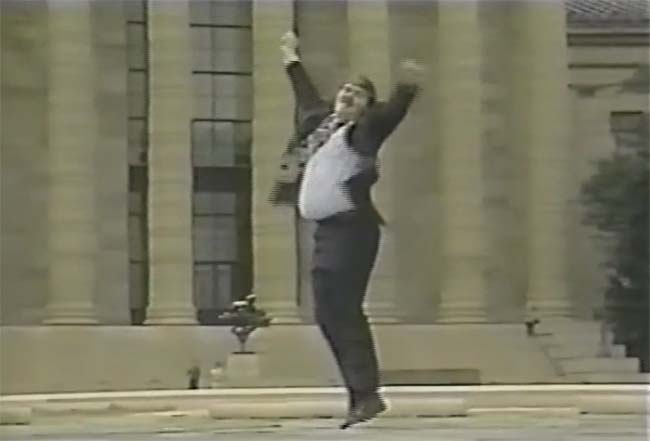
Lemons: In Philadelphia, Shannon was known as the “TV 2 Troubleshooter.” His coverage, as we learn here, could be hilariously epic (in this case, the segment above is “part three of his ten part series on lemons,” as Robbie Timmons introduces) — almost as if he was working on one giant documentary film split into neat segments for the evening news. Wayne’s ability to combine consumer advocacy with comedy is in great form here, especially with the concluding Rocky homage.

Hedgehogs: This “TV 2 Troubleshooter” segment sees Wayne fleshing out his satirical journalism. There’s the opening sound gag, along with some folksy banter with a stamp collector (“Ever been took?”).

The Box Top Rebellion: In this segment on coupon clippers (which contains some eerie parallels to post-2008 economic life), we see that Wayne was very keen on highly theatrical introduction sequences. But he was also very good about learning how a system worked, as seen from the fascinating clips inside a coupon clearing house (“where old coupons go for that big redemption in the sky”).

Magic Nails: Not only do we get a quick glimpse of a young Maury Povich, but we see Wayne taking on “Magic Nails” — a dangerous toy manufactured at a Burger King restaurant. Wayne’s journalistic rigor is on display. He talks with pediatrician Alan Freedman and updates the story with some shoe leather reporting.

The Vent People: I don’t know if the success of Wayne’s consumer advocacy had Channel 3 assigning Wayne to more hard reporting. Perhaps they didn’t quite know what to do with him. But this segment also shows that Wayne was a good journalist. He reveals efforts to uncover how the homeless sleep on the steam vents at night, along with the reasons why others aren’t allowed to help the vent people.

Wayne-Bo and Tom: The first part of this clip is rather baffling. It features “Wayne-Bo” entertaining kids and talking with Eagles quarterback Ron Jaworski. Was this a bona-fide children’s show hosted by Wayne which aired in Philadelphia? The second part features a clip of Tom Snyder extolling Wayne at the end for an episode of The Tomorrow Show, which Wayne made an appearance on. (Note to self: A trip to Paley is in order.)

Santa and Thermatron: The Santa bit is from a bizarre 1981 program that Wayne did called Santa and Son. I have no idea if it even aired anywhere. Then there’s a “Thinking Out Loud” segment on the Thermatron, a precursor to the commentaries that Wayne would be known for during his KRON days.

KRON Clips: Wayne, now at Channel 4, talks with Jonathan Winters. There are three additional segments: (1) a Wayne commentary on how laser beams are being used to cut through clogged arteries (and how Wayne has sought “a revisionist nutritionist”), (2) a closing credits monologue of Wayne on the road, and (3) a Wayne commentary on how to celebrate California adventure (with some inside dirt about then Carmel Mayor Clint Eastwood).

The Merv Griffin Show: Merv Griffin, who lived in Monterey, was a Wayne Shannon fan and invited Wayne to appear on his program. Wayne reveals the trouble he got into for suggesting that dumping atomic waste into the ocean might be a possible solution. “I guess you don’t hear that viewpoint that often.” “Why would you advocate that?” asks Merv. “Well,” replies Wayne, “because everybody else isn’t.”

Claim to Fame Promo: Wayne appeared on another locally produced KRON show called Claim to Fame, in which an assembled panel tried to guess who the person was based on their vocation. Wayne was one of the regulars, along with Ann Jones, Charlie Haas, and Sylvia Brown (later with an E). This promo for the show features Wayne prominently. There is also a ten second clip from the show attached.

Claim to Fame: Here’s a longer part of Claim to Fame, which features a more spartan set than the one with the FAME lights. (Budget cuts at KRON?)

Bay Area Minute: This short KRON segment features Wayne rhapsodizing about the Bay Bridge.

Three KRON Commentaries: In these collected clips, Wayne offers a commentary on Tanzanian chimpanzees getting high on leaves, another commentary on pesticides, and a third commentary on Fleet Week.

CNBC: In these clips from his CNBC days (featuring some charmingly retro graphics), Wayne provides a commentary on Norplant, sits patiently at the ACE Awards (for which he is nominated), co-anchors a Real Estate Report, and interviews Ken Hakuta, the inventor of the Wacky Wall Walker (and self-styled “Dr. Fad”), with absurd results.

TV 25 Vancouver: In this TV 25 Vancouver segment, Wayne investigates a post office branch in Vancouver, Washington, discovering how postal workers toil and the impact of a holiday package influx.

TV 49 Portland: In the first clip from Wayne’s TV 49 Portland days, Wayne probes Nick’s Famous Coney Island, talks with owner Frank Nudo, and contends with hot dogs. The second clip features Wayne’s movie reviews of Mad Love, Judge Dredd, and Crimson Tide>

TV 6 Portland: In this clip from TV 6 Portland, Wayne goes out in search of white deer in Redland.

Ask the Weather Guru: This interview with Wayne Shannon (just after his television days) has Wayne coming out as the “Ask the Weather Guru” man at Yahoo. He attempts to explain what an occluded front is. But I can’t help but focus on just how small his apartment is at this time.

The Memorial Wall: Wayne’s last appearance on television, from August 2011. He was in Idaho, visiting the Vietnam Memorial Moving Wall and wanting to know if three people from his hometown of Moses Lake, Washington had been killed during the war. He didn’t see their names. Months later, he would walk into the woods and never come out.

The Bat Segundo Show: Stewart O’Nan II

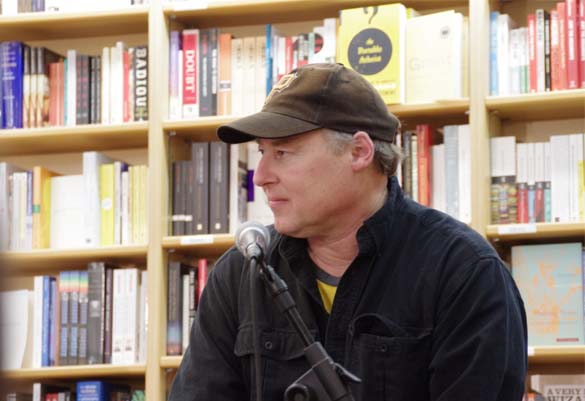
Stewart O’Nan appeared on The Bat Segundo Show #454. He is most recently the author of The Odds. He previously appeared on The Bat Segundo Show #161. You can also read our lengthy conversation by email in 2011. This 2012 talk was recorded before a live audience at McNally Jackson. My gratitude to Michele Filgate, Langan Kingsley, Holly Watson, and, of course, Stewart O’Nan for their help in putting this event together.

Condition of Mr. Segundo: Inexplicably hungering for Wendy’s hamburgers.

Author: Stewart O’Nan

Subjects Discussed: [forthcoming later this afternoon]

EXCERPT FROM SHOW:

Correspondent: Niagara Falls. Here is a location that’s loaded with all sorts of associations. Joyce Carol Oates wrote a book there.

O’Nan: The Falls.

Correspondent: Yes, exactly.

O’Nan: Yes, I was introduced the other night as “the author of The Falls.”

Correspondent: (laughs)

O’Nan: And I was like, “Not that prolific.” Not nearly.

Correspondent: (laughs) Well, you are churning them out one a year.

O’Nan: Oh thank you. Churning them out. You said cranking before.

Correspondent: Crafting! Cranking, churning. All right. But they’re short! They’re short.

O’Nan: They’re tiny.

Correspondent: There’s craftsmanship in there. Don’t worry.

O’Nan: I understand.

Correspondent: But I’m wondering. You’re taking a location that’s loaded with all sorts of cultural baggage. There’s that Marilyn Monroe/Joseph Cotten film.

O’Nan: Gotta love it.

Correspondent: But I’m wondering. Here you are taking two characters and putting them in a touristy location. I’m wondering if you did that to work up against limitations and see what kind of behavior you could mine based off of that. I’m wondering why you chose this. What was the process of selecting the Ice Bridge or the details of the customs location? What went into nailing Niagara?

O’Nan: Well, it’s a ready made stage. Usually when I take on an area or a setting, it’s virgin territory in a way. Conneaut, Ohio. Kingsville in Songs for the Missing. No one’s ever written about that in any kind of novel. Western Pennsylvania. Butler, PA in 1974. So I always say I’ve written the best Butler, Pennsylvania novel ever written.

Correspondent: (laughs)

O’Nan: Or Avon, Connecticut. Usually these are overlooked places. Like New Britain, Connecticut, that Last Night at the Lobster takes place in. I write in that interzone, that nowhere America of strip malls. It has been kicked around forever. But in the new book, I thought, let’s focus solely on the characters and put them on a stage that everybody knows. So I don’t have to do that disorienting, here is the place that you don’t know and now I’m going to tell you about it. So I had a little less responsibility to the setting and I could spend a little bit more time on the characters.

Correspondent: I have to ask you about the odds as chapter headers for all of these. Some are, in fact, true. “Odds of a black number coming up in roulette: 1 in 2.06.” I Wikipediaed that. Some are unscientifically true. “Odds of a marriage proposal being accepted: 1 in 1.001.” So I’m wondering. How many odds did you collect? I mean, I’m wondering if you were sitting on a bunch of odds sets.

O’Nan: Yes. Yes.

Correspondent: You were?

O’Nan: Yes, I was. And I was trying to figure out: How do I weave these into the book and what effect are they going to have when I get them in there? And they seemed to me to work. When I thought of using them rather than chapter headings, in the way I did with, say, Emily or in Songs of the Missing, I saw them as how the chapter headings are in something like Blood Meridian or in, say, 19th century fiction work, which is “In this chapter I am eaten by sharks.” And before you even get into the chapter, you’re like, “Oh sharks! This could be cool!” So it kind of brings the reader and it gives them an expectation of what may happen in this chapter. Not necessarily has to happen. But it may happen. The odds of dying in a bus crash. Whoa! There might be a bus crash. I’ll stick around and find out.

Correspondent: It’s interesting. Because here you are in one sense messing with the reader for the first ten pages, repelling them, and then on this, you’re subverting their expectations. It’s actually, “Ooh! I want to continue to read this chapter.”

O’Nan: Well, you hope.

Correspondent: What of this bipolar approach to fiction writing?

O’Nan: Flannery O’Cononr. Flannery O’Connor said, “Distract them and hit them over the head.” Absolutely right. Absolutely right. Give them a reason to come into the place. A Prayer for the Dying. The opening sections are very — it’s a terrible thing to say, very beautifully written. I use the language. I make the beauty of the language a key thing to hang into. And so the reader gets rewarded somehow. And by the time they have to go through the book, they’re kind of stuck. They’re like, “Well, I don’t really want to hang around and watch this guy go crazy while I’m inside of his mind.” Well, it’s too late. So like Poe, say, in “The Black Cat.” Once you get them in the door, then after a certain point, they’re kind of yours. They have to follow along. Or you hope so. You always hope so.

Correspondent: I’m curious if the odds sets actually were methods for you to riff off of Art and Marion. If you were stuck at a certain place. Is this a point? I mean, you’re a former engineer. I presume that this was either heavily designed. Or were there false starts? And did the odds help you in anything?

O’Nan: No. There weren’t a whole lot of false starts. I knew the characters very well before I opened up. It’s also a small novel. It’s very much sort of a drawing room novel in a way. It’s the one weekend. You’ve got the unity of place. The unity of time. You’ve got a lot of pressure on them from the memories. This is their second honeymoon. They’re in Niagara Falls. And you have the time pressure of, well, at some point, they’re going to have to put their money down on the wheel. And they’re always kind of at odds with one another. They’re always picking at one another. So I had a lot to work with. The plates were already spinning when I started getting into it.

Correspondent: I wanted to also ask you. One interesting thing that you also do with Marion is body image. She doesn’t like Art to see her undress. And in one of the passages you’re going to read tonight, the only thing you mention is her stomach. We actually don’t really know what she looks like physically. So I’m wondering if this is a method for you to not reveal certain details to the reader or this reflects your relationship to the reader. Is this your way to protect your own characters? To not divulge all? Or is this your way to encourage judgment? Perception on the reader’s behalf?

O’Nan: This is more to encourage the reader to join in the process of creating the work. And I don’t say what the character looks like unless it’s really necessary to the arc of the story there. So what the characters look like is completely up to the reader there. And I leave judgment to the reader. I don’t try to steer the reader too much in terms of who’s good, who’s bad, who’s right, who’s wrong. And it’s always sort of that inkblot that shows how generous the reader can be or how, on the flip side, how stingy they can be. “I hate Marion. I hate her so much.” It’s like, “Easy there, lady. Easy there.”

Correspondent: Have you had this happen before?

O’Nan: Oh yeah.

Correspondent: Wow. Really?

O’Nan: In Wichita of all places.

Correspondent: Wichita!

O’Nan: “I didn’t like her.” Well, that’s good. That’s your prerogative. That’s fine. That’s you.

Correspondent: You know, one of the interesting things — I’ve read a number of reviews of this book. And they actually don’t mention, for example, Karen or these two characters who are having affairs with the couple. And I’m curious about this. Maybe this relates to this issue of giving the reader something. Maybe they don’t want to talk about this aspect of Art and Marion. What do you think of this?

O’Nan: Yeah. I think they want to key more on Art and Marion and just say, “Look, there are problems in the marriage.” And this is how they work them out over this weekend. Or don’t work them out.

Correspondent: Inevitably, because you do deal with Heart, I have to bring up celebrity gossip.

O’Nan: Heart.

Correspondent: So in late 2010, Nancy Wilson and Cameron Crowe initiated divorce proceedings. It was a great shocker to certain waves.

O’Nan: So sad. They had everything going for them, didn’t they? They did.

Correspondent: Yeah. I’m wondering if you including the Heart concert before or after you heard this news. Or if you possibly predicted this dissolution in anyway. I mean, what of this?

O’Nan: I don’t know.

Correspondent: Some sort of angle here.

O’Nan: No. I don’t know. It’s accidental subtext, I guess. I guess it happens from time to time.

Correspondent: Another silly question. Wendy is a character. And I have to ask you, and I know this is really pedantic, but I have noticed in all of your books — nearly all of your books — there’s a moment where someone eats Wendy’s. A Wendy’s hamburger.

O’Nan: Really?

Correspondent: But not, not in The Odds. The last time I saw this was Last Night at the Lobster. There was a Wendy’s moment. It was the Stewart O’Nan Wendy’s moment!

O’Nan: He doesn’t go to Wendy’s.

Correspondent: Oh, he doesn’t go to Wendy’s?

O’Nan: He decides not to go to Wendy’s.

Correspondent: But he does actually consider it!

O’Nan: This is a climax. This is a climax in an actual work of fiction. “Want to go to Wendy’s? Nah.”

Correspondent: Do you eat at Wendy’s quite a bit?

O’Nan: No. Maybe that’s it. Maybe I want to eat at Wendy’s more. I can see my biographer doing a lot on Wendy’s now. A map of all the Wendy’s around my house.

(Photo credit: Here)