New Directors/New Films: An Oversimplification of Her Beauty (2012)

[This is the second in a series of dispatches relating to the New Directors/New Films series, running between March 21, 2012 and April 1, 2011 at MOMA and the Film Society of Lincoln Center.]

Vol 01 — Slightly Eccentric Lede Intended to Mimic the Film’s Structure, Offering a Knowing Nod or a Tedious Longueur Depending Upon What You Prefer

You’re not supposed to begin an essay with a digression, but since the film I’m about to write about is a deceptive concatenation of digressions, it somehow seems appropriate to break the unspoken rule.

Vol 02 — Impertinent Observations Reflecting the Essayist’s Eccentric Mind

Upon seeing “ambivalence” misspelled on-screen during An Oversimplification of Her Beauty, the wordsmith in me wondered if this may have been deliberate. After all, filmmaker Terence Nance does have the woman of his real-life and cinematic affections read what appears to be a lengthy (though modified — but I am trusting my memory and I am not Googling it, so I could be wrong) passage from Louise Erdrich’s The Bingo Palace. And Nance’s film is fascinatingly verbal, with words displayed and heard at nearly every point: filling in every stray gap (thanks in large part to Reg E. Cathey’s smooth narration, which intersperses at times with Nance’s — the effect works, the competitive voices suggesting some internal dialogue between a boy and a man, but I wondered at times if the actor from The Wire had to stick to a mere 80% of the film’s narration, rather than the full order, in order to fit his great velvet-voiced services into the low budget), complicating and reviving and reforming and mimicking a long-dead relationship that is also the very subject of this film. So why would Nance misspell the very word that may signal his true and present feelings about what he’s documenting?

It was at this point — perhaps an hour into the movie — that my mind suggested that Oversimplification could be a clever reply to The Americanization of Emily. In the 1964 film (written by Paddy Chayefsky, based on a William Bradford Huie novel; I won’t mention the director because it runs the risk of another 500 words I don’t really want to write right now), Emily is both attracted and repelled by a soldier’s lifestyle. She’s lost many of the men she’s loved during the war and she doesn’t want to see this new guy she’s fallen for, Madison, die either. And then it appears that Madison is dead — the first man to make it on Omaha Beach. And Emily is crushed. But Madison is not dead. He’s living it up as a hero, which is something of an understatement. Because he was actually a coward. Emily says that he should accept his role.

Vol 03 — Oh, Get to the Film Already!

Now let’s take a look at Nance’s film. We are informed that Nance is a young twentysomething who has had a family upbringing without injury or incident (described as “the Cosby effect”). He works twelve hour days, but most of his money appears to be going into his rent and his Metrocard. He has to construct his own bed, relying on Japanese joinery, carrying slabs on the subway, and not getting the bed right because he is not the greatest carpenter and he has used pine instead of sturdier wood. It can be argued that this is a lifestyle: certainly many of today’s artists soldier on in an American climate increasingly hostile to art. And Nance’s choice of inferior wood may indeed suggests that he is beguilingly clueless in some sense. This was the big tip-off for me, in any case, that Nance’s heavily verbal, multitiered film was just as much of an imperfect bed that he would have to lay in for some years.

So Nance meets Namik. The details are imprecise, even as there is the illusion of precision contained within the film’s ongoing narration and structure. (At one point, we are helpfully informed that one section of the film is “up to date as of 2006.”) They sleep together, but they don’t necessarily make love. The nature of the relationship is imprecise, as befitting two confused but amicable young people in some kind of love or lust. It is imprecise even as Nance offers a timeline of events late into the film. We learn that another man has asked Namik to be in an exclusive relationship, which means the end of her involvement with Nance.

Or so we think. Because Nance, crushed by this, decides to dwell on the relationship anyway — even after it is over. He somehow persuades Namik to respond to a letter that he sent her long after the fact and records her response on camera. What starts off as a young man’s friendly and humble self-examination becomes a little creepy for a time. I mean, can you imagine asking some person you slept with several years ago to respond to something on camera for a project that reflects your own personal truth? Especially after both of you have moved on? That Namik does all this without filing for a restraining order speaks to Nance’s strange charm. Or maybe it’s the key ingredient for this film’s weirdly appealing conceptual thrust. In an age of increasing documentation of the self, are we meant to carry on chronicling the very emotions that might be harmful towards us or others? Especially when we’re ushered to shift our Facebook profiles onto a timeline and relive our worst moments? Nance seems game for endless self-examination. He didn’t come off as a narcissist to me, although, given the walkouts I observed, I know his willingness to push into his own seemingly common complexities won’t be for everyone.

Vol 04 — An Attempt to Find a Conclusion

Like Nance, I seem to have drifted in the immediate emotional residue and haven’t even consulted the many notes I took. Many of them are indecipherable. But I’m sure that many of them are readable and profound. I have opted for memory instead. Yet in considering my feelings (which are genuinely positive) for Nance’s film, it’s interesting that I haven’t mentioned the animation. And this isn’t fair. Because there is one past fling which Nance chronicles quite well through animation, where all parties are naked and Nance’s stature waxes and wanes as the giant woman he is describing transforms into a ripe tomato as she gets it on with another lover and Nance begins to comprehend the great pain of trying to stay platonic with a woman you still have feelings for.

This film is Nance’s truth, and nothing but Nance’s truth. Even as Nance includes a trailer for Naink’s possible cinematic response, and even as Nance includes a hazy video clip from a Q&A session just after an early version of the film played a theater, this is still Nance’s truth. It’s worth pointing out that Oversimplification emerged from the bones of an earlier short film called How Would You Feel?. That both films are, in turn, evolved from Nance’s real-life experience leads one to wonder where the original emotional kernel can be found, or whether it’s even worth pursuing.

Nance hasn’t so much oversimplified Namik’s beauty, as he has complicated it into a distorted view that no longer bears any resemblance to the original lived moment. And while another older person (especially one with several failed marriages) might find this annoying or horrifying, I found this oddly enthralling. Nance confesses that he doesn’t really possess the emotional memory of his moments with Namik, and that her motion in the clips edited on his laptop somehow actuated these false highlights. Does technology debilitate the romance or the inherent truth of our memories? Probably. And I think, given the defiant iPhone-centric manner in which he ends his movie, Nance does too. Yet here is a man who, not long after showing a version of his film to Namik, puts the microphone in her face and presses her on how she feels, curling it around her (while sitting behind her) like an arm. I’ll be hard-pressed to find a better epitomization of 21st century life (especially among those who document it) in any film I see this year.

Is this thing on?
New Directors/New Films: The Raid: Redemption (2011)

[This is the first in a series of dispatches relating to the New Directors/New Films series, running between March 21, 2012 and April 1, 2011 at MOMA and the Film Society of Lincoln Center.]

It’s difficult not to take grand glee in an action movie with an aesthetic partially inspired by Eddie Adams’s famous photo of Nguyen Van Lem getting his head blown off. In Gareth Evans’s beautifully brutal new film, The Raid: Redemption, angry heads pop into frame and are pistoled, knifed, and punctured against crumbling chrome walls with rhythmic panache. I spent much of the movie chortling over the audacity.

Last year, I argued that the main difference between a great low-class action movie (Shoot ‘Em Up) and unpardonable trash (Kick-Ass) is that the former invites the reader to make sense of the madness on screen, while the latter wishes to dictate how the audience should react (generally with some knowing musical cue where the irony is ham-handed).

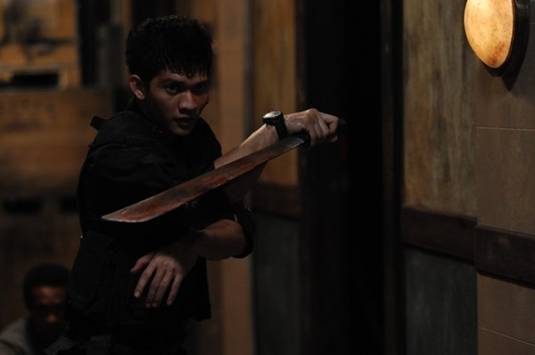
I am pleased to report that The Raid falls into the first category and is very entertaining indeed. For all of The Raid‘s over-the-top violence (there is one amazing scene in which a single man battles a machete gang with near balletic dexterity), Evans — a Welshman now operating in Indonesia — isn’t afraid to bedazzle with his camera. A crane shot lowers from above as twenty elite cops methodically leave a truck with their weapons. But Evans doesn’t stop there. He continues the shot on Steadicam.

Here is a movie where characters chop through the floor with an axe, jump to the level below them, and the camera follows — whether through CGI or a bona-fide stuntman, I know not. And if, for some reason, you can’t appreciate that, consider how Mikhail Kalatozov’s camera in I Am Cuba scaled walls and followed a flag across a crowded street. If cinema can transport us into places we wouldn’t ordinarily go, why should we withhold our praise when an action movie does the same thing?

I haven’t even discussed the way in which Evans uses slow motion. There is a stunning shot early in the film where one of the tenants shouts up a stairwell that the police have arrived. And while this shot continues in slothful time, we see a flying bullet puncture through the wall behind him.

Evans is also committed to barbarous triplets. If you’re a bad guy in The Raid, you won’t just get a gunshot to the head. You’ll get three. If you’re getting pounded against the wall, then the man who is kicking your ass will do his best to make sure you get smashed in three separate places on your way down to death on the floor. The quiet math rock part of me appreciated all this. Death does indeed happen in threes.

And while some of the hallway fights get a little repetitive near the end, exposing the ridiculous and threadbare plot (which turns out to be a knockoff of A Better Tomorrow: two brothers, one a cop and the other a criminal), Evans is very good about keeping the action and the locations varied up enough for us not to notice. He has stuntmen clamber up walls and even has his characters hide inside them. One gets the sense that Evans has truly considered every nook and cranny of his location. And every strike of the knife.

It also helps that the movie contains some unusual dialogue. When the villain was informed at an early point that at least thirty of his tenants who paid rent were now spread across the walls, I knew that I was in capable hands. If I happened to be a violent maniac and property owner, I’d certainly want my underlings to inform me about any recent change in revenue. “Squeezing a trigger?” asks one man to another. “That’s like ordering takeout.” This half-assed philosophical stance gives two men an excuse to get into a protracted martial arts fight.

The line may also anticipate the cult audience this film is likely to attract. For The Raid isn’t ephemeral takeout. It’s the hip new dive you want to tell your friends about before everybody else discovers it.

The Bat Segundo Show: Adam Johnson

Adam Johnson appeared on The Bat Segundo Show #438. He is most recently the author of The Orphan Master’s Son.

Condition of Mr. Segundo: Revising his own narrative.

Author: Adam Johnson

Subjects Discussed: Growing up in Arizona, reading a novel as an act of faith and how style reflects that, narrative which mimics Casablanca, storytelling as the North Korean identity, being the center of your own story, state-sponsored storytelling, DPRK aptittude tests, being trapped in a world of North Koreaness, the American idea of taking on new personae, populating a book with secondary characters from limited information, getting a sufficient Tolstoyian cross-section, knowing very little about Pyongyang, defecting to South Korea, Hanawon, underground societies in Pyongyang, North Korean testimonials, Stephen Crane’s The Red Badge of Courage, how fiction fills in missing factual gaps, the kwan-li-so labor camps, The Aquariums of Pyongyang, how to eat a newt, being unable to verify Yodok, Kenji Fujimoto, whether imagination is truthful enough to fill in the gaps, mining the Stanford libraries for North Korean books, Rikidozan and North Korean wrestling, approaching North Korea from the comic mode, interrogators who give prisoners “alone time,” playing a guitar for Kim Jong-Il, finding propaganda funny, feeling a responsibility to gulag prisoners, balancing absurdity and believability, Kim Jong-Il and the state cinema agency, Pulgasari (the North Korean answer to Godzilla), kidnapping cast and crew to make Pulgasari, the pros and cons of being an American outsider, moral responsibility in narrative, South Park, Madeleine Albright’s visit to North Korea, referring to the dead Kim Jong-Il in the present tense, getting bested by the human heart, North Korea’s attempt at an air defense system, Johnson being unable to find photographic evidence of apartment loudspeakers, the Japanese obsession with the KCNA, reading the Rodong Sinmun daily for eight years, Pork Chop Hill, trying to get a sense of how North Koreans live, North Korean humor, actresses kidnapped from South Korea, Bill Clinton’s efforts with Euna Lee and Laura Ling, Casablanca, resistance to black-and-white movies, Titanic, how the advent of DVD affected how North Koreans watched movies, relying on a stunted version of North Korea from four years, what Johnson saw in North Korea, whether photography can atone for the lack of the written word, the alleged nutritious value of dubious seaweed, scavenging extra calories, the legality of harvesting chestnuts, memory as a conduit between photography and the written word, how writing nonfiction gets in the way of advancing fiction, maintaining hundreds of pages of notes, forming unexpected narratives, being a journalism major and fabricating perfect quotes, capturing the essence of nuts, Robert Coover’s The Public Burning, Kim Jong-Il vs. Nixon, Kim Jong-Il Looking at Things, humanizing a dictator, being drawn to survivor narratives, how physicality and geographic location allowed Johnson’s North Korea to evolve, Soviet refrigerator factories in North Korea, goats on the building roof, turning on the power for the foreigners, how North Korea decides which floor you live on, avoiding exposition while writing The Orphan Master’s Son, Blaine Harden’s Escape from Camp 14, Shin Dong-hyuk’s expense, making a choice at the expense of something else, how Texas served as a narrative mechanism to see North Korea from several vantage points, being one of the first American novels about North Korea out of the gate, Hyejin Kim’s Jia, James Church’s police procedurals, and how facets of the thriller genre helps get at the truth.

EXCERPT FROM SHOW:

Correspondent: Stylistically, the first part of this book requires a great leap of faith for the reader. I mean, we’re asked to believe that Jun Do, despite the fact that his story does not check out, gets released by the interrogator. That he would also go to Texas with Dr. Sung. I don’t think I’m giving anything away.

Johnson: Sure.

Correspondent: But then you have this twist at the end of the first part. Then we are given this surprise and we say, “Oh ho! Maybe the narrative itself doesn’t exactly match up.” Then you have the second part. And the last part almost mimics Casablanca, which of course is a DVD of the world’s best movie that is circulated as well through the text. You have all these references to storytelling. You have Sarge saying, “You think the guys at top don’t know the real story?” You have Commander Ga wondering “if he couldn’t tell a story that seemed natural enough to them now, but upon later consideration might contain the message he was looking for.” So we’re led to believe that storytelling, or perhaps this dim awareness of narrative, is very much the North Korean identity. And I’m curious how you arrived at this involuted solution to North Korea. In terms of why this, of all things, would be their identity.

Johnson: Well, storytelling is my obsession. I love stories. I love to write them and to read them. And I’m really fascinated with how they come out. Especially troubling stories. You know, happy, funny stories are very easy to tell. Stories of success and achievement. And they’re a little boring. But, you know, I’ve studied for some time now how people tell traumatic or painful stories. And the different shapes that they take. And when I started studying North Korea, it made me reconsider how I tell my own stories, the stories I tell myself to feel good. In America, I think, in our literature and in our real lives, everyone is the center of her own story. And our job as humans and as characters is to follow our motivations toward what we want and need to overcome obstacles by looking inward and growing and changing and making discovery towards becoming our best possible selves. But, you know, as I studied the stories about North Korea, because the story there is state-sponsored, I realized that it was a national narrative written by a regime, enforced by a regime, controlled by censors, without another version. And in that, the very few people at top were the central characters. Really, the main character was Kim Il-Sung, Kim-Jong Il, and Kim Jong-un now.

And everyone else in that country was like a secondary character. And this is really borne out by my research and by the testimonials of defectors that, when you’re a child in the DPRK, early on you’re assessed for your aptitudes or certain qualities for the needs of the state. And you’re sent down paths that lead toward becoming a fisherman or a sailor or an accordionist. And in that world, having your own desires and yearnings could run counter to the role that you might fulfill to survive. So I think I started with a character who’s more trapped in a world of North Koreaness, where he must do what he’s told, go where he’s told. He does grim things. And it doesn’t really matter who he is or what he does. It’s just that the role will be fulfilled. Whereas in America, you know, we change our stories all the time. They grow and evolve. And when you go off to a new school or a new job, you just take on a new persona. You change. And I think over the course of the book, because the character meets Americans — he listens to foreign transmissions because he has some encounters; even though he doesn’t defect; even though he keeps maintaining his role — a growing sense of possibility rises in him that he could finally write his own story rather than being conscripted into the state. And in the second part of the book, he does this daring act to try and become his own person. Though there he has to impersonate somebody else even.

Correspondent: Well, secondary characters. I mean, this book is filled with them. And I’m wondering if, from the limited resources you had at your disposal — I mean, you did in fact go to North Korea; we can talk about that in a little bit; I suppose it’s an ineluctable subject — but I’m curious if you could truly, from your vantage point, get a suitable Tolstoyian cross-section when the information you had at your disposal is so thin. I mean, do you feel that there were certain secondary characters you didn’t quite include in the book? That may have actually been included in the previous draft and you would have liked to flesh out further? How do you go about creating a fictive population when the information at your disposal is so thin?

Johnson: Well, I did kind of revel in the secondary characters in my book. I’m glad you point that out. Because I had a lot of fun with them. You know, just in terms of North Korea, what we know and what we don’t know. We know very little about what happens in the secret power in Pyongyang. That the people who are ruling and who are inflicting the power upon others — we don’t know that much. For the lives of normal citizens and the rest of the country — in Wonsan, Nampho, Chongjin, etcetera, we know a great deal actually. Over 6,000 people defected last year. When they make it to South Korea, and that’s a whole journey in itself, they go to a facility called Hanawon, where they’re debriefed. And a real narrative is written about each one of them. And then they go through a kind of school that helps them reintegrate into a vastly different society. But from the information that’s gathered about normal citizens, we know how much they eat. How many hours they work. How their families live. About their housing blocks. About their group criticism sessions. We know how much volunteer labor they have to give to the squads. Etcetera. The mysterious people are in Pyongyang. They don’t tend to defect. They’re all underground. When you go to there, there’s no White House or Blue House. There’s no residence with Kim Jong-Il. He lives in an unseen place in the city. A lot of the big structures are underground. Probably because we bombed them so mercilessly during the Korean War. And there’s an underground society that exists. And we don’t know much about them at all. I saw cell phone towers when I was there, but not a single person on a phone. We have to assume they have the Internet, that they understand about the world, that they watch movies. They probably make international calls, even travel internationally. But because they don’t leave, because they don’t leave any trail, we just don’t know who they are. And what I tried to do in my book was maybe fulfill the human dimension of the normal people outside the city. And, by that I mean, in a place with such self-censorship, in a place where even being perceived to do something against your role in the state could cost you dearly, I wondered how normal people chose to share their inner thoughts. This was the imaginative part. A lot of the factual basis of the book is really accurate. But would a parent tell a child that he thought it was all a lie? Would he transmit that essential knowledge that he accumulated over a life?

The Bat Segundo Show #438: Adam Johnson (Download MP3)

This text will be replaced

The Bat Segundo Show: Sara Levine

Sara Levine appeared on The Bat Segundo Show #437. She is most recently the author of Treasure Island!!!

Condition of Mr. Segundo: Seeking elusive parrot memoirs.

Author: Sara Levine

Subjects Discussed: Ways to state exclamation marks in conversation, unreliable narrators, verbal flair, taking qualities away from a character to create a voice, Robert Louis Stevenson, Jane Austen’s Sense and Sensibility, on Levine not believing that an author has a “real” voice, the academy perspective, unnamed protagonists (referred to as “UP” during the conversation), surrounding an unpleasant character with very nice people, how to separate an author’s viewpoint from a character’s unpleasant perspective, displaying items on tables, writing a book of short length, early drafts of Treasure Island!!!, being edited by Alice Sebold, parrots in heat, getting rid of fat jokes, stereotypical dialogue, American fiction that plays it safe, scabrous characters in contemporary fiction, political correctness and market conditions, creating family details, the inverse of a Facebook profile, placing the emphasis on ego, thinking of a book as a mindspace, not giving readers handles, Lydia Davis, the book’s Cymbeline-like ending, the endings of Victorian novels, four core values, author vs. character temperament, not being a good reader, Alain de Botton, “The Essayist is Sorry for Your Loss,” vocational experience, how to determine how to treat a parrot terribly, reading books about parrots, thinking about gender, living a life a certain way, and reading Stevenson biographies.

EXCERPT FROM SHOW:

Correspondent: I’m not sure how we can say this while also respecting Stevenson. Shall we say Treasure Island Chk Chk Chk? Should we say Treasure Island — maybe Island with extra exuberance?

Levine: Yeah. I think it’s the exuberance I want.

Correspondent: Treasure [in high-pitched voice] Island!!! Something like that?

Levine: Yeah.

Correspondent: Okay. The author of Treasure [in high-pitched voice] Island!!! Sara Levine. How are you doing?

Levine: I’m fine. Thank you.

Correspondent: I’ll try to do less of that as the conversation progresses. But anyway, I wanted to first of all ask you about just what it takes to create such a winsome unlikable character and to perpetuate that for so long. How much do you feel is going over the line or enough? What do you need to do to invite the reader in to someone who is quite literally ineffable? There is no name for this character. So what of this? How does this start?

Levine: Well, how does it start? Or how do I do it? I guess those are the same.

Correspondent: How do you do it?

Levine: Well, I’ve always been interested in unreliable narrators. And part of what interests me is that there’s this gap between the narrator and the author, the implied author. And so I think what you have to do is vary that gap. If the character’s completely unlikable, despicable all the way through, the reader will toss the book aside. But I guess with this narrator, I thought, well, I’ll let her have a few things. I’ll take away compassion. I’ll take away generosity.

Correspondent: You took away quite a bit. (laughs)

Levine: Yeah, I took away a lot. But I will give her language. I will give her verbal flair. And I think that maybe that’s what keeps people interested.

Correspondent: Verbal flair? As opposed to the flair in Office Space. I mean, what do you mean by this?

Levine: Well, I just think she has a — I would say, a syntactically ambitious voice. It’s a very written book.

Correspondent: Taking qualities away. I mean, how did so many qualities get taken away over the course of this? I mean, is this just your inevitable reaction to generating conflict? To create someone who might even be described as sociopathic on some levels.

Levine: And has been. Well, you know, Stevenson himself had this idea about character formation. He said that it’s a kind of psychic surgery. And he described how he did Long John Silver, in fact. And he said, knife in hand, he thought about a friend of his. Henley. And then he cut away all his finer qualities. And left him with courage, but not much else. And I think that’s what I was interested in doing. Was taking somebody that I knew, but taking away those qualities that would help her on her passage. You know, for comic purposes.

Correspondent: So the verbal flair and the syntax — this is something of a buffer. This invites the reader into broaching someone who is just really unlikable normally, do you think?

Levine: I think. I mean, I think there has to be verbal energy there. She’s funny. If she weren’t funny, I don’t think it would be so fun to be in the company of someone like that.

Correspondent: So humor is the secret way with which to peer into these sordid human qualities.

Levine: Perhaps. Perhaps.

Correspondent: So really much of this was just really a way of keeping yourself entertained. That was really the m.o. for this book?

Levine: Well, yeah, and I’m also always interested in perception. What of my favorite parts of Jane Austen’s Sense and Sensibility is this tiny little part where the sister-in-law is talking about the money that her husband was supposed to leave to the girls. And within the course of one paragraph, although it’s third person, you watch her rationalize how they shouldn’t give the money to the girls. Maybe they’ll just give her some dishes. They’ll give them even the second best dishes. And so with this book, I think I was interested in rationalization and ego and certain psychological patterns. And so I wanted to let her be devious in ways. Ways that I think all people are devious. For the purposes of the story, she’s more devious than most.

Andrew Breitbart, Pillar of Hate and Distortion, Dead at 43

Shortly after the stroke of midnight, the last spasms of hate and homophobia flooded through a nasty man’s body. Or, to put it another way, Andrew Breitbart died of natural causes.

Breitbart was a malicious pontificator who liked to run websites which featured the word “big” — the three letter modifier existing in counterpoint to Breitbart’s small and shallow ideas. Big Hollywood, Big Government, Big Journalism, Big Peace. It was all bright and doddering fodder for Breitbart, who spent much of his career desperately seeking legitimacy from a mainstream media that enjoyed quietly pissing into his face. This was the only way to treat a man who was so subsumed with venom that, on the day Ted Kennedy died, Breitbart called him a “villain,” a “duplicitous bastard,” and a “prick.” This Tourette’s-like bile was appealing to a certain type of aggrieved and angry white male seeking a myopic demagogue during a time of political and economic uncertainty. Andrew Breitbart wasn’t terribly special. Yet if Breitbart did not exist, it would be necessary for Grover Norquist to create him.

The most frightening facet about Breitbart is that so many people believed in him. Did Breitbart ever have a nice thing to say about anybody? Why, yes. To Matt Drudge, the very man he sought to emulate. He liked to refer to himself as “Matt Drudge’s bitch.”

“I thought what he was doing was by far the coolest thing on the Internet. And I still do,” said Breitbart in a 2005 CNET interview. Yet Breitbart seemed confused about what real journalism entailed. “I guess I do a lot of new media,” said Breitbart during a 2009 C-SPAN appearance. “I have a website. Breitbart.com. Which is a news aggregation source. In all the years I’ve been on the Internet, all I’ve heard about is newswires. I figured out that that’s where the action is. When you watch CNN and FOX News, and somebody breaks in with a story and they act like somebody in that building actually discovered that story and reported on that story.”

Through such painfully simplistic observations, Breitbart erected a one man media empire devoted to loud eructations. He savaged political careers with unmitigated deception and selective editing — most notably, Anthony Weiner and Shirley Sherrod. With Sherrod, you could almost hear the self-satisfied swish of Breitbart hoisting his own private Confederate flag up a proud pole. In 2010, Breitbart posted two video clips of Sherrod, who was then the Georgia State Director of Rural Development for the United States Department of Agriculture.

The videos suggested that Sherrod had deliberately discriminated against a white farmer. Breitbart seized upon this apparent smoking gun with a theatrical glee comparable to William Shatner’s performance in Roger Corman’s The Intruder as a speaker who moves from town to town stirring up bigotry through lies. “Sherrod’s racist tale,” wrote Breitbart, “is received by the NAACP audience with nodding approval and murmurs of recognition and agreement. Hardly the behavior of the group now holding itself up as the supreme judge of another groups’ racial tolerance.” The controversy forced Sherrod to resign. Yet the full video and the timeline reconstructed by Media Matters demonstrated that Sherrod was offering a far more complex take on race. The NAACP, White House officials, and the Secretary for Agriculture were forced to apologize with considerable embarrassment.

How could such a louche loudmouth, who enjoyed marinating his racism in the stew of libertarian entitlement, be taken so seriously? Because FOX News had him on all the time and because outfits funded in part by Richard Mellon Scaife were fond of giving Breitbart dubious honors such as the Accuracy in Media Award.

Yet when confronted with serious questions about what Breitbart’s “accuracy” entailed, Breitbert preferred fuming to reason. When James O’Keefe, the young man whose selective editing and faux undercover videos helped give one of Breitbart’s websites a big start, was revealed to be a racist and a white nationalist, Breitbart demonstrated that he wasn’t quite so courageous when it came to confronting the truth.

Journalist Max Blumenthal calmly asked Breitbart at the very same conference where he received the Accuracy in Media Award about all this. Breitbart fulminated back, “Accusing a person of racism is the worst thing that you can do in this country.”

Breitbart could not see the irony in his own remarks.

“Why are you so angry?” asked Blumenthal later in the video.

“Because you’re a punk!” sneered Breitbart. “You destroy people! Because you’re trying to destroy people’s lives through innuendo.”

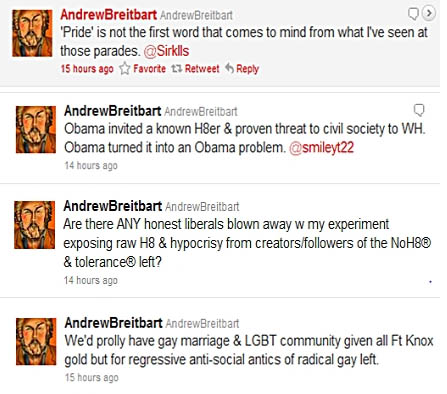
Breitbart was so guided by deranged mania, so without reconsideration or nuance, that his unhinged homophobia would flow like an alcoholic’s stool sample from his Twitter account over the slightest emotion. When Dan Savage made a foolish remark on Real Time with Bill Maher and later apologized for it, Breitbart resorted again to his tired tactic of accusing the other side of the very thing he was practicing.

When he was dumped from ABC Election Night coverage in 2010, you almost wanted to send him a sympathetic fruit basket or a plate of fresh cookies. You figured that something would have to calm the man down — especially since the elephants couldn’t use the tranquilizer gun to put down one of their own. But then Breitbart would work himself into a lather and accuse the people who canned him of cowardice. And you realized he was beyond repair.

The American political kitchen is filled with pots that are fond of calling the kettles black. The American right is populated with leaders who not only refuse to compromise, but who refuse to understand that the beloved Republicans who came before them were forced to compromise to get things done. Andrew Breitbart represented the worst of them. Yet even as I write these words, this baleful pox is being lionized rather than lambasted, fondly remembered rather than coldly resented, even vaguely considered as a hero by the mainstream outlets. These lamentable results represent the nadir of present-day politics, but they also reveal why a gutless political fool placing bullying and spite before reason and might should be thoroughly denounced.