The Bat Segundo Show: Cynthia Ozick

Cynthia Ozick appeared on The Bat Segundo Show #210. Ozick is most recently the author of Dictation.
Condition of the Show: Overtaken by a tyrannical dictator.

Author: Cynthia Ozick

Subjects Discussed: Balancing two authors, two secretaries and other stylistic repetitions that evoke typewriters in “Dictation,” purloining language from Henry James and Joseph Conrad’s letters, Henry James’s “forgotten umbrella,” “Literary Entrails,” parallels between the last two turns of the century, feeling like Queen Victoria, the language GNU within “What Happened to the Baby?” and open source GNU, crosswords in “Actors,” agonizing over every particular sentence, the slowness of sentences, auctorial fingerprints, John Updike, not wanting to be a writer of drafts, a lost manuscript by Lionel Trilling, whether postwar critics are being suitably remembered, those who mock Trilling for his moral seriousness, the origin of names, fiction as a pack of lies, being a stickler for the details vs. sustaining ambiguity, contradicting yourself in essays, when essays are unduly compared with fiction, John Barth’s “The Literature of Exhaustion,” the current literary critical environment, E.M. Forster, descriptive references to necks, on not leaving the house, not writing stories set in the present day, getting lost in one’s head, re-rereading Sense and Sensibility, how much Ozick has to think about a book before writing it, the reputation of America over the past fifty years, defining a “contemporary” novel, the dangers of writing in the present moment, clinging to brand names, books that rethink a particular epoch, religious identity in “At Fumicaro,” pretending about pretending, literary impersonation and multiple personalities, and anchoring fiction with reality.

EXCERPT FROM SHOW:

Correspondent: I wanted to ask you about “Dictation,” the title story. This was very interesting to me for a number of reasons. Because here you have two writers, Henry James and Joseph Conrad, two secretaries of Henry James and Joseph Conrad, and then on top of that, you have a number of repetitions throughout the story, as if to echo or beckon the typewriter. Like in the very beginning, when you have Henry James describing Almayer’s Folly, you kept saying, “He saw. He saw.” And there’s a number of interesting things you are doing in the syntax of the story that almost echoes the typewriter. So I wanted to ask how this particular stylistic device came about. I know you spend a lot of time on your sentences. So you had to have been at least somewhat aware of this.

Ozick: Well not so much of the repetition in consonance with the typewriter, no. I wasn’t aware of that at all. And I’m rather taken aback by hearing you say, “Have you actually seen this or heard this?” I have not. (laughs) I have not. I’m sorry to disappoint. That is not what I had in mind. What I had in mind really was the joy of the mischief when it occurred to me. And the stylistic aspect had to do more not with the sounds — if that’s what you’re getting at — but with the tones and styles of speech of these people in that era. Particularly with the formality of the young ladies, who must call each other “Miss.” To venture into a first name is really quite forward and not to be countenanced by polite society at first. And also the great pleasure of, I suppose, my parodying of James and Conrad. Though, here’s a confession, and having very much to do with style. I purloined certain phrases directly from the letters of James and Conrad. So there are sentences buried in there which are absolutely authentic. Because they’re stolen directly. Not full sentences, but phrases here and there. So that gave me a lot of joy too. Because it was a kind of imitation, mimicry, reflection of what these two amanuenses were up to in their mischievous plan.

The Bat Segundo Show: Sloane Crosley

Sloane Crosley appeared on The Bat Segundo Show #209. She is the author of I Was Told There’d Be Cake, which was recently sold to HBO for series development.

Condition of the Show: Placing the authors and book titles under too much scrutiny.

Author: Sloane Crosley

Subjects Discussed: Marie Antoinette, caring about perception, Veganism, the personal essay as a series of impersonations and observations, on being perceived as “nice,” the text as a prism between author and reader, negotiating the balance between writer and publicist, putting on the “nice face,” assumptions of lying, Oregon Trail, being nice vs. being true, exuberance, imposing internal censorship, the harsh nature of the wedding essay, why things were cut out, David Rakoff’s Fraud, Roberto Benigni, issues that cut into identity, filtering candor, whether personal essayists “tell it like it is,” David Sedaris, defining the nature of truth, using composite characters and disguising real people, speculation and judgment, lax Judaism and free association, criticism through metaphor, the relationship between adjectives and specificity and keeping the floodgates open, inverting language, Twin Peaks, dealing with sentences in essays that contradict each other, on not being prepared to turn sixteen, the original version of the book set up at Harper, the role of Gawker in Crosley’s career, online etiquette, the elusive “they,” being beholden to the BlackBerry, and stealing wi-fi.

EXCERPT FROM SHOW:

Correspondent: In “Lay Like Broccoli,” you write, “Being a vegetarian in New York is not unlike being gay.” But I must ask you. Why care so much about how you are perceived? Because that’s essentially what this is all about.
Crosley: That specific essay or the whole book?

Correspondent: Well, that specific essay. But also the whole book. Because there’s a bit of hiding behind the essays.

Crosley: Well, is there? I think it’s more that clash between trying to grow up and trying to realize who you actually are once you become a grown-up. So I’m not actually hiding behind any specific concern I have about people’s perceptions, but more just trying to figure out who you are. It’s like you’re trying on different cells. I was telling someone the other day that my favorite part of In Cold Blood — I assure you this makes sense for an interview about a humor collection.

Correspondent: I’m sure. Go for it. Please.

Crosley: My favorite part of In Cold Blood is actually this tiny detail where he finds Nancy’s diary and he’s going through it, and obviously it becomes a huge part of the book. But he talks about the actual handwriting and the different various inks and the different colors she would use as she’s trying on different cells, as if to say, “Is this Nancy? Is this Nancy? Is this Nancy? ” Now granted, she’s what — sixteen at the time> So in an ideal world, I would have less colors of ink and different styles of handwriting to try on at twenty-nine years old. So when I say the thing about the vegetarian thing, and the vegan thing, it’s more observational than something I’m actually petrified with living with on a day-to-day basis.

The Bat Segundo Show: Tobias Wolff

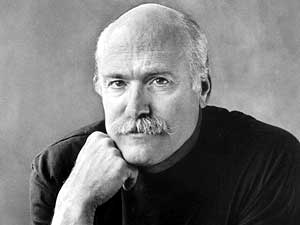
Tobias Wolff appeared on The Bat Segundo Show #208. Wolff is most recently the author of Our Story Begins.

Condition of the Show: Speculating upon Mr. Wolff’s unknown powers.

Author: Tobias Wolff

Subjects Discussed: Writing first-person stories that don’t seem like first-person stories, the use of the word “I,” contemporary short stories and therapy sessions, fiction and narcissism, William Trevor, knowing the lay of the land, the symbols of the everyday universe, tulle fog, writing endings before the endings, Tolstoy vs. Chekhov, whether “Bullet to the Brain” had any specific literary critic in mind for its premise, dog stories, conversations in cars as the common American confessional, the open road, the consciousness of dogs, straying from realism, stories that end with an italicized line or a whisper, the precise and imprecise details within a sentence, arranging the short story order within a collection, “Best Of” vs. “Selected” stories, psychology and the skillful lack of overt specificity within “The Rich Brother,” hiding a story’s design, Flannery O’Connor, and how Wolff contends with variegated reader reactions.

EXCERPT FROM SHOW:

Correspondent: This idea of first-person narration that is somewhat removed — maybe this is more of a classical sense of the short story, in the sense that today, contemporary short stories are, as you point out, more of a gushing therapy session. Maybe that’s what we’re talking about.
Wolff: Well, I don’t know. Again, when I think, for example, of Philip Roth’s first-person narrators, they are interested in the world at least as much as they are interested in themselves and interested in other people. And that shows up in the narration. It would be a pretty boring story that was so — if I could put it this way — narcissistically defined if you didn’t get a sense of the world beyond the narrator or of other people beyond it. I would think that, unless it was deliberately taking on the pathology of narcissism, it would be a deficiency of the story. Some stories, of course — some first-person stories — rely on a very heavy colloquial. And that may be something that you’re noticing with some of the stories. Like the one I just quoted from, “Next Door,” is quite colloquial. In other stories, you get the sense that the narrator is telling the story not in the immediate moment of the story, but perhaps from a distance. Which also would give you a wider vision of the circumstances and the people involved. And also perhaps a more articulate voice. A more capacious voice. So it isn’t just a Catcher in the Rye, moment-by-moment narration, but something that would open up a little more in the way of Philip Roth or William Trevor. The way their first person stories work.

(A lengthier excerpt from the show can be found here.)

The Bat Segundo Show: David Hajdu

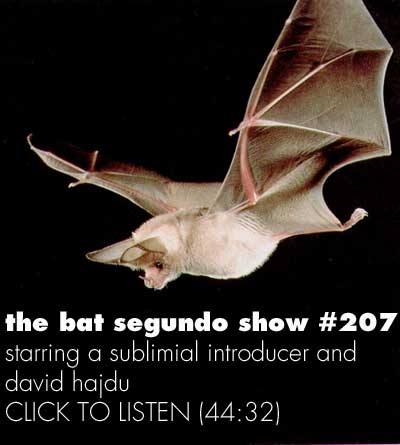
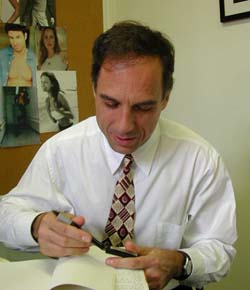
David Hajdu appeared on The Bat Segundo Show #207. Hajdu is most recently the author of The Ten-Cent Plague.

Condition of the Show: Dabbling into hidden threats.

Author: David Hajdu

Subjects Discussed: Hajdu’s approach to journalism, primary sources vs. secondary sources, categories of people to talk with when preparing a book, tracking down people who disappeared, grassroots methods of finding people, changing names, the untold story of women in comics, Irvin Kersener’s early career as an agitprop documentary filmmaker*, corroborating facts against shifting memory, telling history without a fully documented record, Billy Strayhorn’s career before Duke Ellington, remembering details based on a nugget, the ever-shifting complexities of William Gaines, whether EC Comics could have survived if it shifted to magazine format, Will Eisner on not being taken seriously, what caused the great comics scare, literate comics, the fear of kids turning on parents because of a medium, Frederic Wertham’s Seduction of the Innocents and the media’s willingness to give credence to Wertham’s anti-scientific tract, why America needs a lowbrow cultural blaming point for social ills, cultural class bias, pornography and other populist mediums as subliterary forms, comics decency legislation vs. the Hays Production Code, postwar censorship, comics being placed in a position not to challenge authority, Charles Biro’s Crime Does Not Pay vs. yellow journalism, and Bob Wood bludgeoning a woman to death.

EXCERPT FROM SHOW:

Correspondent: I’m wondering if certain artists may have changed their names because the comic book industry was considered a great calumny for many of these various artists and writers. Did you face a problem along those lines in tracking people down?

Hajdu: I did. I had trouble with people who changed their names, but not for that reason. Because most people used their real names. Most people, but not all. Some use pseudonyms. Still do in comics. But most people intended to use their real names. But women married. And women who married in that time took on their husbands’ names. And I was surprised to find when I was doing my research how many women there were in comics. I mean, dozens and dozens of women who did terrific, beautiful, important work. Marcia Snider is one. I was never able to find her. I’d been told that she’d married. And nobody I could find knew what her married name was. In the case of the great many women artists, I only had their maiden names. And I couldn’t find them. I tried social security records, but they weren’t of that much value. And I did hit a wall with women artists. And I’m sure to this day, much of their story remains untold because they’ve been impossible to find.

Correspondent: Well, what steps did you take to atone for this? Because if you’re slicing off a portion of comic book history — a very important part of comic book history that involved women — I mean, how did you make up for this?

Hajdu: Well, I sought to do justice to the story that I can tell. I don’t know what I don’t know. I did make a point to ask about those women to the people who I could find. And that’s the only recourse.

* — Despite Hajdu’s representations in this interview, Kershner remains quite alive!

Interview with Tobias Wolff

This week, The Bat Segundo Show will cross the 200 episode barrier. A future program will feature a conversation with the writer Tobias Wolff, whose most recent book, Our Story Begins, is a short story collection containing previously collected tales — including the classics “Bullet in the Brain” and “Hunters in the Snow” — and more recent offerings like “A White Bible,” a gripping narrative that takes the notion of entitlement to task, but leaves judgment to the reader. In the New York Times Book Review*, Liesl Schillinger wrote, “To read a story is to sink into the soft seat of your grandfather’s strong, modest old Buick and let yourself be carried through an America of small towns, small joys, small struggles and small despairs — a landscape so familiar as to be invisible, the landscape of homeland.” Wolff’s stories are certainly a place to recognize readily identifiable qualities, but what makes him a fabulous writer is the way in which these quotidian moments are charged with import without coming across as overtly portentous.

I got the chance to talk with Wolff last week when he was in New York. He was a confident figure beating a bad cold. And while he was interested in how readers interpreted his stories, he had no desire to offer explanations. But I did pry further. And I was able to unfurl some of the science Wolff brings to his tales. What follows is a partial transcript of our conversation.

Correspondent: This idea of first-person narration that is somewhat removed — maybe this is more of a classical sense of the short story, in the sense that today, contemporary short stories are, as you point out, more of a gushing therapy session. Maybe that’s what we’re talking about.

Wolff: Well, I don’t know. Again, when I think, for example, of Philip Roth’s first-person narrators, they are interested in the world at least as much as they are interested in themselves and interested in other people. And that shows up in the narration. It would be a pretty boring story that was so — if I could put it this way — narcissistically defined if you didn’t get a sense of the world beyond the narrator or of other people beyond it. I would think that, unless it was deliberately taking on the pathology of narcissism, it would be a deficiency of the story. Some stories, of course — some first-person stories — rely on a very heavy colloquial. And that may be something that you’re noticing with some of the stories. Like the one I just quoted from, “Next Door,” is quite colloquial. In other stories, you get the sense that the narrator is telling the story not in the immediate moment of the story, but perhaps from a distance. Which also would give you a wider vision of the circumstances and the people involved. And also perhaps a more articulate voice. A more capacious voice. So it isn’t just a Catcher in the Rye, moment-by-moment narration, but something that would open up a little more in the way of Philip Roth or William Trevor. The way their first person stories work.

Correspondent: I’m wondering if it’s something similar to Nabokov’s idea — that he had to know the lay of the land before he could write any particular novel or short story or what not. Maybe this is your concern.

Wolff: Well, by the time I write the last draft of a story, which — well, when Nabokov wrote his first drafts, they were like the last drafts of anybody else’s. By the time I write the last draft of the story, I certainly do know more than I can ever tell about my characters’ situations. So you’re just seeing a part of it.

Correspondent: I wanted to ask about the very subtle use of symbols throughout these stories. They are essentially straightforward realism. But you have, for example, in “A White Bible,” the attention to Frontage Road. You have the light shutting off at the end of “Say Yes.” And also, I really love the tule fog at the end of “The Rich Brother.” So these are really symbolic. But also, at the same time, they come from this realism. And I should also observe that, particularly with these endings, these symbols pop up often when you have a concise story.

Wolff: Well, they’re not symbols in the way that a high school English teacher teaches symbols. They are features of the story that a reader can probably sense some consequence without being able to define it. Yeah, at the end of “A Rich Brother,” Pete’s in a bit of a fog. But it’s also a very real fog. If you drive through that valley in California — the Central Valley, that time of night — you’re going to be in a fog. So what symbolism there is simply what life itself gives us. I mean, we actually navigate our lives by symbols. That is, by the outward signs that lead us in one direction or the other. Nature is filled with these things. And, of course, writers make use of them.

Correspondent: Well, in terms of endings, I think also of “Powder” and “Say Yes,” which have endings before the endings. In the sense that we think it’s going to end at a particular point, but, in fact, it ends before that point. And we are then forced to speculate upon where these characters are going. I mean, again, this supports the theory I’m throwing out at you that these concise stories have more going on or the action needs to be stopped at intervals.

Wolff: Well, the ending of a story, I think, contains all that the reader needs to have an intuition of how the story might continue. And they shouldn’t necessarily spell those things out, as some readers do. Tolstoy, for example, writes short stories as if they were novels. But to make a contrast, Chekhov draws enough of an arc that you imaginatively complete the circle yourself. You’re given all you need to do that. And my own practice as a short story writer has tended to gravitate toward that. One of the things I like about the story form is how much it can imply. Not as a kind of guessing game or some cute riddle you’re playing on the reader, but in the way that situations in life imply other situations. I mean, we actually, in our daily lives, become quite adept at intuition, at teasing out implications of present situations in order to get a sense of how the future might unfold. When we go out with a girl on the first time, we’re doing that. We have our first week at a new job, we’re doing that. We meet a new friend. We’re just constantly in these. It’s a very natural and emotional exercise that we do. And I try to find a way of expressing that in the forms of my stories. I don’t close things down because they aren’t closed down in life. The way that Tolstoy closes things down is that he has his characters die at the end. And that is a pretty neat way to do it. But they’re not going anywhere then. I love his stories, but they aren’t the kind of stories that I write.

* — One must point to good fiction coverage in Tanenhaus’s rag from time to time, with the unrealistic hope that such plaudits will correct unpardonable oversights elsewhere.