Review: The Spirit

spirit

The critics were not happy during the screening. The critic to my left fell asleep in his chair for an hour. The critic to my right — a jovial man who really wanted to like it — gradually realized that this was a film impossible to come to terms with.

Gone were Eisner’s primary colors, replaced by muddy and amateurish black-and-white visuals with digitally added snow that never seemed to stick. The Spirit was so bad that it made Warren Beatty’s Dick Tracy look like a masterpiece.

Everyone was excited at the beginning, knowing that this was Will Eisner’s classic character finally brought to the screen and that it was Frank Miller who was going to steer it forward. But one of the fascinating aspects of this screening was observing the precise point in which each audience member would give up, knowing that Miller was cheapening a legend. Knowing that the film was wasting its cast and crew. Knowing that Miller was producing something even more odious than The Dark Knight Strikes Again or that crappy Robocop comic. (And let’s be honest. Has Miller truly contributed anything important to comics in the last ten years?) Knowing that it was Mr. Rodriquez who was the great force behind Sin City, and not Miller. (And to think that Rodriquez abandoned the DGA for this hack.) Knowing that just about everybody wanted to lock Miller into a room and punch him repeatedly in the face for about eight hours for producing this travesty. Knowing that something we all had hoped would be good was such a steaming turd.

I counted eight walkouts. There may have been more. But I can’t be sure. I was too busy slumping in my seat, stunned by the film’s relentless determination to sodomize Will Eisner’s corpse, assaulted by the film’s muddled script, which couldn’t even clear up the origin story until two-thirds of the way into the picture, its needless misogyny (women are either whores, nurturers, or kept in the background as laconic sidekicks), its inability to strike a single human note, and its failure to evince one note of fun.

Yes, Frank Miller should be punched in the face for this. It’s the only way to be sure.

There were jokes — one involving an ass on a copy machine — in which not a single person laughed. And again this was a friendly and rowdy crowd. But they all sunk into their chairs, feeling very angry that their time had been greatly wasted.

Oh, Stana Katic, how you tried as Morgenstern! You are as wonderful as Mageina Tovah, who played Ursula in the Spider-Man movies. I can now watch you in just about anything. And I feel so sorry for you for having your talent wasted. How much did you fight to keep the remainder of your quirks in? Bill Pope, I have admired your cinematography for quite a while. But this film was beneath your great talent and you should have known better. Samuel L. Jackson, signing on for a role just because you’re a geek simply isn’t worth it anymore.

Miller directs his cast as if they are statuary and handles his crew as if they are expected to generate magic simply by standing around. He is an ugly and crude man who does not know the human condition, and he is more interested in Eva Mendes’s ass than any innate personality she can use to sex up her role. He has tossed around crude pop culture references — including buildings and trucks named after Eisner’s collaborators — in an effort to win over the fanboys. But the fanboys will not bite. What Miller doesn’t understand is that geeks are too refined to swallow codswallop. What Miller doesn’t understand is that hell hath no greater fury than a fanboy spurned.

If there is any justice, the fanboys will lynch Miller at a future Comic-Con. If there is any justice, this film will fail at the box office and the money men will reconsider handing Miller the Buck Rogers reboot.

But there is rarely justice in Hollywood. The fact that this film was allowed to be made is testament to that.

Review: Revolutionary Road

road1

In Blake Bailey’s A Tragic Honesty, an excellent Richard Yates biography, Bailey depicts Yates’s efforts to adapt William Styron’s Lie Down in Darkness for director John Frankenheimer. The film, as we all know, was never made. And although Yates took this lucrative gig to whirl away with the money, this didn’t stop the troubled and cash-strapped literary master from writing to the requirements of the cinematic medium. Yates included careful music cues (“light, tinny, inexpert” xylophone music to be played during a moment of rage), specific camera angles, and even facial expressions, but, above all, he remained faithful to Styron’s text, condensing and tweaking the narrative without sacrificing its visceral dynamic. To tamper with Styron too much or to water it down would involve a conventional and pointless facsimile, a flaccid adaptation dishonest to Styron and the possibilities of cinema itself.

Bailey concludes that Yates’s screenplay “may have amounted to a great movie adapted from a great novel.” And he quotes Frankenheimer forty years after Yates’s labor: “God, it’s good. I’d still like to make that movie.”

It’s doubtful that the team behind Revolutionary Road had any solicitude like this in mind. Justin Haythe’s unpardonably distilled screenplay “adaptation” manages to whittle away all that was interesting within Yates’s book. It is, like the 1974 film adaptation of The Great Gatsby, a dull and literal winnowing of a literary masterpiece. You know you’re in trouble from the get-go when Yates’s opening chapter in a community theater, which masterfully sets up the artifices of the Wheelers, is replaced with aloof flashbacks.

Clumping their heavy galoshes around the stage, blotting at their noses with Kleenex and frowning at the unsteady print of their scripts, they would disarm each other at last with peals of forgiving laughter, and they would agree, over and over, that there was plenty of time to smooth the thing out. But there wasn’t plenty of time, and they all knew it, and a doubling and redoubling of their rehearsal schedule seemed only to make matters worse.

Granted, it takes a screenwriter of exceptional talent to process those precise interior sentences into the visual exigencies of the film form. But Haythe is incapable of introducing anything that might permit us to see the wheels spinning in Frank’s head. Nor is director Sam Mendes up to the task of reinventing the Wheelers by establishing behavior that is as specifically rendered as Yates’s prose.

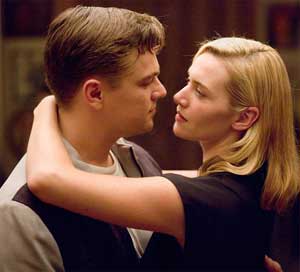
road3Instead of the backstories associated with this disastrous local theater run, we see Leo and Kate (certainly not anything close to Yates’s Frank and April, and considerably removed from Cameron’s Jack and Rose) looking across at each other at a party. But we have no real sense in the film of why these two would be attracted to each other, and, because of this, there’s no real reason to care. It doesn’t help that the Wheeler household looks more like a Pottery Barn catalog than a middle-class dwelling in 1955. And it doesn’t help that Mendes cannot even depict two pivotal acts of carnality with accuracy. (In the Mendes universe, couples have passionless sex and finish each other off in twenty seconds without even the tiniest whimper of pleasure. This is as preposterous and implausible as Sharon Stone’s over-the-top masturbation scene in Sliver. In a narrative that demands close verisimilitude, this is an inexcusable artistic decision.)

There’s a better effort to account for the Wheelers’s emotional deadness later on in the film, when the Wheelers sit down for breakfast after a fight. Leo and Kate deliver their lines in a husky and stilted manner, and the stale atmosphere in this scene is perhaps the closest this film comes to making something stick on the screen.

Nevertheless, I wondered if director Sam Mendes had really wanted to make this movie. Did he even understand the book? Had he even read it? In book form, Revolutionary Road is, among other things, a harrowing portrayal of potential castrated in the comforting traps of suburbia. And if you’re going to make a movie from this, you need an actor in Frank Wheeler’s role who is not only capable of selling us the masculinity muted beneath the cube worker, but you need someone who can intuitively grasp the emotional complexities carefully embedded inside the novel.

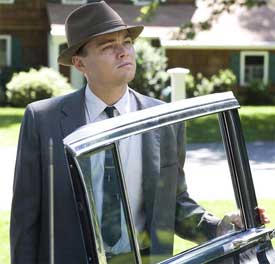
road2Leonardo DiCaprio is not that man. He demonstrates little thespic understanding of what it means to be stifled. He gives us nothing in the way of sorrow, save the cartoonish wails and the exaggerated throwing of physical objects from surfaces. DiCaprio has been relying on this ever since a few people convinced him that he was a serious actor. But he is unable to present us with some of the reasons why Frank would be tempted by an extramarital affair. He can access the territory of knowing he’s not good enough to be someone special. But when we learn how Frank Wheeler’s cavalier act gets him ahead, it is not because of DiCaprio. It is because Haythe and Mendes spoon-feed it to us ad nauseum. A scene at a beach, a scene with his co-workers at a diner, a scene with April. This is an inefficient and an insulting waste of minutes. We need not be told twice, let alone three times, that Frank Wheeler has what it takes to get ahead at Knox Business Machines. It should be self-evident in the way that Frank Wheeler acts on screen. But DiCaprio here cannot merge into the tempo established by his environment.

Some of this may be bad casting and bad direction. But it’s clear watching this film that DiCaprio’s mind, emotions, and personal experience — as portrayed here — remain unsuited to a man in his midthirties who knows nothing more than a shitty job.

As April, Kate Winslet is better. She did, after all, play Sarah Pierce, the bored thirtysomething housewife who feels entitled to something better in Little Children, nailing the opportunity to fuse hauteur with vulnerability. (Perhaps Todd Field should have been the guy to write and direct Revolutionary Road.)

But her husband is not suited to direct her. Instead of crafting a performance out of Winslet, Mendes constantly places Winslet in the center of the frame, as if this visual juxtaposition will somehow atone for the bad material.

road4Instead, Mendes and Haythe, who appear to be a writer-director working team about as competent as Akiva Goldsman and Joel Schumacher, see Yates’s endlessly nuanced novel as an opportunity to remake American Beauty for the 1950s, with a number of sexist nods to Mad Men thrown in for commercial appeal. “I must scoot. Toodle-ooo,” says one bubbly neighbor. And this cornball emphasis suggests that Mendes and Haythe don’t see the 1950s as a time in which real people lived and wrestled with serious decision. It is a decade to be played merely for cheap laughs.

And this contempt for audiences makes Revolutionary Road a movie designed for illiterates who will likely give this dreadful film a pass because they refuse to demand better.

Perhaps Mendes and Haythe’s incompetence can be summed up in the film’s final scene, which takes a good two minutes to execute. But Yates got to the point in two sentences. It’s a pity that this film never dares to trust its audience and speed up its pace through natural beats and a meticulous attention to human behavior. If it had, it might have come close to understanding the welcome, thunderous sea of silence at the heart of Yates’s novel.

Review: Nothing But the Truth

nothing1
Before Jonathan Demme became a world-renowned filmmaker, he was a film critic working for a small newspaper. The glorious schlock producer Roger Corman was shrewd enough to give the likes of Francis Ford Coppola, the late and profoundly misunderstood Paul Bartel, Martin Scorsese, the woefully underrated Joe Dante, James Cameron, and John Sayles their early starts. And Corman saw something in Demme while Demme was working for him as a unit publicist. Demme got his first directing assignment from Corman in 1974: a not-bad women-in-prison flick called Caged Heat that features catfights, gratuitous nudity, and a score from Velvet Underground founder John Cale. Demme followed this up with two more films for Corman before being snatched up by Paramount to direct Handle with Care. The rest, as they say, is history. I’ve long had a theory that the unfettered freedom that Corman gave to guys like Demme was invaluable. They became serious filmmakers a few decades later. And when we consider that some of the top-grossing Hollywood entertainments of the past decade (The Lord of the Rings, the Spider-Man trilogy) came from, respectively, Peter Jackson and Sam Raimi — two filmmakers who, only two decades ago, could not be possibly be identified as having mass commercial prospects, the theory that exploitation fare serves as an essential training ground becomes more plausible.

Like Demme, Rod Lurie was also a critic before he was a filmmaker. Regrettably, he did not have a Corman-like figure who encouraged him to go completely wild. And this apparent restraint, whether self-imposed or dictated by studio forces, has prevented Lurie from being anything more than a by-the-numbers filmmaker. One watches Lurie’s films wondering if the id will ever burst completely to the surface. Here is a man who put “win” in the names of two soldiers in The Last Castle, and was silly enough to have a scene in which a 64-year-old shirtless Robert Redford moves rocks without rest across a prison yard. There is clearly great exploitation potential here. But Lurie seems convinced that he is making a deeply intelligent film with each offering. He’s infinitely more interesting when he relies on these goofy what-the-hell moments, such as the audacious casting of Jeff “The Dude” Bridges as the President of the United States in The Contender. Not only does Jeff Bridges play, well, Jeff Bridges, but Lurie also includes a silly scene in which this President offers a ridiculously oversized sandwich in an effort to “break bread” and is taken aback when his political associate does not accept the offer.

This struggle between wanting to pound moral issues into his audience’s skulls with all the grace and subtlety of a limbless deli worker trying to use the meat cutting machine to make a hero and embracing film as something that is often fun and inexplicable is what makes Lurie’s most recent film, Nothing But the Truth, perhaps his most interesting. While my moviegoing companion dismissed Nothing But the Truth as “a steaming pile of dung,” I felt compelled to defend the movie’s odder moments, even as I simultaneously recognized it as a deeply flawed political drama.

Beneath Nothing But the Truth‘s implausible and pleasantly preposterous politics beats the half-hidden heart of a perfectly respectable exploitation film. There are girl-on-girl jail fights and a conjugal visit in which a woman screams, “Thanks for the fuck! It really hit the spot!” These are not the scenes that one expects from an austere political drama, and the film held my interest during these moments because I wanted to see just how far Lurie would go. Personally, I do not believe that Lurie went nearly far enough. And I felt sad. Because American cinema needs more people who take chances. I concluded that the only way that Lurie could get attuned to his innate craziness would involve remaking the wonderfully terrible movie, Ilsa: She Wolf of the SS, a script incapable of being directed with total sincerity. An Ilsa remake would put Lurie’s naivete to an end and would finally release him from the needless task of making “important” films. Failing that, perhaps Abel Ferrara could be employed to hold Lurie hostage for a month and Lurie could emerge from the smoky anarchy with a newfound determination to make batshit crazy films.
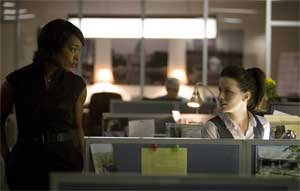
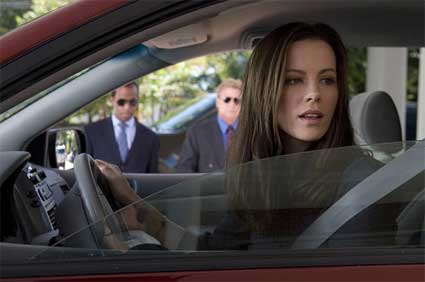
nothing2Let us first ponder why a reprogramming along these lines is necessary. The film opens with a presidential assassination attempt with an unbelievable paucity of Secret Service agents. Later, there’s a stern judge who announces “Anyone want some tea? It’s from Greece” in his chambers at a wildly inappropriate moment. The newsroom of the fictive Capitol Sun-Times, more All the President’s Men than All the Present Realities, is utterly implausible with newspaper cuts and the Tribune Company’s bankruptcy in recent headlines. Everyone seems to have plenty of time to bullshit around in an editorial meeting. The graceful Angela Bassett almost sells her silly role as a top editor, until she urges Our Intrepid Reporter Based Heavily on Judith Miller (played by Kate Beckinsale) to get some rest, a wildly improbable request when today’s newspapers demand immediate copy to fuel sales. Our Intrepid Reporter lives in a very spacious house with another writer, who has written only one novel. (It’s safe to say that Lurie isn’t familiar with the financial ups and downs that would preclude such an affluent lifestyle.)

Lurie has this funny habit of getting one fact right, only to be completely wrong about another one. At one point, a CIA agent submits to a polygraph test. As anyone who had read Ken Alder’s interesting book, The Lie Detectors, knows, a polygraph is inadmissible in court, an unreliable measure, and entirely unscientific. (For more on polygraphs, you can listen to my podcast interview last year with Alder.) But Lurie doesn’t seem to know this, or at least never mentions it. Lurie does know that CIA agents are trained to beat a polygraph test (and this is mentioned). But if the CIA agent can beat the test, why would the investigation bother to carry it out? These numbskull decisions are at odds with the movie’s (perhaps unintentional) quirky charms.

Most egregiously, Matt Dillon has been cast in the role of the prosecutor who goes after Our Intrepid Reporter.

A few words about Matt Dillon: If you need someone to play a dick or a former high-school jock who is past his prime, Dillon’s your man. If, however, you need an actor to offer convincing authority, Dillon simply cannot be taken seriously. The director John McNaughton — a man, unlike Lurie, who knows how to have great fun with sleaze — understood the Dillon dilemma when he cast him in Wild Things and played this up. And one suspects from Dillon’s memorable appearance on Fishing with John that Dillon exhibits these qualities quite naturally.

Dillon is one of those guys who could easily be beaten up by out-of-shape thugs at a suburban bar. Sure, the bluehairs accepted his unintentionally hilarious performance in Crash and nominated him for an Academy Award. But the rest of us know that his attempts to take charge of a scene and exhibit masculinity are as dopey and diaphanous as a used car salesman trying to convince that he’s a friend. Had Nothing But the Truth possessed the courage to embrace its exploitation potential, Dillon’s casting would have proven to be a stroke of genius. But Lurie wants us to accept Dillon as a threat, because he believes too much in his premise, and has Dillon spout such silly lines as, “You know, vilify me all you want, but I had a job to do.” (To get a sense of how ridiculous this line is, imagine it spoken in Dillon’s voice, with that regrettable Dillon pause at the commas.)
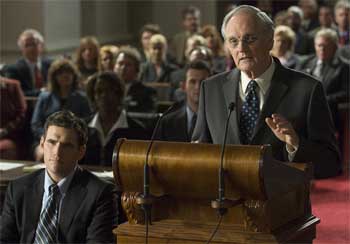
nothing3Alan Alda, on the other hand, is very good as the attorney who defends Our Intrepid Journalist, even when he’s given a preposterous scenario in which he essentially whines to a judge, “Oh, come on!” That Alda can work these scenarios without diminishing his authority is a credit to his great powers as an actor. Lurie was lucky to get him on board.

Beckinsale is okay. David Schwimmer is ridiculous. Vera Farmiga has been better elsewhere. But I liked Floyd Abrams as the Judge. (This may be because he’s a well-known lawyer. Perhaps he gave Alda some helpful tips.)

Even Alik Sakharov’s camerawork here is befitting of a quickly made film produced by Corman: lots of long lenses with soft and blurry backgrounds, too many closeups, muddled editing. This appears to be an effort to create claustrophobia. But it only serves to reinforce the rhetorical Don Edmonds question raised above. What would Lurie do with Ilsa?

I am not quite sure if I’ve written a bad review. But I have spent far more words than I expected to on Lurie’s latest opus. And there are pages of notes I haven’t even touched on. I know that Rod Lurie is a bit obsessive about leaving comments at nearly every website that reviews his films. Perhaps he cares very deeply what some of us think. So, Rod, if you are looking for advice, do yourself and the film world a favor. Remake Ilsa. Stop injecting your screenplays with silly moral predicaments. Be honest for once and realize that there’s a great big cornball exploitation filmmaker inside you. If you’re true to that voice, then maybe you could be a Demme decades down the line.


Review: Special (2006)

There are severe problems with Hal Haberman & Jeremy Passmore’s Special — scheduled to play on November 21st in Los Angeles and New York as the second film in Magnet Releasing’s very intriguing Six Shooter Film Series. (I have also seen Timecrimes, a very fun time travel movie from Spain that I can recommend to you. Timecrimes manages to do everything right that Special does so wrong, and I will write about it later.)

Here is a film that strives to be a partial satirical sendup of the pharmaceutical industry, but that gives us a protagonist who has little going for him other than a crush on a stuttering supermarket clerk and a loose friendship with two brothers who work at a comic book store. Here is a film ridiculing an average Joe (or, in this case, an average Les) who clings to kind acts and antidepressants to find some personal meaning, but that likewise asks us to empathize with him after he has been beaten to a pulp. Here is a film attempting to celebrate the geeky fantasy of having superpowers, but that lacks the bravery to suggest that some of our seemingly insignificant acts are less solipsistic and more meaningful than the ability to walk through walls.

Here is a case in which Les isn’t more, and he really needs to be in order for the premise to work. He’s a gushing parking enforcement officer played with too much earnestness by Michael Rapaport. We first see Les as a thrashed up man wandering in the night, with a handheld camera drifting in and out of focus. “I used to dream about flying,” says Les in the first of many voiceovers. We learn that this narration represents what he styles his medication journal. Les has signed up for a clinical trial program. (The doctor is named Dobson, which may be a nod to the evangelical Christian.) Rather suspiciously, Les is not asked to take any physical tests. The pills are handed over, and he’s asked to ingest a new phramaceutical called Specioprin Hydrochloride. Nothing happens at first. But shortly after eating a sad microwaved meal in his apartment, a mostly barren place populated by a few comic book posters hanging behind the couch, he finds himself levitating in his living room. He rushes back to the doctor to demonstrate his abilities, and it soon becomes apparent that all this is in his mind. He soon quits his job, determined to pursue a new life as a crimefighter (and to avoid the dreaded mantra, “I’m important and I keep this city running,” that his boss frequently has him utter). Aside from the power to fly and the ability to run through walls, Les also believes that he can read minds and make objects disappear.

This all sounds like a fantastic premise. And you’d think that a movie featuring a Takeshi Kitano-like scene in which Les punctures a man’s ear with chopsticks would have the spirit to pull this premise off. But the filmmakers have foolishly placed their collective faith in a high concept idea, when they really needed to pay attention to human behavior. I got the sense that Haberman and Passmore weren’t particularly interested in the way that ordinary people feel and think. And I desperately desired for someone to send them a crate of Stewart O’Nan and Richard Yates novels.

This contempt was evident when Les’s frequent tackling of potential suspects is broadcast on the evening news. The video is played over and over, as if it were a crude YouTube video or a Jackass outtake, with the Channel 3 anchor declaring, “Let’s take one more look at it.” It’s there in the hard rock music that plays as Les runs around the city in his makeshift costume. We’re expected to laugh at Les’s cluelessness. But this film takes itself seriously. And when a film wants us to care like this, it should not treat its main character like something to be pummeled in a Punch and Judy show.

The contempt is also there in the PG-rated thoughts that Les “hears” in his mind. (One man says, “Sweet juicy peach.” His girlfriend calls for peach cobbler.) Now this is an interesting choice from the filmmakers. You would think that a man who has been repeatedly tricked out of issuing parking tickets, who has indeed been called an “asshole” by a woman offering a maudlin sob story, would have a less chaste view of other people’s “thoughts.” But the filmmakers don’t want to transport us into this very interesting place. We’re expected to accept Les as nothing more than a pathetic and bumbling thirtysomething hick who got hoodwinked into the drug program because he was “happy” and he didn’t quite know his place. And with such a one-dimensional portrait, we can neither hate him nor like him, much less be interested in him. And this is simply not good enough for a narrative that wants to matter. It is also a terrible cheat to present an undeveloped character, have him periodically abuse himself by running into walls or getting mugged by thugs, and then try to ramrod the audience into sympathizing with him.

Les doesn’t get a chance to breathe, even though Rapaport does manage to sell a fight sequence in which his assailants are “invisible,” but beat him up anyway. I was reminded of the moment in Fight Club in which Edward Norton punches himself. But that moment worked, because we were damn curious about how far Norton’s character would go. What does Rapaport have react to? “You have no idea what kind of man I am, motherfucker,” followed by a flip courtesy of digitally erased wires.

There is also one glaring plot hole. If the “suits” from the drug company are after Les, and they want him to stop taking the experimental drug, why don’t they just wait for Les’s bottle of pills to run out? It is suggested multiple times in this movie that Les’s condition will continue so long as he pops the pills. But so far as we know, he only has one bottle. Certainly if the drug company wanted to leave Les out in the cold, they could simply wait it out. But instead they resort to violence. And they drive a fancy limo around town, with the men wearing bloody suits and drawing attention to themselves.

A narrative involving the tragedy of interior self-delusion is certainly a good idea for our uncertain times. But the more I think about this movie, the more I realize just how little time the filmmakers devoted to working out their story.

NYFF: Waltz with Bashir (2008)

[This is the thirteenth part in an open series of reports from the New York Film Festival.]

About a week ago, fearing that all of the films were turning my mass into flabby mush, I walked two brisk miles in twenty minutes to take in Ari Folman’s Waltz with Bashir, my fourth film of the day. The movie had been described to me by one critic, who purportedly writes for a newspaper, as “a little fiesta” — a qualification that I certainly quibbled with at the time. I’m not sure that a movie depicting the trauma of war and memory can be accurately identified as a “little fiesta.” Certainly, the real-life figures drawn from the Israeli Army do interpret a break between battles as a “little fiesta,” even if they do not precisely use these two specific words. It is true that these soldiers toil in homemade banana leaf huts on the beach and frolic about just before their comrades get shot in their head. But to suggest that these activities represent a “little fiesta” is, I suspect, missing the point just a mite. I’d like to think that the critic in question was having me on, but when I questioned him about specific points in Israel’s history, he had no knowledge of events that went down in 1967.

A professional animator informed me that he had disliked the film because of its gimmick and what he characterized as “amateurish” animation, but this same gentleman had gone bananas over Shuga, a film that I did not care for very much. But it should be observed that the device of a journalist-like protagonist (here, Folman) who questions various people about the meaning of some hazy memory has its roots in Citizen Kane and numerous personal documentaries. I don’t think that Waltz with Bashir is a documentary exactly. It’s more of a recreated narrative with the appearance of an objective pursuit. Something akin to a memoir played out for the camera. Certainly the animation technique, of which more anon, lives up to this notion of reconstruction. If it is not technically successful, then it is certainly viscerally successful.

But I was determined to make up my own mind. My initial reaction after the screening was somewhat ecstatic. But now that it has been a week since I’ve seen Waltz with Bashir, I see the film with slightly different eyes. This is a film that stacks its deck just a bit too heavily. War is bad, and it doesn’t matter what side you’re on. But this predictable rush to condemn war leaves little for the audience to make up their own minds. Paths of Glory is one of the best antiwar films in cinema, but it was Kubrick’s visual genius and his insistence on wiggle room for the audience that made the film work. Waltz with Bashir offers no comparative anthill. It offers more of a sideways glance for a topic that requires thinking in twenty dimensions and more time than you have for rumination. (As Tom Bissell noted in his underrated memoir, The Father of All Things, Vietnam is a subject that one can easily devote a lifetime to.) Waltz is, however, very good about clarifying something just as troubling: more than two decades later, it cannot be stated with any certainty that war memories match up to the reality. (Come to think of it, this is likewise a subject broached by Bissell, and Waltz with Bashir and The Father of All Things might make an intriguing book/movie double bill, or perhaps “two little fiestas” for critics who cloak their ignorance in uninformed mirth.)

The reality itself is the 1982 Lebanon War, and Folman was directly involved. He fought in the Isreali Army and, now in middle age, he retains a memory of naked young men emerging out of the water before a ruined city. Some key friends figure into this fugue: the long-haired Carmi Cna’an, the teenager who everybody figured would succeed in any science, now living in Amsterdam and fiercely protective of his privacy; Shmuel Frenkel, who has taken up vigorous physical exercise and maintains a bald pate; and Israeli war correspondent Ron Ben-Yeshai, who telephoned then-Minister of Defense Ariel Sharon about the massacres at Sabra and Shatila and was given a peremptory answer to back off.

What is quite interesting about Waltz with Bashir is its production method. Folman tracked down the people who haunted his memories, interviewed them, and then styled an animated narrative around these efforts. He even managed to persuade these people to reproduce their voices for the film. (Only a handful of Folman’s subjects declined.)

Each figure appears flat, representing a clear demarcation along a particular focal point. At times, it’s akin to watching a Flash animation or something involving cardboard cutouts from a pre-digital time. Folman’s team has added layers of smoke and reflections atop this basic approach.

Folman also has respect for his subjects’ wishes. When Carmi Cna’an declares that Folman can draw him as he is talking about war, he requests that Folman not include his son. Sure enough, the camera drifts away from the house as Carmi Cna’an engages in this paternal pastime.

But while the testimony that Folman unravels from his subjects certainly inhabits a feel of a bygone time — an atmosphere enhanced by a decent soundtrack and dutiful pop cultural juxtaposition — Folman fumbles a bit on memory’s false starts. Folman’s best friend and shrink, Ori Sivan, brings up a psychological experiment. When subjects were given photographs containing one false element, they believed that the false element was part of the memory. While Folman has exonerated himself somewhat by presenting this caveat to those seeking truth, he nevertheless remains very determined to align his memories to the film’s final moment: a live-action video clip depicting Sabra and Shatila’s aftermath. And while this footage is heartbreaking, with injustices that made me quite angry, I’m not sure if it is entirely fair to corral the film’s theme of ever-shifting memory to this harder reality. If anything, this piecemeal clip presents additional questions about the relationship between documentation and memory that were better pursued in Standard Operating Procedure. This conclusive curveball not only undermines Folman’s thesis and stubs out the strengths of his early emphases, but I suspect that this eleventh-hour departure was why the critic offered me a diabolical conclusion about war being “a little fiesta.”