New Directors/New Films: Barking Water (2009)

[This is the first in a series of dispatches relating to the New Directors/New Films series, running between March 25 and April 5 at MOMA and the Film Society of Lincoln Center.]

barkingwater

Oklahoma, a state unfairly associated with Rodgers and Hammerstein, is a vast prairie with a pan-shaped territory suggesting a definitive cooking surface for the great American melting pot. It has been dismissed by East Coast elitists as a hotbed of virulent Christianity and backwater intellect. But as Will Rogers famously quipped to the state’s detractors, “When the Oakies left Oklahoma and moved to California, it raised the IQ of both states.”

It’s something of a relief to know that filmmaker Sterlin Harjo has dedicated himself to not only raising the stereotypical plateau with which his homestate is viewed and understood, but by documenting the state’s Native American population over the course of three films. It should be noted that Oklahoma has 25 Native languages, which is more than any other state. The lingua franca is so fascinatingly variegated that the Oklahoma Legislature passed a bill in 1990 that permitted a Native language to serve as the state-mandated high school language requirement.

Language of an altogether different sort is what makes Harjo’s third film somewhat interesting. Here is a young filmmaker struggling to collect the quiet experiences that older people often keep to themselves. At one point, our two heroes — Frankie, a man dying of cancer and hoping to clear up a few fractured relationships before passing on, and Irene, his ostensible soulmate — thumb a ride from a young couple from Tulsa. The young woman, Wendy, remarks to her husband about how adorable they are and how they might be able to forward to a future where they can be just as comfortable with each other. Her husband looks upon this lifelong commitment with a quiet horror. And when Irene brazenly announces that the two are not together, the young couple’s illusion is shattered. But a mix tape serves as a cross-generational point of reconciliation. One particular song proves so intoxicating to Frank that we see him torturing Irene later, playing the tune over and over again in a car. Since the man is dying, he’s excused for this apparent rudeness. But is it really rudeness? Or is this Frank’s way of expanding Irene’s rigidly parochial perspective? Is the lie that Irene committed years ago — a prevarication that Frank himself has quietly braced and has never attempted to clear up with anyone — worse than Frank’s auditory sleight?

That such character questions are buried inside this film is a testament to Harjo’s talent. Perhaps it’s the landscape itself that’s cloaking these concerns. Harjo frequently cuts away to shots of rusted stop signs and the flat terrain, as if to suggest that the patient and restricted Oklahoma culture may be responsible for some of these communicative failings.

There is one unexpectedly flamboyant scene at a diner that suggests an alternative Oklahoma. Irene, who only has a ten dollar bill for their journey, is in the habit of calling friends and relatives to get people to buy the two meals. She calls on a nephew that neither Frank nor Irene are particularly crazy about. The nephew and his friend are delightfully boorish. (The pal insists on ordering nothing but “a whole mess of bacon.”) And Harjo films this scene using wild and often low diagonals, even capturing the large deer’s head at the top of the wall. The glum waitress taking the order insists that every breakfast platter requires toast. And one gets a sense of the need to resist such rigid folkways by the bacon enthusiast’s baseball cap reading RESIST.

“That’s what I miss most about being young. Magic,” says one character at one key point in the film. And this sentiment reveals the film’s major flaw. Harjo doesn’t quite have the chops to present us with the magic dazzling at the other end of life: that jam-packed existential epoch just after sixty troublesomely incompatible with Hollywood’s commercial emphasis on the young and unshaped. Frank and Irene keep a very interesting enigma to themselves. But instead of permitting these characters to communicate the edges of this mystery with a telling look or a curious conversational fragment, Harjo spoils it all with that most amateurish of film narrative devices: the flashback. And once this mystery is revealed, Frank and Irene become thinner in character dimension than they have every right to be.

Here is an ambitious film that knows its underserved state very well, but it doesn’t quite know people as well as it should. But I harbor a faith that Harjo’s subsequent films will become more expansive as this young filmmaker matures with time. Let us hope that some benefactor permits him to make more films and hone his craft. His voice, as unformed as it is, is needed.
The Covenant

Some years ago, not long after Herb Caen’s death, I decided to make a series of pilgrimages to the San Francisco Public Library to dust my hands and wrangle microfilm. I had known Caen’s three dot columns for some time. Or, at least, I thought I had known. When Caen passed away, as others dwelt on his coinage of “beatnik” and “Baghdad by the bay,” I felt that it was my civic duty as a San Franciscan to begin at the beginning, which very few at the time had thought to do.

As it turned out, in the late 1930s, Caen had started off as a nightlife columnist, attending swank parties and banging out his observations. What’s rather amazing about this old school epoch is that the newspapers once hired about five or six guys to go around town like this. They’d drink a good deal at upscale hot spots and write columns about their social engagements late into the night as their heads crashed with the competing crassitude of too much gin. When scanning through the microfilm rolls for Caen’s words, I was stunned to see photographs of other dapper gentlemen next to other columns. And I suspect that, beyond the prohibitive cost of scanning and providing all this online, the newspapers may not want you to know that they once actually paid whole armies of columnists of this ilk. This was, in short, a newspaper in which plentiful voices were represented, even on a seemingly pedantic subject. Here was a cadre of niche-specific columnists gathered together under one umbrella. And with multiple newspapers in town, there was a healthy competitive spirit that encouraged the columnists to do better.

You might say that these columnists were the bloggers of their time. And Caen, with his little snippets, certainly reflected the compact summation that Izzy Stone would later offer by mail and bloggers would later present through the roundup format (which has subsequently gravitated to Twitter, where the act of reader engagement becomes more explicit). But these columnists were different because there was an odd journalistic quality attached to these activities. You’d think that columns about running into dilettantes and drinking martinis would be somewhat superficial. But despite this emphasis on swank social tableaux, Caen always had a good eye for observation. He noted odd conversations and paid attention to the details around him. And he did this without belittling what could easily be belittled. (To compare this with the present epoch, we’re now expected to see a report of a party or an event from some snarky Gawker type. Easy targets are eyed and assessed. But what do we really learn about how this world works? Does Gawker really have the longer view in mind? Would it not be better if it dared to detail or if it dared to establish an off-the-record trust with which to convey the scene?) Because Caen was able to establish a trust with the social scene he was documenting, he was able to acquire details and, decades later, his columns remain immensely helpful. For instance, I learned from these old columns that there had been a chain of stores called the Martha Washington Candy Shop. (This was essentially the See’s Candies of its day.) The chain had inexplicably folded and there simply wasn’t any information about it on the Internet. So I began jotting down all of these details, compressing them into months and putting them all into a short-lived blog that I called Raising Caen.

Herb Caen, as we all know, became indelibly associated with the San Francisco Chronicle. He was a revered figure (and many attempted to cajole or influence him) because of his details, and because of his voice. There hasn’t really been a Chronicle columnist on that level since. Unless you count Mark Morford (Steve Outing draws the line), who provides an often frenetic metrosexual voice to the Chron. Hiring Violet Blue was a step in the right direction. The vanilla newspaper simply had to come to terms with the fact that they were circulating in a sex-friendly metropolis. But here’s the thing about Morford and Blue. Neither of them are particularly good at using their voices to get at those important details about a location or an event. Blue does interview people from time to time, but opts for a predictable Q&A format. What if her editors pushed her to give us multiple sources or a description of a scene? What if an editor demanded that Blue provided those vital details that made Caen a draw? As for Morford, his problem is that he is so caught up with wild conceptual approaches and stunts that we often don’t get a sense of Morford either (a) in the thick of things or (b) engaging directly with the community. (The alternatives to this, of course, are the dutiful Matier and Ross, the bland and voiceless Debra J. Saunders, and dependable cultural columnists like Tim Goodman. But what has caused this schism between voice and journalist? Why must it be an either-or proposition?) The newspaper columnist, who once served as a vital chronicler and detailer, is now viewed as an apparent draw only in so much as she can present a perspective. The columnist, in turn, deals with the public through letters and emails.

But perspective, as important as it is, simply isn’t enough. What made Caen such a local household name was his ability to include his readership within his columns. If he found a particular morsel, he would always attribute the reader who included it. His readers therefore felt a level of engagement.

One must therefore ask why Roger Ebert, aside from his television work and his Pulitzer Prize, remains such a household name with the Chicago Sun-Times. It is because he also engages directly with his readers. Consider his blog. Read through the comments and you will find Ebert personally responding to comments in bold. Ebert, like Caen, knows that a columnist’s responsibility involves engaging with his readers. What has changed, however, is the manner in which that engagement is presented to the public. What was once a series of private exchanges now becomes open to public scrutiny and dissection. But by including the readers in the manner that he does, Ebert offers his readership a place for their own ideas. His site remains a draw. Trolls are discouraged and a spirit of civil disagreement is maintained because the readers know that Ebert may respond to their comments.

In the past several days, many have fawned over Clay Shirky’s “Newspapers and Thinking the Unthinkable,” as if Shirky’s obvious and belabored points about newspapers failing to seize the possibilities of the Internet were new. What Shirky fails to observe in his section on micropayments is that Paul Krugman was, in fact, a big draw for the New York Times. When Krugman was behind a paywall, there were ways of obtaining his column. An informed perspective seemed to matter. And this wasn’t all that dissimilar to the rampant Dave Barry piracy with which Shirky initiates his essay. For that matter, we must ask whether those who clipped out columns (and there were many who did this in the pre-Internet days) were any less piratical than those who pass along a link to an article by email or Twitter. The information, I suspect, has always wanted to be free, even before this notion became a hip catchphrase. It’s wanted to be free whether a second-hand newspaper swiped from a cafe or a printout of a microfilm decades later. The real question is whether the columnist is fulfilling a public need. And by “public need,” I am not necessarily referring to a mass market. (A recent Minnesota Post article pointed to small local papers still doing well. The number of adults reading small community newspapers actually increased from 81% in 2005 to 86% in 2008.) The real question is why newspapers have failed to provide an atmosphere in which tomorrow’s Dave Barry or Herb Caen might be allowed a voice.

Small wonder then that readers have turned to blogs as a substitute for this. Indeed, since expanding the word count of these posts, I have seen readers refer to my posts as “columns,” as if I am fulfilling some journalistic duty that I did not anticipate. I leave the comments open to everyone and permit anyone to take me to task, if they must. But some of the more heavily trafficked blogs have not, contrary to Caen or Ebert, respected the readership like this. Love or hate Boing Boing, one of its key appeals involves massive strings of comments attached to each post. But Teresa Nielsen Hayden’s egregious disemvoweling strikes me as anti-communal and disrespectful of the readership. This autocratic arrogance is not advancing the case for trust between columnist and reader. And it’s just as bad on other sites. There was a time when, if you want to leave a comment at one of the Gawker sites, you were expected to “audition” for it. (Thankfully, this control has been relaxed.) There is, in these sites, a fundamentally antidemocratic act of disengagement. The commenter must humble herself to the blogger, and not vice versa. All of this fails to acknowledge the fundamental democratic ripple floating from from the undulations spawned by any newspaper columnist.

Shirky is right to point out how the exclusive informational terrain of newspapers has transformed. A specific journalistic item can be disseminated in a 140 character tweet, and it’s no longer new news. CNN’s scrolling news ticker has likewise suggested that audiences want their news in capsule form. But the successful journalism at Talking Points Memo works because the investigative process is now a part of the relationship between journalist and reader. This approach now permits a journalist to carry out his work and to obtain helpful tips with which to pursue a story. The reader, again, is engaged with the process. And instead of print people and bloggers seeing this dramatic shift in the presentation of information as an opportunity to do better and to attract a greater readership, they have instead declared war on each other. The Washington Post‘s Kathleen Parker writes a vitriolic column bemoaning the “drive-by pundits” who are pointing to the deficiencies of present journalism. A South by Southwest panel labeled “New Think for Old Publishers” sees publishers who aren’t providing new information to a paying crowd, but demanding this information from the audience. Instead of the print people listening to the criticisms and learning from these developments, they ignore them and refuse to listen. And the bloggers, in turn, don’t always consider that there are virtues in long-form journalism. In many cases, they wish to tap-dance on the hospital bed of the dead tree patient succumbing to a terminal cancer. (Jeff Jarvis is by far the worst offender in this regard.)

And when Shirky declares

Round and round this goes, with the people committed to saving newspapers demanding to know “If the old model is broken, what will work in its place?” To which the answer is: Nothing. Nothing will work. There is no general model for newspapers to replace the one the internet just broke.

the idea-slinging optimist in me wants to muzzle the man. Nothing will work? Really? Is it possible that the medium itself doesn’t matter? Will the Seattle Post-Intelligencer‘s investigative work be any lesser because the newspaper is now only available online? (Indeed, the big question is whether or not the Post-Intelligencer becomes self-sustaining if the costs of print production are reduced. As Nicholas Carlson recently suggested, it would cost the New York Times twice as much to print and deliver the newspaper in one year than it would to send every subscriber a Kindle.) If the local papers in Minnesota are attracting more readers, might it not have something to do with this broken covenant between the reader and the journalist? Might it not have to do with the information itself? Have newspapers seen their subscription base dropped because they have failed to respect the readers? And have bloggers been hindered from teaming up along the lines of the 1930s nightlife columnists because this has become a zero sum game predicated on one’s authority and rank on Technorati? Are bloggers and newspapers guilty in not respecting the old covenant?

The New York Times‘s dreadful practice of referring to a “well-known consumerist blog” without citing the URL that first established the connection runs counter to this spirit of connectivity, and the demands of the covenant. Technology chipped away at the verdigrised armor that we all begrudgingly accepted before the Internet spawned what Parker refers to as “drive-by pundits.” And I suppose this is the fruit of Shirky’s “unthinkable” proposition: the idea that print and online journalists might join forces and a more effective economic model will emerge. Because a fusion of voice, the journalist-reader covenant, and investigative journalism will become a must-read central point for all concerned parties.

When Maureen Dowd fixates on Michelle Obama’s biceps, she is breaking the covenant. When Lee Siegel impersonates a reader and leaves a comment in a desperate effort to feed his own hubris, he is breaking the covenant (indeed, so much so that he should not be invited to be part of the process). When Jeff Jarvis or a clueless publisher lets ego get in the way of listening to what somebody else has to say, they are breaking the covenant. The readers are intelligent and they want to be engaged. They want others to synthesize the information so that they, in turn, can synthesize it. They look to any columnist or journalist or blogger and they want to be engaged and challenged. They want voice and they want to be a part of the process.

The nice thing about the covenant is that it doesn’t necessarily mean that the journalist has to capitulate to the readership. The journalist can be as subjective or as wild as she needs to be. The only part of the deal is this: The journalist must listen. Particularly to the points of view that seem unseemly.

The Bat Segundo Show: T.C. Boyle III

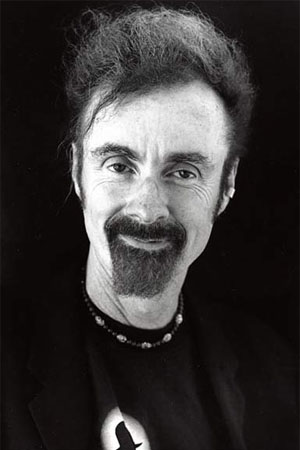
T.C. Boyle appeared on The Bat Segundo Show #273.

T.C. Boyle is most recently the author of The Women. To listen to our previous interviews with Mr. Boyle, check out The Bat Segundo Show #70 and The Bat Segundo Show #10.

segundo273

Condition of Mr. Segundo: Pondering new author taxonomies.

Author: T.C. Boyle

Subjects Discussed: How to conquer jet lag, Ellen Key’s The Woman Movement, the individual vs. the spirit of the time, feminism and Frank Lloyd Wright, notions of education, Miriam’s presence and hypercaffeinated prose, balancing the women in The Women, the ABAB narrative of the first section and Talk Talk, representing Wright through his women, novelizing a fictive novelist’s biography, Blake Bailey, the burdens of chronological order, parallels between Wright and Boyle, the question of what anybody really knows about history from hearsay, seeing the details through an ever-shifting prism, the novel as a suspect medium, Riven Rock, dashes, sentences, and parenthetical information, annotations and “the rest is commentary,” art standing above morality, balancing empathy and the satirical impulse, rejecting reader expectations, reputation and renown vs. not knowing, why cruelty is necessary, reevaluation, empathy and narcissism, and understanding an artist.

EXCERPT FROM SHOW:

boyleBoyle: I try to get it both ways. I try to involve you in something in a satiric way. And yet it should also move you. And of course, in this book, I had to do that because of the tragedy of Mamah, which will conclude the book. So you have to set the reader up for that throughout. And I think there is tragedy throughout the book. Tadashi’s life is incredibly tragic in many, many regards. So again, I’m playing one element against the other throughout. And there is commentary upon commentary upon commentary. And, for me, it opened up the structure and it made it fun. It made it invigorating. A lot of the footnotes exist to give you information that I would like you to know about Frank Lloyd Wright and his buildings and where he was at any given time. But a lot of them also, I just express surprise on the part of Tadashi. And I find the hilarious.


Correspondent: Well, the question is: Okay, the reader wants to know about the artist. And essentially you believe — your own particular view is — that the art should stand above any morality. This is interesting because we don’t know about the artists. And simultaneously, well, you do have many details about Taliesin, as well as the skies and the views and all that. But I’m curious if this almost runs counter to the impulse if you’re playing with the reader’s expectations. So that they will never know about the artist, even though this is, in fact, why they read your books. Whether that’s entirely fair to the reader.

Boyle: Well, don’t forget that when I am creating art, I don’t mean to be fair to the reader or unfair to the reader. Those questions lie right outside the parameters of what I’m doing. I’m dreaming something. I’m creating something for my own purposes. I deliberate to you. And I hope that you interact with it in some way. And obviously you do and other readers do. Sophisticated art, to my mind, doesn’t provide answers and doesn’t have an agenda other than art itself. So I think a book like this one, of all my books, is probably the one in which the reader will be most engaged to try and unravel the truth of what it is in its own right. And don’t forget. I’m not writing about an unknown figure here. Kinsey, as you know, was recognizable second only to the President in this country in his time. But by the time I wrote about him, everyone had completely forgotten who he is. No one knows who he is. And Kellogg too was lost to the mists of history. But again, Frank Lloyd Wright, there’s been a thousand books. There’s a cult. People are lined up in Chicago today, freezing, to get in and go on the tour. So this is someone who has been written about eternally and is very well-known. My interest is: How do I get a new angle on this?

Correspondent: So by him being more well known than Kinsey or Kellogg, you can then justify this notion of not knowing Frank Lloyd Wright. That’s what you’re saying. Of the reader not knowing.

Boyle: If this is your interpretation, I would say yes. But again, I think you do know him. You do see him from his point of view a few times. But I didn’t want to represent his point of view a great deal. Because then you know his motivation and you know what he’s thinking. I would rather have it — that’s why I called it The Women. I’d rather have him viewed from other perspectives so that you can make your own determination. And, yes, I think part of that determination is that he was incredibly narcissistic. Maybe one of the most narcissistic people who ever lived. And yet narcissism, as we talked about with regard to Peck Wilson in Talk Talk, can be very damaging to everybody around you. I like to hope and think that I am sympathetic to people whom I meet and with people who are close to me. And that far from damaging them, I might even be aiding them in some way. A narcissist like Frank Lloyd Wright though, or Kinsey or Kellogg, doesn’t view the world in that way. Everybody else is simply valuable, only as they fit into his regime. So I think that any reader, even the least sophisticated reader of this book, will have a portrait of Frank Lloyd Wright that may be more true than what you get from a biography.

(Photo credit: Christopher Felver)

BSS #273: T.C. Boyle III (Download MP3)

This text will be replaced

The Bat Segundo Show: Andrea Peyser

Andrea Peyser appeared on The Bat Segundo Show #272.

Andrea Peyser is most recently the author of Celebutards.

segundo272

[PROGRAM NOTE: At the 22 minute mark, while the conversation concerned itself with the dangers of generalization, a woman, who was sitting at a table located a good seventy-five feet away from them, gave Ms. Peyser and Our Young, Roving Correspondent a note. The note read: CAN YOU PLEASE TALK QUIETER? Now it should be observed that, while the conversation was animated, the two talkers did keep their volume level to a reasonable decibel level. Indeed, many folks sitting adjacently to these two appeared to be interested in the conversation. (This has been known to happen from time to time, since these conversations are recorded in public places. Indeed, there are a few amicable people working at one Midtown cafe who have urged Our Correspondent to come back because these conversations are apparently quite odd and intriguing to them. It also helps that we tip well.) It should also be noted that the woman with the note had congregated with a group of peers for a discussion that deployed such strange terms as “synergy,” “collaboration,” and “market forces,” and that this group talked at a level far exceeded all other conversations occurring in the cafe. We note all this for several reasons: (a) to explain to the listener yet another odd and unusual moment in the history of this program, (b) to point to the problematic lack of distinction between workplace and social gathering point in our present epoch, and (c) to demonstrate that strange forms of passive-aggressive behavior remain troublesomely alive and well.]

Condition of Mr. Segundo: Pursuing the unexpected qualities.

Author: Andrea Peyser

Subjects Discussed: Why celebrities cannot be ignored, “anti-American” sentiment, Sean Penn’s trips to other countries, whether or not Alec Baldwin is entitled to privacy, photographers and paparazzi, the limits of the media, whether hypocrisy is a valid description of celebrity, First Amendment rights, Martin Sheen’s 9/11 remarks, being invited to be honorary mayor, rudimentary viewpoints and free thinking, Nancy Pelosi’s importance, whether it’s possible for Peyser to agree with Al Sharpton, Munich and Black September, the problems of holding an artist’s statement on the same level as the art, Steven Spielberg’s remarks about Israel, the problems with generalizing about Mumia Abu-Jamal’s followers, being friends with Rosie O’Donnell and O’Donnell’s betrayal, on not taking the high road, celebrities of virtue, Bruce Springsteen, old Hollywood vs. the present publicity machine, on being vituperative in the New York Post column, quibbling with the infamous Heath Ledger column, “knowing” the celebrity from a snippet view, whether or not Peyser is happy, giving into the readership, and a few positive things that Peyser can say about the entertainment industry.

EXCERPT FROM SHOW:

peyserCorrespondent: You deem Alec Baldwin a celebutard partly because of the infamous voicemail to his daughter. But I’m wondering if it really is fair, given what you’ve just discussed in relation with Sean Penn and his political sentiments, to take something that was never intended for the public and put it up there with something that is actually in the public record. I mean, is it really fair to deem someone a celebutard for their private actions like this?
Peyser: Well, private actions. He left a voicemail. Any idiot knows that anything you say on a cell phone, anything you email and voicemail, it’s out there. He was in the middle of a custody battle. He was threatening his daughter. To come over to California and straighten you out. It got into the public eye and he got furious because of that too. He blamed others for his own actions. That’s also a common thread in celebutardism. When Barbra Streisand, for example, is caught being really, really stupid, she blames other people for her own stupidity. So in the case of Alec Baldwin, he did something really stupid — actually dangerous — and he blamed someone else.

Correspondent: But if it were not Alec Baldwin, someone could leave that voicemail and it may not have been disseminated out into the media like this. Just as, for example, you mention George Clooney and his anger and fury towards a photographer shooting a picture of him above the men’s stall. You’re saying to me that if a photographer came up to you while you were doing your business that you wouldn’t have any particular problem with that?

Peyser: No.

Correspondent: It’s out there to be disseminated?

Peyser: I wish George Clooney would make up his mind. One day, he’s fighting against the stalerkazzi, as he’s called them. As other celebrities have called them. People who stalked Princess Diana. Of course, the courts found that she was killed not because of the paparazzi, but because of her drunk driver. But anyway, he made a very big deal about that. People could be seeing it as censorship. Whatever. But then he turned around and he decided that I am going to back off. And that is censorship. And it’s okay. Say whatever you want about me. So I wish he’d make up his mind really.

Correspondent: Well, he is expressing understandable anger at a photographer shooting a picture of him above the stall. If someone did that to me, I would probably also be quite upset. I’m sure you would too.

Peyser: Yeah.

Correspondent: I’m wondering if it’s fair to hold him accountable for that particular understandable reaction and use this in the broader painting of who he is in relation to all of his other actions.

Peyser: Well, that was in Australia, first of all. He’s giving a picture of the media. The media. I love that word. I’m not shooting George Clooney naked. I really don’t care. But that was in Australia. He got the thing suppressed. He threatened a lawsuit. And I wish he’d now be quiet. And now he’s decided that the media has to be left alone. Which one is it? Are they killing Princess Diana? Or are they okay? Which one is it?

Correspondent: But do you believe that a celebrity is entitled to some level of privacy? Is it really fair to constantly — I mean, you’re living a life as a celebrity. You’re having all these photographers, reporters, paparazzi, you name it, invade your particular personal space. So understandably, your particular lines in interviews and the like are going to be subject to more scrutiny. And so this makes me wonder whether it’s actually fair to attack them.

Peyser: What I really love is how somebody — like, take Madonna, for example. Way back when, she was creating things that would attract media attention. She was desperate for media attention. And now that she’s a huge star, she’s the most controlling person who exists as far as interviews go. So why can they run to me and say, “Please, pay attention. Pay attention.” They do everything including taking their clothes off in public to get us to write about them. To take their pictures. And then when they reach a point of fame and fortune, it no longer exists. I don’t know. Actually, I would say that the media is dreadfully controlled by celebrities. I don’t think it’s as much of a free-for-all as you’re suggesting. I think there are armies of publicists out there who really control the image.

Correspondent: I certainly agree with you about that. You make many interesting points about Tom Cruise and Michael Moore certainly.

Peyser: Yes, that’s very…

Correspondent: I would never interview them because of these particular controls. But nonetheless, look at what happened with the Christian Bale outburst. This was remixed in a very fun way on YouTube. And suddenly things did get out. But the question is whether it’s entirely fair. I mean, I understand what you’re saying. Which is that the media — one needs it to advance in one’s career. But simultaneously, is there a particular point when the media should back off? Should they be probing and taking pictures of children and the like? And that sort of thing?

Peyser: Well, you know, personally, I have never done that. I don’t go after somebody’s children. Not without permission. But you know, I don’t know. Michael Jackson goes out in public with his children in veils. I would say that he’s attracting more attention to them then if he had just gone out in public with children with their faces showing. But I don’t personally condone using children. But I think that a lot of celebrities put them out there. Put them out there to attract attention.

Correspondent: Even if they’re doing their shopping, for example. And the children happen to be along. And then the paparazzi come. I mean, see, this is where we get into — I’m trying to just clarify where you’re coming from here.

Peyser: See, once again, this is a very small thing. I make the point. And I do this in the cases where the celebrity is obnoxious in the control. Of pointing out that at one point in their career, when they were very young, they would do anything for attention. Now I have never stalked anyone. Everything I get is from above-board sources. So I’m not speaking for myself. I’m talking about the hypocrites. The celebrities who use the media and then have no use for it once they’re famous and rich.

BSS #272: Andrea Peyser (Download MP3)

This text will be replaced

The Bat Segundo Show: Tony Stone

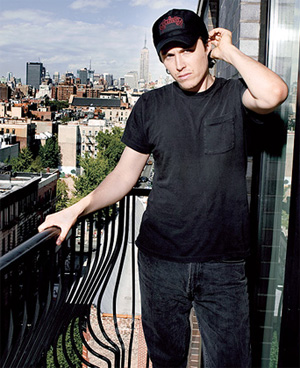
Tony Stone appeared on The Bat Segundo Show #271.

Tony Stone is the director, writer, producer, editor, and actor of Severed Ways, a film about Vikings that opens in limited release on March 13, 2009.

segundo271

Condition of Mr. Segundo: Unsure of whether he wants to be a Viking or not.

Guest: Tony Stone

Subjects Discussed: The many crew positions that Tony Stone worked, music clearance people who keep weapons under their beds, making a film with seven chapters, how a two week shoot went on for three years, not getting the visuals right the first time, motivations for handheld camera work, accepting art as it is, “Greedo shoots first,” contemporary slang transposed into Viking talk, A Knight’s Tale, how far filmmakers can go in “modernizing” historical settings, the ethics of killing chickens on screen, Ingmar Bergman’s Shame, helpful ways of agitating both vegetarians and meat eaters through cinema, filming a defecation scene, the appropriate constituency of shit for a beautiful shot, Charles Leland’s Algonquin Legends, abstaining from profiling the Abenaki religion, paganism, anarchy, and secular humanism.

EXCERPT FROM SHOW:

tstoneCorrespondent: “This fish is pretty killer.” Well, “killer,” as I understand it, is a recent modifier in the English language.

Stone: Yes, it is.

Correspondent: And I don’t think necessarily that the Vikings were using this or that the Nordic tongue had any answer to “killer.” So why the modernization of etymology here? Is this an inroad point along the lines of the Viking headbanger who likewise appears in this?

Stone: Yeah. It’s that. But it’s also that a lot of the times, you’d watch any period piece or historical film, whether it’s Romans or barbarians or whatever else, they’re speaking in semi-Shakespearean accents in their Old British. It doesn’t really make any sense. And everything’s very formal. There’s no reason why, a thousand years ago, they weren’t just as casual as us and they had their own vernacular. So this is using a piece of dialogue — like “This fish is killer” — is basically more of an accurate translation in my mind. Because you’re taking whatever their vernacular was and putting it into our vernacular. So you understand the tone and the vibe of what they’re actually saying. So I actually find there’s more accuracy in it. And we’ve just been so beaten down by the traditional Hollywood stupidity of how I’m dealing with history in films. So that sort of explains why I wanted it there. And of course, the film is trying to bridge the past and the present. And so it’s maing these characters have mannerisms that maybe the dude walking down the street has. Or whatever else. It’s trying to just not have it be this distant, far off, separate thing. It’s trying to make it more current and now. And it is with us.

Correspondent: But on the flip side, there is a certain point where it becomes ridiculous; i.e., A Knight’s Tale, for example. In which you have the Nike swoosh in the Middle Ages. Do you remember this film?

Stone: Yeah, I do. I do.

Correspondent: I mean, it was totally ridiculous. It was fun. But at the same time, one does not look to this for verisimilitude.

Stone: “The Boys Are Back In Town.” Yeah.

Correspondent: So the question is: how far can you go with this?

Stone: Yeah, that’s interesting. A Knight’s Tale. I forgot about that. It’s been a while. But yeah. They use modern music.

Correspondent: “We Will Rock You.” Yeah.

Stone: Then there’s that amazing part where they’re going back to London. And the Thin Lizzy song comes in. “The Boys Are Back In Town.” (laughs) It’s very incredible.

Correspondent: I mean, if we’re talking about Hollywood stupidity, I’m wondering how…

Stone: Yeah. Obviously, there is a level of absurdness to it. I’m not going to deny it. But I think the film is sort of rebellious in a way. It’s trying to set up a dialogue. I don’t know. But in a way, like I’m saying, it’s sort of modernizing the Viking. Making him a current character. Making him more similar to somebody maybe you know is the idea. I’m just getting away from that wall that’s usually put up in terms of dealing with historical material.

BSS #271: Tony Stone (Download MP3)

This text will be replaced