David Heatley appeared on The Bat Segundo Show #247. Heatley is most recently the author of My Brain is Hanging Upside Down.
Condition of Mr. Segundo: On the waiting list for a brain transplant.
Author: David Heatley
Subjects Discussed: Surreal dream comics, the Ramones, memory and associations, Francois Truffaut looking at an old school photo and remembering all the names of his fellow students over an entire day, the deficits of memory, training your brain with a journal, apologetic footnotes to family members, the ten year rule, protecting careers and trying to be considerate with memoir, pink bars covering penises, flinching from the pornographic narrative, “Family History” as a hip-hop montage, why four Ns are good for the UNNNNH, using an all-red palette for extreme emotions, David Rees, the muted color scheme of “Sex History,” the 48 panel setup, Dave Berg’s “The Lighter Side,” shifting from squiggly panel lines to precise lines, the feelings that a ruler conjures, being traumatized into preferring memoir, imagination at the expense of reality, documenting a life without a sense of style, shifting dreams into narrative, being the dutiful client to the therapist, the influence of therapy upon Heatley’s comics, larger intentions, cliche in personal comics, Heatley depicting himself sobbing, Heatley’s ideal reader, Aline Kominsky-Crumb and Julie Doucet as influences, Doucet’s dream comics and castration, digesting a narrative involving dog fucking, retouching through computers, revealing biographical truth, Heatley’s angry father, depicting personal use of racist language, shared common experience with the reader, and being too concerned with being unique.
EXCERPT FROM SHOW:
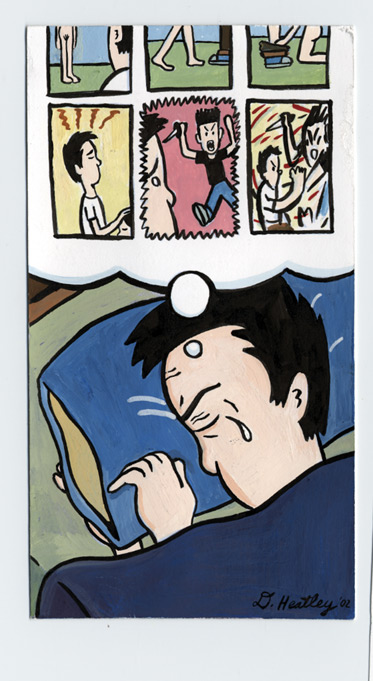 Correspondent: I wanted to also talk with you about your “Family History” strip. I mean, it’s probably the closest thing in this collection to a hip-hop montage. You have, of course, the many births with the common images. A mother — one of your ancestors — giving birth with the “UNNNNH!” And you have a marriage with the “I do.” The swathed baby who is being held up by the white hands. And the like. I wanted to ask why repetitive images, or a hip-hop montage, seemed the best way to approach your own particular past.
Heatley: It’s funny. I never would have — that phrase “hip-hop montage” is strange to me. But it also rings true. So, yeah, thanks for that. You know, the repetitive thing is about — once I had my own baby, it was a realization that every single person that’s been born in my family history was this baby at one point. And every mother of that baby grunted in the hospital, and pushed it out. So it’s sort of honoring all these faceless women who have been lost. And it’s also — I think that strip is about, if you take any one of those babies, you can make a book this long about them. And so I’m just one of the babies in that book. And here’s my entire story. And I do it with my daughter at the end. Instead of doing one panel for her life, I wind up doing four pages, focusing on that day. So you could do that for any of those babies too. You could focus in on what was happening that day when they were born.
Correspondent: How did you settle upon the four Ns for the “UNNNNH?”
Heatley: (laughs)
Correspondent: I’m really curious. I mean, did you try out three? Did you try out five?
Heatley: I did, yeah.
Correspondent: Did that just look right? Four Ns really cut that particular verisimilitude?
Heatley: (laughs) Yeah, it did. You know, it’s like poetry. It felt right.
Correspondent: (laughs)
Heatley: That’s a great question though. Four Ns. I didn’t even know they were consistent.
Correspondent: Because it’s four Ns in almost every….I mean, we could dig it out right here. It’s four Ns almost every single time.
BSS #247: David Heatley (Download MP3)
Listen: Play in new window | Download
 Correspondent: I wanted to ask you about the subject of payola, which comes up multiple times in this book. Eliot Spitzer is, of course, unfortunately now out of the game. But he did do some good things, such as investigating the relationship between the promoters and the radio conglomerates. One of the most condemning documents revealing Clear Channel’s “pay for play” policy was when an email from Sony’s Epic label basically asked, “What do I have to do to get Audioslave on WKSS this week? Whatever you can dream up, I can make it happen.” Now there was extraordinary payola in all these instances. Sometimes as much as $400,000. But if you are a promoter, you are always going to have to deal with payola on some level. Whether it’s a fruit basket. Whether it’s a free CD. I mean, what is the maximum level of what we might call payola? Inarguably, I bought you this coffee that you’re enjoying right now. So are you perhaps — is this payola? I don’t know.
 Correspondent: Going back to the idea of the general reader, or the common reader — whatever we want to call the audience here — the philosophical proposition involving the fly, the bat, and the worm expressing basic cognitive abilities, and how cognitive abilities come together so that humans are a higher form of animal than other animals, this was a very clear way of expressing this particular concept of individual senses. And I’m wondering if this was something that you concocted. Or that you took from Kant. Because I actually tried to find a philosophical precedent for this as well.
 Correspondent: You have this train running behind the Sasaki home. And this suggested to me, along with the fact that you cut this film frequently crossing the axis in the editing — crossing the 180 line — it almost suggests an Ozu parody. Or the kind of movie that Ozu would have made if he were to live in our particular times. And I wanted to ask you how this visual style originated, as well as the subway line.
 Correspondent: It’s safe to say that you are an idea man. So I must ask you: to what degree do you worry about an idea? Does your mind brim with more ideas — even correct ideas — than you can possibly use? Are you thinking of ideas right now? Is there a slight sense of panic with any idea? What is your idea of ideas?