The Death of the Heart (Modern Library #84)

(This is the seventeenth entry in the The Modern Library Reading Challenge, an ambitious project to read the entire Modern Library from #100 to #1. Previous entry: Lord Jim)

“I won’t ruin it for you,” emailed my fellow Modern Library reader Steve, “but so far, that’s the 2nd worst book I’ve read for this project.” And while I was corralling my thoughts and feelings after finishing the latest tome for a project which I now realize (nearly one year after the gauntlet cleaved my happy little picnic table) will take me five to six years, I noticed that Devon S., another trusted Modern Library adventurer, served up only a soupçon more hope: “I don’t know how to judge my indifference to this book. Sometimes books are like calf leather gloves in August: sumptuous wonders of of craftsmanship and texture that we’d appreciate if only we weren’t too tired, too harried, too dull, too careless, too immature, too hot, at that moment.” Maybe so. But when the Brooklyn nights outside are 13 degrees and you’re still wondering why two stuffy high society types (one reappears very sparingly throughout the rest of the book) have chosen the “bronze cold of January” with its shivering swans, of all places, to dish dirt during the oddly loquacious opening of Elizabeth Bowen’s The Death of the Heart, calf leather gloves in August feel as distant as last year’s milk. What the good Lydia Kiesling will have to say about Bowen is anyone’s guess.

Death is a novel quite at odds with a reader’s expectations, which is very much to its credit. Here is a book so blithe about its splenetic revelations that a cigarette lighter illuminates a telltale betrayal in the dark of a movie theater, the moment as casual as a chicken’s throat getting sliced on an abattoir assembly line. Yet even with the flashy reveal of a 20th century habit’s fire, Bowen is fixated on the “taut blond silk” of a character’s calf and fingers keeping up “a kneading movement.” If you’re thinking Bowen’s characters come off as positional objects more clay than flesh, then you’re catching on quick. At times, Death reads as if Bowen blossomed her bulb when describing a dining room’s “sideboards like catafalques” or characters who sit “with pencil poised, preparing to make disdainful marks” rather than with internal emotion. Yet even with Death‘s weird fixations on crudely general and somewhat ridiculous maxims (“There are moments when it becomes frightening to realize that you are not, in fact, alone in the world — or at least, alone in the world with one other person”) and carefree racism (“Matchett, who was as strong as a nigger”), I’d be hard-pressed to deny Bowen’s voice. In chronicling the numerous cruelties heaped upon the sixteen-year-old orphan Portia by servants and gentry alike, Bowen commits herself to an unremitting ugliness in a way rarely seen these days outside of a private party hosted by Roger Ailes.

Last year, The Rumpus‘s Charlotte Freeman described how she admired the way in which Bowen refused to save any of her characters. She asked, “Could one publish such a book now? A book in which no one is healed, in which everyone is, in fact, injured by contact with another?” Perhaps the real question to ask is this: Can a sanguine type of any stripe read such a book now? Joanthan Yardley suggested, in his fulsome praise for Death, that “[a] certain measure of experience, of exposure to life’s cruelties and compromises, is necessary for a full grasp of it.” Spoken like an unadventurous pessimist. Yet I didn’t detest the book like Steve, nor did I feel Devon’s indifference. I think there’s some credence to the idea that time and reference was Bowen’s real game with Death. Maybe Death, like many interesting books, is a Rorschach test. And if that is the case, the place to start surely is the reader’s temperament.

I’m not the type who flits through life without kenning that humans can be cruel (and I have had more than my share of this), but my approach is to be cheerful, protectively acerbic if need be. I’d rather believe that everyone — even the scabrous souls who make existence miserable, often without knowing it — has the power to be kind and decent. My earnestness may seem out of place in New York, but this is a city with a population who performs many quiet favors to strangers. And I’ve lived close to four decades with the good apples far outshining those rotten to the core. As Tracy says at the end of Manhattan, “Not everybody gets corrupted. You have to have a little faith in people.” Sensible advice. My disappointment rumbles when people choose to be mean and avaricious and subpar, especially when they do so without any corresponding set of virtues or they are driven by callow opportunism or stomp on other people on the way up or deliberately set out to destroy something dear to a decent person who isn’t doing any harm. Which is not to suggest that I haven’t sinned or that my own sense of what’s right may be another person’s wrong. (And any opportunistic pixie who props herself up as “fair and empathetic” without copping to the possibility that she may be more than a bit hypocritical in blind spots is not to be trusted. Idealogues come in several forms.) I’m not against healthy skepticism or getting revenge (although it’s better to stick with good deeds, when possible), but the idea of swallowing the bitter pill before seeking any delight, or assuming that people are driven first and foremost by malice, strikes me as a needlessly melancholy way to live.

And yet, on the page and from Bowen’s pen, these selfsame qualities are strangely alluring! So if you have a particular type of titivating heart, you may be confused by Elizabeth Bowen. I may protest Bowen’s worldview (and, after listening to this sour lecture broadcast in 1956*, I don’t think I’d want to know her), but I’m fascinated by how she could think this way. Sixteen-year-old Portia has no parents. The only family members she has to turn to are Thomas Quayne, her half-brother some two decades older, and his wife Anna, who is clinging to lingering youth in crueler, pre-Botox days. (She’s so inveterate that she finds Portia’s diary and reads it. One of Death‘s more brutal subtleties is that nearly all of Portia’s private thoughts are read by other characters. Is this Bowen’s way of scolding the reader?) Thomas and Anna send Portia away to a small town — allegedly “by the sea,” but of course not at all — so that they can have their vacation. Even if one accounts for the fact that Thomas works in advertising and has this tendency to stare at nothing “with a concentration of boredom and lassitude,” one ponders why wanton neglect would be the natural state. Yet as Bowen pushes Portia into a bigger mess — with various letters and diary entries spelling further hints of Portia’s despair; no accident that I thought of Jack Womack’s excellent and needlessly neglected novel, Random Acts of Senseless Violence, while reading these parts (Womack was kind enough to respond to my connective enthusiasm on Twitter) — it’s almost as if Bowen’s pushing the limits of how vicious she can be (which is, as it turns out, sometimes more sadistic than Evelyn Waugh). I haven’t even mentioned the disgracefully rakish 23-year-old Eddie, who not only leads Portia into sham chivalric romance, but doesn’t even know how to smooth things over, much less apologize, when he bungles things up. One of the novel’s high points is Eddie hitting the resort town where Portia is staying and causing a cringe comedy disaster that I cannot in good conscience spoil.

There’s some truth to the notion that Elizabeth Bowen may very well be the missing link between Virginia Woolf’s stream-of-consciousness and Iris Murdoch’s masterful fusing of behavioral study and philosophy. Yet as I’ve intimated above, Bowen can be curiously dictatorial and objectifying with her interior monologues:

She was disturbed, and at the same time exhilarated, like a young tree tugged all ways in a vortex of wind. The force of Eddie’s behaviour whirled her free in a hundred puzzling humiliations, of her hundred failures to take the ordinary cue. She could meet the demands he made with the natural genius of the friend and lover. The impetus under which he seemed to move made life fall, round him and her, into a new poetic order at once. Any kind of policy in the region of feeling would have been fatal in any lover of his — you had to yield to the wind. Portia’s unpreparedness, her lack of policy — which had made Windsor Terrace, for her, the court of an incomprehensible law — with Eddie stood her in good stead. She had no point to stick to, nothing to unlearn. She had been born docile. The momentarily anxious glances she cast him had only zeal behind them, no crucial personality.

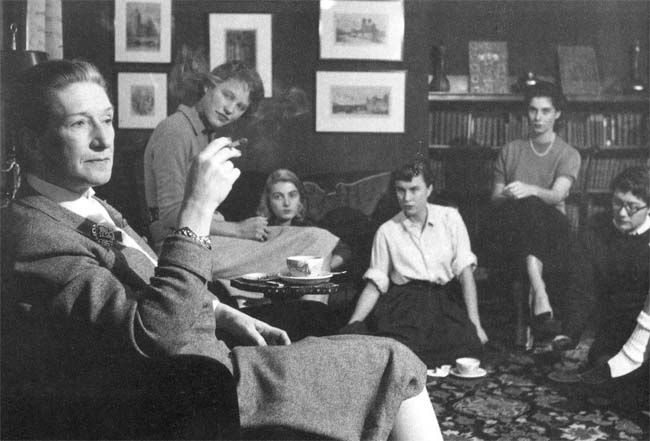
A “young tree tugged all ways in a vortex of wind” sounds like an engineer maneuvering object-oriented data into a massively multiplayer video game universe. And it’s interesting how Bowen shifts from a simile into an entirely different metaphor (“whirled her free in a hundred puzzling humiliations”) before riding with geographic imagery (“the region of feeling,” “No point to stick to”) and concluding this section with highly general and irreversible conditions (“nothing to unlearn,” “born docile,” “only zeal behind them,” “no crucial personality”). While this language certainly mimics a teenage girl’s confused feelings very well, this deliberately incoherent poetic effect (the “new poetic order,” if you will) pushed me away from Portia as I wanted to relate to her. I could admire the language from an external vantage point, but I kept wondering what might have happened if Bowen had dared to give us more of Portia’s heart. Was I meant to read this book much as the young students in the photo above gaze at Bowen? Let me finish my Gauloise, my young pretties, or I shall send you to Samoa to be cooked in a white wine sauce by the cannibals! Fair for the reader or not, nevertheless, I was engaged enough with this novel to want to read more Bowen (still, given the choice, I would rather read more Iris Murdoch). I don’t think I would call The Death of the Heart a masterpiece, but it was good to find a book with a new hook to take me both outside and inside my zone. I never thought the Modern Library would have me affirming certain pockets of sanguinity.

* — Despite Bowen’s grating voice, which is so off-putting that I was compelled to open a window and happily stick my head into the frigid winter air about five minutes in before returning to the last six minutes, the lecture is still quite interesting in what it reveals about Bowen’s methods. She refers to self-conscious expression offered in lieu of description as “character analysis” and has this to say: “Two things may be remarked about the stream of consciousness as a showing of character. It does take time and it deals almost always with prosaic experience. Scenes are reacted to in a highly individual way. I don’t know whether we should ever have, for instance, a stream of consciousness novel about somebody scaling Everest. Because the scaling of Everest is quite exciting enough in itself. In the ordinary stream of consciousness, the excitement, the sense of crisis, resides in the personality. And all the other characters in the novel are likely to be very slightly out of focus.” These sentiments make me want to reach for John D’Agata, Nicholson Baker, Daniel Clowes, or Yannick Murphy and howl to the heavens. Why wouldn’t a mountain climber’s interior monologue be as exciting as the action? And yet I can’t help but marvel over Bowen championing the stylistic dialogue of Henry Green and Ivy Compton-Burnett, whereby there is often no distinction between characters, as a quality which might be altering the form of the novel itself!

Next Up: V.S. Naipaul’s A Bend in the River!

The Bat Segundo Show: Thomas Frank

Thomas Frank appeared on The Bat Segundo Show #428. He is most recently the author of Pity the Billionaire.

Condition of Mr. Segundo: Wondering why Grover Norquist keeps leaving voicemails about tax pledges.

Author: Thomas Frank

Subjects Discussed: House Majority Leader Eric Cantor’s notion of “compromise,” the Republican failure to acknowledge Reagan’s complete history, Reagan’s Continental Illinois bailout, efforts to “erase” liberalism from Washington, Barack Obama’s failings, Congressional disapproval by the American people (as reflected by recent polls), how George W. Bush became a toxic Republican figure, the Tea Party movement, the Great Recession, how the Right co-opted populism after 2008, the 2010 extension of the Bush tax cuts and Bernie Sanders’s filibuster, Obama signing the NDAA “with serious reservations,” the Democratic Party less about the working man and more about expertise and technocrats, Obama’s TARP bailouts vs. Roosevelt’s Reconstruction Finance Corporation bailouts, government agencies that become instruments of Wall Street, “purified” capitalism, firing bank managers, conservatives mimicking progressive ideologies of the past and protest movements of the 1930s, co-opting outrage, Orson Welles’s influence on Glenn Beck, The War of the Worlds, being subscribed to Beck’s email newsletter, Jack Abramoff, Grover Norquist, the Republican base being united over the past few decades by “quasi-military victory” and lack of civility, Howard Phillips and “organized discontent,” why the Democrats are allergic to discontent and anger, Roosevelt’s tendency to stump and explain legislation vs. Obama’s failure to do so, the Democratic tendency to use experts as a selling point, Jon Stewart and the New Political Privilege, the Rally to Restore Sanity, Occupy Wall Street, blue-collar invisibility in DC, living in a neighborhood in which 50% of the population have PhDs, NASCAR, idiosyncratic hangover cures, diffidence and resistance against righteous indignation in the last few years, the hard times swindle, Scott Walker and attacks on the Wisconsin labor movement, attempts to investigate why liberalism can’t stick in recent years given The Wrecking Crew‘s suggestion that people inherently expect a liberal state, the myth of small business job creation (specific data breakdown on new jobs creation from 1992-2008 from Scott Shane discussed by Correspondent and Frank), George Lucas calling himself an “independent filmmaker,” C. Wright Mills’s White Collar, small business serving as a propaganda front for big business, America’s reticence in discussing how we are all corporate slaves in some sense, Tea Party memorabilia, Glenn Beck’s CAPITALISM painting, Rep. Nan Hayworth’s dodging questions about Verizon with empty utopian bluster, whether it’s possible to take back the term “small business,” the Black Panther Party, ways to organize political movements, whether it’s possible to build a dedicated base to combat a corrupt two-party system, legal blockades to third party movements, protesting out of resentment and self-pity, self-pity and the resurgent Right, whether the Tea Party is protesting with a shared sense of humiliation, populist politics as a gateway drug, searching for good things to say about the Tea Party, liberalism and populist movements, Atlas Shrugged, Walter Issacson’s Steve Jobs biography, Jobs being selfish with his money, why selfishness is a uniquely American draw, retreating into laissez-faire purity, Ayn Rand’s prose style, capital strikes as fantasy, leftist versions of Atlas Shrugged, John Dos Passos, Steinbeck, Frank’s collection of proletarian fiction, Upton Sinclair, the cold sex and descriptions of steel and machinery in Atlas Shrugged, the connections between recent political movements and mythology, German sociologists from the 1930s, the social construction of reality, Karl Mannheim’s Ideology and Utopia, how the Left might find political possibilities in passion, pragmatism, and anger, the neutered Left falling prey to forms of mythology that are just as nefarious as present myths on the Right, organized labor, Steven Greenhouse’s The Big Squeeze, how politics tends to inspire perverse behavior, and train wrecks.

EXCERPT FROM SHOW:

Correspondent: We’re talking only a few nights after a really fascinating 60 Minutes interview with [House Majority Leader] Eric Cantor. I’m not sure if you saw this.

Frank: I didn’t see it.

Correspondent: Well, it was interesting. Because it reminded me very much of your book. I’m about to talk with you and this happens. So [Cantor] appears. And it’s this fairly amicable, typical segment. And then Lesley Stahl basically says, “Will you compromise in any way?” And he dodged the issue of being able to compromise on anything. And then Lesley, of course, brings up the Reagan tax increase.

Frank: The 1986?*

Correspondent: Yes. And he denies that Reagan ever did that. And then, to add an additional monkey wrench into this, there’s an off-camera press secretary who says that’s a lie. And then, of course, they play the clip.

Frank: What?

Correspondent: Yes! And they play a clip of Reagan using “compromise” as a verb** when he’s talking about this tax increase. So this seems a very appropriate beginning to some of the issues in your book.

Frank: That’s amazing. That’s exactly what I’m writing about. These people who are essentially blinded by ideology. But when I say it that way, it sounds like some kind of slang term. Or something like that. But I mean it in a very serious way. That these are people who have bought an entire utopian way of seeing the world and are able to close their eyes to things that are obvious. And what you just said about Reagan, that would be a juicy detail that I would have loved to have had for the book. But there are so many other examples — essentially, they deny. Look, I went to a graduate school and studied history. One of the baseline things that historians agree on is that for the last thirty or forty years, we’ve been in a conservative era. That people around the world — governments, politicians, elites around the world — have discovered the power of markets and have moved in this direction towards markets that are deregulated, have privatized, have done all these things. This is common knowledge. A conservative movement today — you talk to a guy like Eric Cantor? No, that’s never happened. We’re still living under socialism. And we have been since Woodrow Wilson. Or something like this.

Correspondent: But why is it that Cantor and the Freshman Republicans want to just keep their blinders on about history? About their man Reagan? Is there a specific…

Frank: They have to have a hero and they’ve thrown George W. Bush under the bus. Because of the bailouts. But at the end of the day, look, it’s opportunism. Reagan is very popular. Bush is not popular. Nixon is not popular. So they have to have a hero. And it has to be someone who is beloved. Ipso facto, it has to be Reagan. But they have to deny all sorts of thing about Reagan. For example, Reagan bailed out Continential Illinois Bank — at the time, the biggest bank failure in U.S. history. Reagan, as you’ve just mentioned, raised taxes. Reagan sold weapons to Iran. You remember that one? Iran-Contra. I mean, there are all sorts of other crazy things that Reagan did that don’t look so good. I mean, Reagan really liked Franklin Roosevelt. Reagan was a more complicated person. But none of that is admissible. If you’re going to follow this ideology and this utopian vision that they have of what I call “market populism” — if you’re going to follow that all the way — and, of course, part of the idea of this is that you’re going to have to follow it all the way — and we’ll get into that a minute — you basically have to whitewash history. I mean, it’s almost Soviet, what you’re describing.

Correspondent: The phrase you use in The Wrecking Crew. “The Washington conservatives aim to make liberalism not by debating, but by erasing it.” And I’m wondering if there’s any past political precedent that would suggest they could entirely efface liberalism from our political machinations.

Frank: Or from our memory.

Correspondent: Or from our memory. It’s very strange.

Frank: Well, that was the big subject a few years ago — when The Wrecking Crew was published. One of the topics of conversation was these grand schemes that the Republicans kept coming up with. The Republicans in Washington here, I’m talking about. I’m not talking about your rank-and-file Republicans. But the Republicans in Washington kept coming up with the grand schemes for some kind of political checkmate. Some kind of move that would end the debate forever and yield victory for their side forever. And they include — privatizing social security was a big one. Another one — the one that I focused on in The Wrecking Crew — is deficits. And that, I’m sorry to say, I turned out to be right about the one. By deliberately running up the deficits in the Bush years, it doesn’t give them permanent victory, but it does stay the hand of whoever, whatever liberal follows — in this case, Barack Obama — and it has worked exactly as they planned it to. Although Obama pushed it a little farther than they thought possible with the stimulus package. But now look at what’s happened with the debt ceiling catastrophe and all that sort of thing. So that turned out to be effective. They were able to limit the debate by some deeds that they pulled while they were still in power. And some of the other things that they are trying or will try or I predict they’ll try, they are things about tricking the franchise. Somehow keeping or dissuading people from voting. That sort of thing. But there’s always this search for the doomsday device. Yes, and it still goes on.

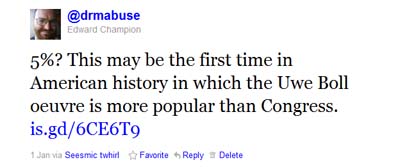
Correspondent: But this level of no quarter, no compromise. I mean, isn’t there some kind of “uncanny valley” or Hubbert’s Peak to what they can do before it’s just not acceptable? I mean, there was that latest Rasmussen poll where Congress got a 5% approval rating. That was a few days ago.

Frank: 5%?

Correspondent: 5%.

Frank: Well, that makes a difference in the Presidential Election. But that really won’t make a whole lot of difference, strangely enough, in the Congressional Election. Because people might hate Congress, but they like their own Congressman. That’s the classic, the old saw. But, look, what you’re getting at is a really interesting phenomenon of these people, instead of being pulled to the center — as all of your political science theorizing and all of your DC punditry insists that the gravity of politics pulls people to the center. Political scientists have believed this for fifty years. And this is a pet peeve of mine. Because I think it’s rubbish, okay, for reasons that we’ll go into. But it’s been just dramatically disproven in the last couple of years. Think back to 2008. You had the Republican Party in ruins. You had all these scandals in the Bush Administration. All this corruption. And then it ends with this catastrophic meltdown in the market. The housing bubble bursts. The banks start to go under, one after another. Then Wall Street starts shedding 700 points per day. It’s this crazy disaster. The financial crisis. And then they do the bailouts, forever sealing Bush’s fate not only with the general public but with the Right. One of the most unpopular Presidents of all time. The Republican Party is in ruins in 2008. And you have pundit after pundit weighing in and saying, “These people are done for. Bush led them too far to the right.” The era of George W. Bush was where they went too far to the right, and Tom DeLay and all those guys, they went too far to the right, and now they have to make their way back to the center or they will risk being irrelevant forever more. Or for the next twenty years or something like that. And look what happened. They did the opposite. Guys like Eric Cantor, they did not embrace the moderates in their party. They excommunicated them. They purged them. I mean, these guys, they behave like Communists in a lot of ways. This is one of those things. They purged these guys. They throw people out. And they don’t want them in the Party anymore. And they moved deliberately to the right. Way to the right. That’s what the Tea Party movement is all about. And I’ll be damned if it didn’t work. They just scored their biggest victory in eighty years. Or seventy what — a whole lot of years in the 2010 off-term elections. They had a huge victory. So obviously that strategy has vindicated for them. It worked! It paid off! And there’s no reason why they would go back on something that just succeeded. It was a success.

Correspondent: But in the chapter in this book, “The Silence of the Technocrats,” you describe this collapse of Democratic populism from 2008. You point to the failings of the Democrats to challenge the Tea Party, people at the town hall meetings. You point also to the manner in which they formed corporate alliances with healthcare and also the bailouts that we were just talking about. The failure of the stimulus package. The list goes on. Only a few days ago, Obama signed into law the NDAA, which essentially gives the government the right to detain any citizen, and he had this whole “with serious reservations” claause that he did while he signed it. So the question I have is: if Democrats are offering the defense that Obama is being forced into this predicament…

Frank: They’re listening to the pundits. The Republicans did the opposite of what the pundits suggested. The Democrats are listening to them. There’s this DC elite that the Democrats are listening to. This is what Obama’s Presidency is all about — it’s looking for a grand compromise. But the Republicans, they’re not interested. Make him come to us, they say. He can come to us. He can compromise in our direction. Look, at the end of the day, this is something you can figure out with game theory. It’s really simple. If they’re the side that stands pat and makes the other guy come to them, they win. But that’s neither her nor there. I think the Democrats really misplayed the hand they were dealt with. I mean, misplayed it in a colossal manner. In a catastrophic manner. And Obama may well get re-elected in 2012 at this point. Who knows at this point?

Correspondent: Well, with the crop of candidates, it’s a big clown car.

Frank: Elected for what purpose? After what’s happened, why bother? They didn’t understand the needs of the moment. The cultural and political needs of the moment, which were populist. They didn’t understand that all that political science theorizing that I was telling you about, where the center is where the gravity always pulls you — you have to move to the center. You have to make compromises with the other side. That all of that old way of thinking about everything was discredited. The financial crisis. The Great Recession. The huge business slump. We were going into Great Depression II, it looked like back then. And what was called for was 1930s style politics. The conservatives offered it. The Republicans offered it. Or I should say the Tea Party offered it and has since grafted it on the Republican Party. And the Democrats behaved as if everything was just as it was in the 1990s. That if they acted like Bill Clinton, everything would be fine. They did not understand that the old scheme was completely out the window.

Correspondent: Why though would they continue to act as if they wished to rise above partisanship? This notion…

Frank: That’s who they are.

Correspondent: I mean, even after the whole debt ceiling showdown. That whole business.

Frank: Can you believe that? Don’t you think that that would be the big convincer?

Correspondent: But why do you think this is? I mean, why didn’t Obama just go to the people and say, “Look, this is going to have serious actions even if I approve it or veto it. I am actually going to you, the American people, and I am explaining to you that the Republicans want to throw the Bill of Rights into a flaming trash can…

Frank: (laughs)

Correspondent: “So I can’t in good conscience sign this.” Why do you think he can’t do that?

Frank: Well, the point where this really got out of hand — I mean, there were several big turning points in the Obama Presidency, but the one that really just blew my mind because it was such a misplayed moment. And we think Obama’s a very intelligent man. And he is. I met up. He’s a super-duper smart guy. But some of the political moves have just been total rookie mistakes. The one that got me was when he still had a Democratic Congress. It was a lame duck session. This would have been at the end of 2010. And he renewed the Bush tax cuts. Why not make the Republicans come to him and offer something in exchange for that? No. He just gave it to them. It’s like the biggest prize on the table. And he just handed it over.

Correspondent: Leaving Bernie Sanders to do that long filibuster. But that ended up being all for nought. Even though it was an impressive theatrical display. Everybody was behind Bernie Sanders. Finally somebody standing up.

Frank: Oh sure. But it wasn’t up to Bernie Sanders. It was up to Barack Obama. And he just gave it away — the one ace he had in the hole, he just gave it away. And so maybe he did it as a good faith gesture to the Republicans. And look what it got him? This terrible smackdown with the debt ceiling crisis.

Correspondent: An embarrassment.

Frank: The kind of naivete that that takes. To not understand that that’s how these guys play the game. There’s plenty of journalists that wrote about the DeLay Congress and the Gingrich Congress. We know how these guys play. Or George W. Bush. Look at the career of Karl Rove. These guys play to win. They don’t mess around. And the innocence of Washington that it took to make a blunder — let’s call it what it is. A blunder like that is shocking to me.

Correspondent: If he’s so smart, why does he constantly come to them? I mean, why give the game away like that?

Frank: Because that’s who they are. That’s the Democratic Party nowadays.

Correspondent: It’s been like that for a while though, you know?

Frank: It has. And, hey, let’s be fair. Obama isn’t the — all of their last six Presidential candidates have been cut from the same cloth. I think Obama is, in lots of ways, smarter and a better speaker, and more talented than a lot of their previous leaders. But this is who the Democratic Party has become. Many years ago, they were the party of the working man. Everyone knew that. They were also a party that had an ideology. An ideology that arose from organized labor, that arose from the New Deal. And that has been lost. They are the party of technocrats now. Look, everything I’m telling you right now is right on the surface down at Washington DC. The big Democratic Party thinkers talk about this all the time. We are the party of the professional class. And if we aren’t that yet, that’s who we’re going to be when we’re done. We’re going to get there eventually.

* — This is a very pedantic stickler point, but one that nonetheless demands clarity. Reagan raised taxes twelve times during his administration. Frank is referring to the Tax Reform Act of 1986. But, to be clear, Stahl was specifically referring to Reagan’s 1982 tax increase in the 60 Minutes segment.

** — Another highly pedantic (and perhaps needless) stickler point. Reagan used “compromise” as a noun, not as a verb: “Make no mistake about it, this whole package is a compromise.” And while Reagan’s specific words convey the same point (indeed more definitively with a noun), it is important to remain committed to painstaking accuracy — especially when the corresponding approach being discussed over the hour involves how political parties cleave to mythology.

The Bat Segundo Show #428: Thomas Frank (Download MP3)

This text will be replaced

The Early Fiction of Sarah Hall

(In an effort to ensure that all of Sarah Hall’s work is covered in some form on these pages, I am collecting all material I have written on Ms. Hall. What follows is an essay, which covered all of Hall’s fiction up to Daughters of the North and appeared elsewhere in slightly different form in 2008. Hall’s fourth novel, How to Paint a Dead Man, was the subject of a roundtable discussion that was published on these pages during the week of September 7, 2009: Part One, Part Two, Part Three, Part Four, and Part Five. An essay on Sarah Hall’s fifth book, The Beautiful Indifference — infuriatingly without an American publication date, but available in the United Kingdom and Canada and well worth your time — is forthcoming. You can also listen to my one hour interview with Hall, conducted in 2008.)

Sarah Hall’s fiction ekes out a territory somewhere between Scarlett Thomas’s “novels of ideas” and David Mitchell’s narrative know-how. In her first two novels, Hall examined the dramatic effect that the construction of a reservoir has upon a small town (Haweswater) and chronicled a tattoo artist’s journey from a gritty English seaside resort to Coney Island, its fraternal twin across the Atlantic (The Electric Michelangelo). Her third, Daughters of the North, adopts aspects of dystopian fiction reminiscent of Margaret Atwood’s The Handmaid’s Tale and Anthony Burgess’s The Wanting Seed, presenting a world in which women’s reproduction has been regulated, the economy has collapsed, and environmental resources have been whittled away. An isolated army of feminist revolutionaries represents slim hope for human progress: Daughters‘ futuristic time frame, its more concise prose, and its first-person perspective would appear, at a cursory glance, to be at odds with the 1930s settings, lengthy descriptive passages, and omniscient narration contained within Hall’s first two novels. But the novel represents both an extension and an evolution of what might be best perceived as a narrative inquiry into the relationship between humanity and environment.

This close connection is intimated by Hall’s tender attention to terrain. In Haweswater, the earth’s manipulation is an essential part of the story, with a river “redirected out of the lake — flowing within a man-made channel away from the heart of the building arena.” One of the women in Daughters has a “blue tattoo above her ear ran all the way around her skull, down the median of her neck, disappearing at the hem of her jersey.” These passages share a unique directional quality that provides a moody map for the reader, reflecting the deeply tactile manner in which Hall’s characters relate to their world.

But Hall’s characters must also contend with a constructed world of their own making, a topographical tapestry of makeshift structures and occupied edifices, closing in. Michelangelo‘s hero is mostly confined to a hotel and tattoo tents. In Daughters, an initiation ceremony involves throwing a new revolutionary recruit into a dog box for a period of time. And the harsh price to pay for this self-actuated world is not unlike that embodied by the child in Ursula K. Le Guin’s philosophical essay “The Ones Who Walk Away from Omelas,” who is forced to live in a small, squalid room so that others might enjoy a constructed utopia.

The body itself is frequently as scarred as Hall’s environments. Haweswater‘s main character, the farmer turned anti-reservoir activist Janet Lightburn, has a star indentation on her forehead, the result of a bullock’s kick and “a reminder that her life has included the sporadic brutality of her family’s trade.” Likewise, in Daughters, one of the female soldiers has a dent in her forehead, described as “the mark of a perpetual frown, an expression that seemed to be worn perhaps even when she did not mean for it to be present.” In both cases, the mark serves not so much as a stigma but as a proud physical badge of hard work. It’s as if these women are the new Zeuses of the landscape, with untold deities springing from their foreheads to follow in their footsteps.

Michelangelo‘s chief protagonist, Cy Parks, grows up in Morecambe, working with his mother in a hotel for consumptives. He is horrified by the bloody basins he must collect in the halls, but this leads him to be relatively inured when he serves as an apprentice to Frank Riley, a bawdy tattoo artist who teaches him his artistic skills. Interestingly enough, Cy’s mother shares the steely fortitude of Haweswater‘s Ella, who is Janet’s mother. Ella likewise contends with the visceral horrors of nurturing the wounded when serving as a World War I nurse but has no problem inhabiting this “brutal landscape of the mind.” Indeed, Hall’s female characters are often stronger than their male counterparts. During Cy’s encounter with a dissatisfied customer, Grace stops this contentious banter with the flash of a knife, telling Cy shortly afterward, “You are a kind man. I think if you ever truly had to sting someone, you wouldn’t survive it.”

Hall’s environments sometimes take on the metaphorical characteristics of a body. In Michelangelo, Coney Island is a “fat, expensively dressed in-law with a wicket smile and the tendency, once caught up in the mood, to take things too far.” That both Coney Island and Morecambe are “made up of a multitude of interdependent entertainment cells designed to remove a person from the dimension of ordinary life” suggests that these vacation spots are not so much living and breathing organisms, but complex environments presenting alternative ways of living to the commonwealth. And if this desire for an alternative existence is so seductive, it might also explain what causes Daughters‘ protagonist, Sister, to venture northward to Carhullan, a farming community run by an idealist with the telling “Tricky Dick” name of Jackie Nixon.

But as these environments become anthropomorphized, the faces of Hall’s characters, in turn, reflect the fierce qualities of landscape. In considering a career-ending assault upon Riley, Michelangelo‘s Cy notices “how a man’s face in barbarity will show traces of compassion even though it is already determined in its fulfillment of cruelty.” When Cy first meets Grace, the muse he falls in love with, Grace’s face is described as “pale and vividly sloped.” Pages later, Hall observes that “the face under the make-up seemed not be hers.” As Grace watches Cy draft a sea of illustrated eyes upon her body, her face one rare part of the canvas left bare, Hall describes the “dark red hair pinned back off her recessive face.” The phrase invokes “the old distinguished grace” of Yeats’s “Upon a Dying Lady”, who reclines “her lovely piteous head amid dull red hair….rouge on the pallor of her face.”

Equally important in this interdependent relationship is the way that Hall, in her first two novels, separated her descriptive prose from the chatty islets of her dialogue, as if unable to unite these components into a singular narrative landscape. But in Daughters, Hall began merging dialogue and description within the same paragraph, causing an altogether different postmodern device to emerge from this blending. The novel, which is the fictional statement of a female prisoner, has much of its “data lost.” And this lost testimony involves unseen violence. This is a particularly striking elision, considering the grisly consumptives and tattoo customers in Michelangelo and the brutal deaths of expendable reservoir workers in Haweswater. Hall appears to be sharpening her own formidable talents for novels of greater complexity and accessibility. There may be masterpieces in the future, but, in the meantime, these three fine novels present a great novelist in bloom.

Dmitry Samarov’s Hack

It was recently suggested by The New York Daily News‘s Alexander Nazaryan that Jonathan Safran Foer’s purported “truth about human experience” could be instantly dismissed due to Foer not really knowing a life without bona-fide hardship. Nazaryan came to this viewpoint not necessarily because he is bitter (he claims to be, but I don’t think he is), but because he was raised in Soviet Russia.*

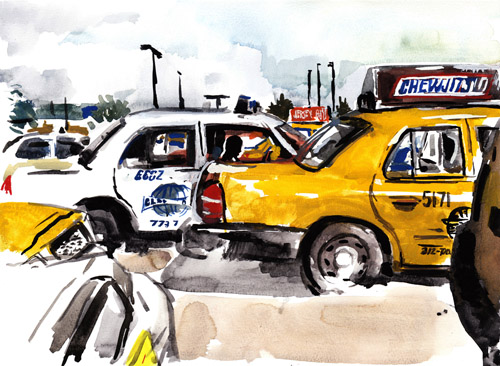
Fortunately, one recent book is committed to a less abominably assumptive approach to human existence. Like Nazaryan, artist, author, and cab driver Dmitry Samarov also experienced a childhood in Soviet Russia. And I suspect that this background is one very salient reason why Samarov’s insights into everyday life in Chicago are so real and winsome, rather than trite and didactic like Foer. Eschewing prepackaged claims of Taxicab Confessions authenticity (although the show is mentioned twice), Dmitry Samarov’s Hack (University of Chicago Press, $20) is a slim yet thoughtful volume on what it is to live as a taxi driver. The book bristles with an intriguing street poetry, referring to a gas station’s “welcoming neon glow” as “fool’s gold” when Samarov describes the difficulties of finding a place to relieve himself and depicting the unusual dernier cri (“a straw cowboy hat and a green Day-Glo bracelet”) which elude the monied charlatans who hole themselves up in vacuous manses. Samarov is clearly interested in people, but, like the prostitutes, the journalists, and the psychotherapists who cater to their clients in similar fashion, he knows very well how his fares perceive him. He registers his observations in a rapid-fire yet unpretentious manner (many of his anecdotes originated on a blog), as if he has only a few minutes to capture a few sentences (or sketch one of the many illustrations accompanying his stories) before hustling for the next fare.

Samarov is candid enough to express his understandable self-interest, describing how he wants his cheeseburger more than an “angry man with a backpack [who] marches right up to the window and demands service” at a McDonald’s which prohibits walk-ups (and which generates a quick fare stream for wayward cabs in the area) while also showing us his reticence to reveal certain personal details to his more probing clients.

And why should the hack spill? After all, when we enter a cab with the idea of entering a conspiratorial trust with the driver, how much of our taxicab conversations do we truly remember? Isn’t there something inherently troubling about placing our trust with a stranger like this? Perhaps. This may be one of the reasons why so many “confessions” of this sort often depict the taxi driver as some dutiful stoic who has seen it all. But this take severely underestimates the hack’s ability to understand the implications of his observations. As Samarov himself writes when trying to peg a woman pushed into the back of his cab by a disheveled old man, “There’s no polite way to broach such a subject, so I content myself with speculating.”

Samarov is willing to impart his fears and dangers, even when they reveal unexpected thoughts about on-the-job dignity. Of dealing with incompetents and ireful types on the road, he writes, “I wouldn’t be caught dead out here if there wasn’t money at stake. The fact that the masses submit to it of their own volition makes me question my membership in the species.” Does this need for the take, often ruthlessly pared down by a cashier when checking the cab in, make Samarov any less superior to Foer? Not at all. But it’s refreshing to see Samarov marvel at the universe even as he seems conflicted about it. It’s this marvelous duality of being alive that books, especially in the hands of the prissy and the uptight, too frequently take for granted.

* And if you’re truly on the fence about whether or not Foer is a loathsome human being and/or an astonishingly overrated individual, consider the fact that Foer had the audacity to apply, and win, one of the coveted Cullman Center fellowships (which awards a $65,000 stipend, an office, and considerable resources to each winner) offered by the New York Public Library this year — this when Foer himself owns a $6.75 million brownstone in Park Slope (purchased in large part through the family’s coffers), is doing extremely well with the Extremely Loud & Incredibly Close film rights and foreign sales, and this after Foer’s equally pansified wife, Nicole Krauss, won a Cullman grant two years prior to her husband. A source informs me that Foer resigned from the fellowship, which explains why his name is no longer listed among this year’s fellows. Still, why would any remotely decent person do this? I suspect the answer is quite self-explanatory. If you go for an evening stroll through Prospect Park, especially when it is colder and more desolate in the wintertime, you can listen to the gelid pelt of Marie Antoinette-like sweat oozing from the west without surcease from Nicole Krauss’s privileged pores, which is siphoned into a special stock for the children so that they too can sup from the free ride tureen well into early adulthood. Given all the recent dialogue involving the richest 1% taking everything from the remaining 99%, it’s astonishing that the Foer family’s unrelenting selfishness and unfathomable avarice has gone without remark or rebuke by the literary community. But I digress.

Ocean Marketing: The Dramatic Reading

It began, as most forms of Internet frontier justice do, with a post that spurred outrage. Ocean Marketing, a firm that had promised to deliver an Avenger game controller before the Christmas holidays, failed to live up to its pledge. People did not get their controllers. There was an email exchange whereby aggrieved parties attempted to seek restitution with Ocean Marketing. But Ocean Marketing, failing to comprehend one time-honored maxim (‘The Customer is Always Right”), decided to get huffy about rectifying its mistakes, with the company’s representative becoming mind-numbingly arrogant when it came to the power of memes and the potential for serious screwups to create viral PR nightmares. The result was a public outcry and subsequent investigation that revealed even more astonishing sins, including plagiarism and phony charities.

In other words, the whole Ocean Marketing mess quickly became a veritable rabbit hole: a fascinating and time-consuming parable on how a representative’s poor conduct revealed a company’s true disgrace buried not especially deep beneath the dirt.

Others have done a commendable job of following this ongoing story. So in an effort to provide the appropriate journalistic context, I have performed several dramatic readings of the more snottier Ocean Marketing emails. I hope that my performances have appropriately represented the smarmy and self-serving behavior which galvanized this mighty electric storm. (Please note that I have replaced all instances of “LOL” with suitably melodramatic laughter.)

Ocean Marketing: Dramatic Reading #1 (Download MP3)

This text will be replaced

Ocean Marketing: Dramatic Reading #2 (Download MP3)

This text will be replaced

Ocean Marketing: Dramatic Reading #3 (Download MP3)

This text will be replaced