The Bat Segundo Show: Adam Ross

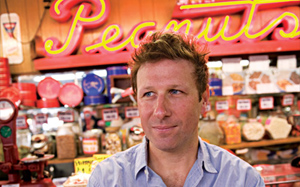
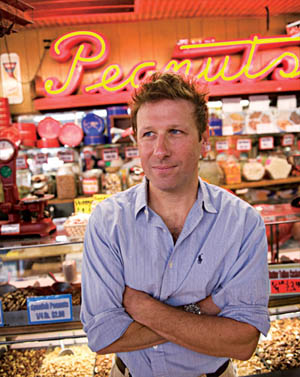
Adam Ross recently appeared on The Bat Segundo Show #349. Mr. Ross is most recently the author of Mr. Peanut.

Condition of Mr. Segundo: Caught within the vertiginous sensation of a Mobius strip.

Author: Adam Ross

Subjects Discussed: [List forthcoming]

EXCERPT FROM SHOW:
Ross: I think that what keeps us going day in and day out as we live our lives — and certainly we live our lives, hopefully, as members of caring relationships — is the belief that we can improve and change. And when I think of the idea of change, progress, and the improvability of character, that to me is a belief that character is somewhat linear. Right? That, okay, I learned that lesson back then. I’m never going to do it again. And yet my experience as a guy who’s been successfully married for fifteen years is that the experience of living with someone you care about a great deal for a long period of time is to come up against the reef of circularity, but also to enjoy the bliss of recurrence, right? So it’s paradoxical. There are these competing desires. The closed circles that Mr. Peanut presents. The entrapment, which is the same experience, I think, of looking at Escher. Which is that weird — you look at the art object from the outside. But if you really enter an Escher, you have this perceptual experience, where it’s inescapable and then you have to step back. It’s to me kind of analogous to the experience we often feel with those closest to us. Whether it’s brothers/sisters, mothers/fathers, or husbands/wives, we want to believe that we could get past X. But we often don’t. And that, to me, is the heaven and hell of marriage.

Correspondent: Yeah. So what you are suggesting here….

Ross: I’m suggesting tension. I’m suggesting a tension between those two.

Correspondent: Well, that’s true. But you’re also suggesting that by David embarking on this manuscript, by embarking on his marriage from the outside, and then also actively discouraging himself to look at the actual symbols — everything lines up. That’s really the dilemma that you’re laying down here. And then simultaneously you add an additional meta element by having the reader involved. Because then the reader is looking from the outside from the outside from the outside.

Ross: Yes. Well, let’s — because there’s nothing better to me as the writer than having this kind of a conversation. Because you’re putting your finger exactly onto me. What I was trying to examine. And so the first question I would say, in terms of decoding some aspects of Mr. Peanut is this. When is David writing this? Because essentially the book hints that there is a period of him being terribly blocked. And then there is a period where he is liberated to close the circle. Close the Mobius band, right? At the same time, it is, to me, powerful works of art — a movie that comes to mind just off the top of my head is either something like Nicolas Roeg’s Don’t Look Now or the great movie, Francis with Jessica Lange — where the effect of the work is to shock you and stun you. Another book like this would be John Hawkes’s The Lime Twig. Where the power of the nightmare is forceful enough that you emerge from it not just still reeling from the things you’ve seen, but also hopefully more awake to what’s right in front of you in the real. And so the question is: Is the virtual a prophylactic from life? Or does it have this possible saving power? Does a reader — who I bring in and as you say look from the outside in at all these moments that are fraught with conflict and violence and moments of joy and missed opportunities — is the reader there more awake to his or her life? Or, to the reader, is it just another entertainment? Is it just another enchantment? I don’t have the answer to that. My hope would be that it’s a wake-up call. But my experience is that these wake-up calls — we’re on the band also. We’re constantly forgetting. Does that make sense?

Correspondent: No, it totally does. And actually I want to lay out just a sampling of the numerous Hitchcock references in this book to jump off of this point.

Ross: Sure.

Correspondent: You have, for example, Nurse Ritter referencing Thelma Ritter in Rear Window. David encounters business cards made out to Dr. Fred Richmond from Psycho, Dr. Alex Brulov from Spellbound, which is also the name of his software company. Jesslyn Fax is a co-worker of Alice’s, but also the actress who played Miss Hearing Aid in Rear Window.

Ross: Yes.

Correspondent: And so on. So I’m wondering, based off of your last answer, whether there was a specific science in these particular references. Or whether they were all pure MacGuffins. Pure ways of detracting the reader, of inviting the reader to look in at something — again, going back to the question of semiotics — that is either complete bullshit. Or whether there is any kind of remote justification. Or whether it was just you having fun. Again, it works on this level of “Here, reader, look from the outside. But if you peer in, you will find nothing.”

Ross: I’ve been watching Hitchcock films intensively for twenty years. And it would be pure postmodern kitsch — pure postmodern trash — if those references didn’t have, as it were — that they didn’t rhyme thematically. In fact, there is, throughout the novel, a semiotics of naming which you’ve already put your finger on. And with some of the names you’ve already brought up for instance. Ward Hastroll is an anagram for Lars Thorwald [Raymond Burr’s character from Rear Window]. It’s the Hastroll section in terms of the way names are used. And not just names. They’re the Escher obverse of Rear Window. So, for instance, and I’ll only give a few of these away, but to give you an idea that there is method to the madness, I mean, the newlyweds that Ward Hastroll interviews are named the same actors in Rear Window.

Correspondent: Yes.

Ross: And if you go through, it actually in some ways — for instance, in that case — it modernizes the conflict that the couple has in Rear Window. Ross Bagdasarian is the name of the piano player in Rear Window. And his wife — that’s Judith, he says — is the woman who’s also named Miss Lonelyhearts. And so they clearly — in that one quick cameo that Ross Bagdasarian has — they clearly had a happy life. But now their life is fading from memory because of his Alzheimer’s. So there’s that. There is the superstructure. But more importantly, in the Sheppard section — and I wouldn’t want to give too much of this away, because I’m waiting for people like yourself to start really dealing with it. The Sheppard section is comprised both in terms of content and certain kinds of rhyming themes of multiple Hitchcock narratives. Vertigo plays an enormous part, both in terms of content and thematically in the Sheppard section. Shadow of a Doubt. Strangers on a Train. Marnie. Rear Window. To name but a few. Spellbound, as you said, does reemerge. I could go on. North by Northwest. Which also has its very clear semiotics of the kind of spy action caper. Because I think Hitchcock, at the time, was very tired of the action caper MacGuffin and wanted to introduce an element of absurdity. So, for instance, Cary Grant’s wallet in North by Northwest — this teeny little wallet — never empties of money. And he’s constantly doling out cash throughout the whole film. Little tricks like that. A Hitchcock scholar will start to enter that labyrinth and will start to see a way in which these themes — even on the level of mise en scene. I mean, if you look at the way certain characters are dressed in the Sheppard section, and where they go to buy clothes, it is not just using Hitchcock locales and settings.

The Bat Segundo Show #349: Adam Ross (Download MP3)
This text will be replaced

Review: The Other Guys (2010)

For the record, I enjoyed Anchorman. I was lukewarm on Talladega Nights. I skipped Step Brothers. But now that I have seen Adam McKay’s disastrous cop-buddy comedy, The Other Guys, I think that I can safely conclude that McKay is turning into a gutless fauxteur more on the level of Dennis Dugan rather than Judd Apatow. He’s a man who might improve his floundering artistry, were he to live by a more literal mantra of the comedy website he co-created with Will Ferrell. Had there been some creep screaming “Funny or Die!” into McKay’s tinnital ears every five minutes or a psychotic aiming a gun at McKay and his co-writer Chris Henchy as they were banging out their flaccid script, it is quite possible that The Other Guys would not be such a stunning sack of shit. At least I’d like to think so. And I’d like very much to believe that McKay is more than Anchorman. I am, after all, an optimist at heart. But the truth here is that McKay has turned out a film that is worse than Kevin Smith’s Cop Out, a movie that is not even worth folding your laundry by. That alone takes a stunning paucity of talent. McKay’s mind is a Costco storehouse of discount humor. He’ll point his mass audience in the right direction. But when it comes time to make a purchasing decision, you’re limited to the stock at hand. You’re then forced to stand in line a very long time for only a few saved bucks. And your only real consolation is the cheap hot dog on the way out.

The cheap hot dog in question is a series of helpful infographics playing during the closing credits, featuring such left-leaning stats as the plummeting value of an average American’s 401K account, the uptick in the average executive’s salary, and the growing disparity between the rich and the poor. There was a part of me very tempted to give McKay more of a pass for having the audacity to pull an unexpected progressive parlor trick at the end of a multiplex film. But then I remembered that I had just endured a particularly unfunny film, sitting next to two annoying ringers who laughed at every dud, that had contained abundant misogynist jokes and several strange potshots at the eco-friendly Toyota Prius. And if McKay wanted to make a statement about corporate greed within a mainstream comedy, then why didn’t he have the balls to do it during the preceding 90 minutes?

I’ve called McKay “gutless.” I’ve called him a “fauxteur.” Let me explain. McKay is gutless because he features a potentially funny scene in which two cops address an elementary school classroom, pointing out that African-Americans and Hispanics are more likely to get involved in crime. These are, of course, racially insensitive remarks. The camera cuts to a reaction shot. And the true horror of what these two cops are saying might have been funny and disturbing if the kids had been composed entirely of African-Americans and Hispanics, an ironic twist that would have improved the joke. But in the reaction shot, it’s a largely Caucasian crowd. McKay is a fauxteur because he doesn’t understand that repeating a gag several times over a movie doesn’t necessarily make it funny — particularly if it’s a tired cultural reference. Case in point: Will Ferrell’s character, Allen Gamble, likes to play Little River Band to rev up his masculinity. It’s somewhat funny to hear “Reminiscing” once, groan-inducing the second time, and nauseating the third time. (Also, if Gamble really was into “River Band,” would his taste not extend into tunes beyond the popular hits?)

Just as McKay disguised his Talladega inadequacies by casting Sacha Baron Cohen as a very funny Frenchman, he resorts to casting a British comedic legend (Steve Coogan this time) to quickly paint over the cracks in the wall. Alas, the astute McKay viewer will recognize quite rapidly just how much the man is slumming it. The criminally underused Michael Keaton fares better than Coogan and even finds some ways of improving the material with his performance, offering a spontaneous wink just after a so-so line to get a big laugh. But these living legends are merely the supporting players.

So it falls upon Mark Wahlberg and Will Ferrell to anchor the comedy. Both fail spectacularly. In Wahlberg’s case, it’s not his fault. He previously demonstrated that he had comic timing as a stiff sergeant in Martin Scorsese’s The Departed. But in The Other Guys, McKay has directed him to be a one-note caricature of that role. And his presence becomes needlessly tedious. Wahlberg’s character, Terry Hoitz, is stuck to his desk because he accidentally shot Derek Jeter. (Because of this, he is partnered with Ferrell’s Gamble, which I’ll get to in a mite.) Hoitz has an estranged relationship with a ballet teacher and even shows up at her studio to demonstrate his dance moves. But Wahlberg just doesn’t have the material to sell his character. He rants and complains about his failure to get some action on the streets, about Gamble’s reluctance to take a radio call. He makes goo goo eyes at Gamble’s wife. But none of these qualities offer us enough to care.

As for Ferrell, one must now ask the perfectly reasonable question of whether the man is still funny. I’m becoming increasingly convinced that he’s blown his wad and will end up starring in lackluster family films like Eddie Murphy: a withered husk of whatever jones he had in the first place. Allen Gamble falls into the same one-note Ferrell archetype. Suburban middle-aged dork has a crazy past and a wild streak that comes out from time to time. Which we saw before with Old School‘s Frank Ricard and on countless Saturday Night Live sketches more than a decade ago. In this case, before he became a police accountant, Gamble was a pimp in college. Aside from the fact that a police background check would make it utterly impossible for Gamble to be employed, the flashback that reveals this backstory relies not so much on wit or character detail, but on Ferrell increasingly resembling a pimp. Chains appear around his neck. He starts to talk in ghetto cliches. In short, it’s the kind of humor one can easily discover in a high school drama class, not what one expects of comedy professionals.

Hoitz and Gamble are paired together, but they never get any action on the streets (thus motivating the movie’s raison d’etre: “comedy” fused with noisy car chases and constant shoe pilfering). These guys are NYPD office drones. Gamble sifts through paperwork and finds the buildings erected without construction permits. And all this is, in Hoitz’s eyes, rather boring. The movie could have had a stronger premise if it had played this idea up. What if Hoitz and Gamble, these ostensible bureaucratic stiffs, actually uncovered greater danger than the assaults, robbery, and mayhem on the streets? Certainly, the end credits suggest that this angle may have been a stronger priority in an earlier screenplay draft. But had the film maintained this emphasis — similar to Ron Burgundy’s sexist values being challenged by the 21st century or the clash between Ricky Bobby and Jean Girard in Talladega Nights — it would have played more to McKay’s comedic strengths: namely, finding the comedy within ideological conflict.

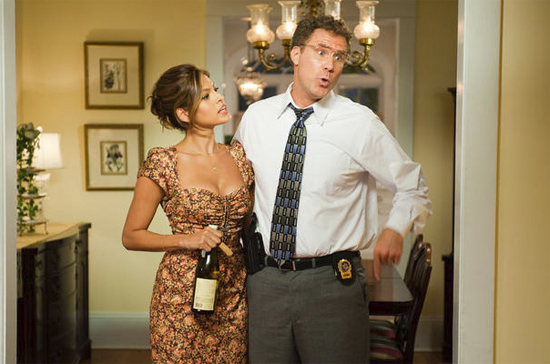
But McKay and company appear more interested in wallowing in misogyny. Gamble is ridiculed for having a man purse. “I feel like we’re literally driving around in a vagina,” says Hoitz upon driving in Gamble’s Prius. Gamble gives Hoitz a gift: an FBI mug that spells out the acronym FEMALE BODY INSPECTOR. But McKay reveals just how much of a women-hating frat boy he is by having Eva Mendes show up as Gamble’s wife. The joke here is that Will Ferrell can’t possibly have married such an attractive woman. But despite Mendes’s character being a resident doctor, we never really see Dr. Sheila Gamble at work. We see her constantly cooking, constantly encouraging, and being told by Ferrell that her dinner tastes like dog testicles. And what’s the draw here in the relationship? That the Gambles have wild sex. It apparently hasn’t occurred to McKay that Mendes’s character may possess a professional life that supersedes such throwback I Love Lucy duties. Contrary to McKay’s fantasies, women are interested in more things than fucking and supporting their men. So it turns out that Ron Burgundy’s misogyny isn’t terribly removed frmo McKay’s. And if that isn’t enough, McKay thinks it’s funny that the homeless here like to engage in circlejerks (“It’s called a soup kitchen!”) within any abandoned Prius.

Much like a loutish neighbor who believes that skimming an issue of The Economist makes him a responsible citizen, The Other Guys would like its audience to think that its a liberal bomb trapped within a mainstream comedy. Hardly. The comedy here is a bit like watching a white supremacist group attempt to make sense of Brown vs. Board of Education. You really hope that the participants will become enlightened, but the atavism won’t go away.

Hate Mail Dramatic Reading Project #10

Earlier in the day, I had emailed a “journalist” some off-the-record information — no specific quotes, just some key data that he might wish to investigate for a story. I believed that this information might be of help to him. Despite being clear to point out to the “journalist” that the email sent to him was “off the record” and that I could not divulge the specific quotes or the absolute specifics out of respect to my subject, the “journalist” violated my trust and posted the email anyway. I then telephoned the “journalist,” asking him to remove the post in a firm yet polite tone.

This “journalist” then emailed me an ALLCAPS email. Who sends emails in ALLCAPS anymore?

Therefore, my audio series — Hate Mail Dramatic Reading Project — must continue.

The following clip represents my dramatic reading of the hate mail in question, read in the style of Mel Gibson talking on the telephone. The names have been changed.

I plan to continue reading any and all hate mail that arrives my way. And I will be happy to read any specific hate mail that you’ve received. (If you do send me hate mail for potential dramatic readings, I only ask that you redact the names of the individuals.)

Click any of the below links to listen.

Hate Mail Dramatic Reading Project #10 (Download MP3)

This text will be replaced

Previous Hate Mail Dramatic Reading Installments:

#9 A hate mail read in the style of Tennessee Williams
#8 A hate mail read in the style of Jimmy Stewart
#7 A hate mail read in the style of Glenn Beck
#6 A hate mail read in the style of a Miss Manners schoolmarmish tone
#5 A hate mail read in the style of Richard Milhous Nixon
#4: A hate mail read in the style of a drunken Irishman.
#3: A hate mail read in the style of a quiet sociopath
#2: A hate mail read in a muted Peter Lorre impression
#1: A hate mail read in a melodramatic, quasi-Shakespearean style

The Bat Segundo Show: Ken Russell

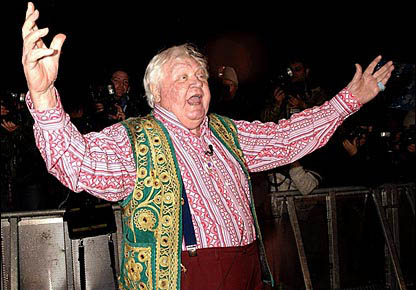
Ken Russell recently appeared on The Bat Segundo Show #348. Mr. Russell is the director of such films as The Devils, Women in Love, Tommy, The Music Lovers, and Altered States. Beginning today, Russell’s films will be playing at the Film Society of Lincoln Center for one week (many of which are unavailable on video), where Russell himself will be appearing each evening. Considerable thanks to Elize Russell and Shade Rupe for their invaluable assistance.

Condition of Mr. Segundo: Wrestling nude with 83-year-old directors.

Guest: Ken Russell

Subjects Discussed: [List forthcoming]

EXCERPT FROM SHOW:

Correspondent: You got into a fight with Alexander Walker, a man who, by the way, you’ve outlived. Other critics have called your films monstrously indecent. Walker was not the first one. So why did you hit tap him on the head, or beat him on the head, with a newspaper. I’m curious. Do you remember what was going on in your mind at the time? Or did you finally have enough of all these critics who were needlessly shitting upon what I think is a remarkable output?

Russell: Well, I guess I got tired of him putting me down. When he said, “You change things. We actually see Oliver Reed’s testicles crushed.” And I said, “Excuse me. That’s in your mind.” We don’t see his testicles crushed. Because they weren’t crushed. Only in your dirty little mind, you pig. And so he took exception to that. So I hit him over the head with his own review. Which happened to be a tissue of lies from start to finish. So that was a reason.

Correspondent: One of the few filmmakers to really get pugilistic about your critics there.

Russell: Yeah, well, he shouldn’t have said that. I mean, we didn’t see Oliver Reed’s testicles crushed. He may have wished we had. But we didn’t.

Correspondent: It was really — you were sticking up more for Ollie than you were for yourself?

Russell: That’s right. Yes.

Correspondent: I’m curious about a couple of things I’ve heard. One being that Oliver Reed apparently slammed you to the kitchen floor so that you would include the nude wrestling scene in Women in Love. I’m not sure if that’s true. Wanted to run that one by you. There’s another rumor going around that Ollie and Keith Moon were so drunk on the set of Tommy that they were improvising their lines. And then there’s another one that you guys got kicked out of the resort that you were filming at because of Ollie’s behavior. First of all, I wanted to find out if these stories were true. And second of all, given that this obviously must have been a very difficult working relationship at times and I know that you Ollie again until Prisoner of Honor, what accounts for the delay between Tommy and Prisoner of Honor?

Russell: Well, the delay between the two films was simply down to the fact of availability. Oliver Reed was only available at certain times and he wasn’t available. In Prisoner of Honor, that was why I didn’t use him before.

Elize Russell: You got along with him well.

Russell: Yeah, I got along with him very well. He…

Elize Russell: He called him Jesus.

Correspondent: He called you Jesus?

Russell: Yes. That wasn’t a compliment.

Correspondent: (laughs) So a little tempestuous there.

Russell: (laughs) Yeah.

Elize Russell: But he did throw you to the floor and you said that he convinced you to do the scene.

Russell: Oh yes. Yes, he did. I wasn’t going to do the nude wrestling scene. Because I couldn’t think of a way to do it. Because nude wrestling was frowned upon in British cinema.

Correspondent: In more ways than one.

Russell: In more ways than one, yes. So finally, he agreed to do the nude wrestling as long as there was no nude wrestling to be seen. (laughs)

Elize Russell: And how did he convince you to do it in front of the fireplace?

Russell: Well, he dropped round to my house for supper and said, “It could be done! It was very simple to do.” And he showed me how easy it was. You just faced each other, put out your hand and shook it, and threw each other onto the ground.

Correspondent: Did he often persuade you to insert scenes along these lines? Because I’m sure it couldn’t have been limited to Women in Love.

Russell: No. It was one of his favorite methods of perusasion.

Correspondent: Throwing you to the kitchen floor? That wasn’t the only time then.

Russell: Oh no.

Elize Russell: There was a sword fight.

Correspondent: Aha!

Elize Russell: But you won that one by mistake and closed your eyes.

Russell: Yeah.

The Bat Segundo Show #348: Ken Russell (Download MP3)

This text will be replaced

Review: Get Low (2009)

There is a type of moviegoer, generally between the age of 30 and 45, who will witness Bill Murray in a movie and laugh at his every tic, his every moment, his every step forward. Yes, Bill Murray is a very gifted comic actor, quite possibly the 21st century’s answer to Buster Keaton. But such a preprogrammed response misses the point of Bill Murray. It suggests very highly that he is some jester for our steadfast amusement rather than a soul to be genuinely interested in. Small wonder then that the roles that Murray has taken in the last ten years have involved sad loners in their autumn years.

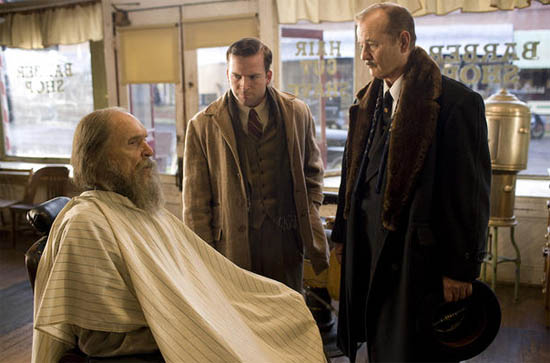
Given such thespic expectations (and such tittering moviegoers: two of whom were at the screening I attended), it’s a relief to see Murray playing an opportunistic funeral director named Frank Quinn in Get Low, a supporting role comparable to Wild Things‘s Ken Bowden, Cradle Will Rock‘s Tommy Crickshaw, and Mad Dog and Glory‘s Frank Milo. Few filmmakers seem to ken that Murray best anchors a film when his hangdog mug scatters into the background. Maybe director Aaron Schneider gets this because he’s also a cinematographer. But a movie set in the 1930s concerned with how misfits are judged by a town square’s cruel metric works better with Robert Duvall cast as the misunderstood “freak” and Murray as the lonely man riding his coattails.

Get Low takes it inspiration from Felix “Bush” Breazeale, the nearly forgotten figure who, according to James Ewing’s It Happened in Tennessee, decided to attend his own funeral on June 16, 1938. Breazeale’s funeral was heavily publicized in the papers, in part because Breazeale had been charged with murder many years earlier, with the charges later dropped. But where the real-life Breazeale sifted through the crowd at funeral’s end, signing programs and shaking hands, this movie’s “Felix Bush” views Breazeale’s eccentric act less as an individual’s unusual exertion of identity and more as the tragic aftermath of a misfit’s whims skimmed over and ignored by a capitalist system. This Felix Bush is picked on by the local townsfolk. He introduces a raffle component to his funeral during a radio appearance, encouraging greater throngs to attend. The film’s Uncle Bush is more familiar with marketing techniques. He takes a photograph with his long mane in disarray, only to have a barber trim himself for the big day. (Not so for the real Uncle Bush.) This film’s funeral is held so that Felix Bush can see what stories have circulated about him, whereas the real Bush was a fastidious type who wanted to see his service conducted in the right manner. Get Low takes the position that Bush’s funeral is an act of corrective catharsis, of setting matters straight before a hostile crowd.

Yet despite these concessions to conventional narrative, Get Low mostly works. It feels less like a biopic because of its leisurely pace, its efforts to establish a small town atmosphere, and its willingness to maintain Bush’s personal secret for so long. It understands that, when you have actors as good as Duvall, Sissy Spacek, Lucas Black, Murray, and Gerald McRaney, you let them play out the moments. It has some funny lines, most of them delivered by Murray. Frank Quinn defines his sales track record when he grumbles, “I sold twenty-six of the ugliest cars in the coldest day of Chicago.” Shortly after Bush threatens to put the kibosh on the gambit, Quinn says, “Is it just me or is he extremely articulate when he wants to be?” Yet Murray’s character, for all of his quips, is lonelier than Bush, even when he’s sitting around a table and taking in local gossip. We’re left to wonder why this man had to flee Chicago so late in life. Quinn offers some nebulous story about switching sides of the bed shortly after his wife left him, but it’s just one small part of the story. Just as the stories circulating about Uncle Bush, very much the local recluse, hardly tell us anything we need to know about the man.

And this narrative approach, helped in large part by screenwriters Chris Provenzano and C. Gaby Mitchell, very much turns a shaggy dog tale into something more memorable. There’s a certain irony in this movie opting to print Felix Breazeale the legend, rather than Felix Breazeale the man. Sometimes, Get Low needlessly overplays its hand — such as the brazen need to telegraph its time period with “I’m Looking Over a Four Leaf Clover” or the lost love plot that never quite congeals, even when Duvall bangs on the door in the pouring rain. But its efforts to capture some impression of a bygone time, fusing these with an undervalued human gusto, reminded me of a needlessly forgotten 1999 film called Man of the Century. American culture has been too preoccupied with condemning the oddballs. It’s a relief when a small movie like Get Low comes along to remind us why they’re so interesting, and why Murray isn’t just some aging goofball.