Review: Hey, Boo (2010)

Hey, Boo, a largely hagiographical overview of the great Harper Lee, has the finest cinematic aesthetic that 1986 has to offer. Or maybe with all of the talking heads, it’s the finest television aesthetic. I wasn’t surprised to learn that the film’s director, Mary McDonagh Murphy, worked at CBS News for twenty years. Unfortunately, this experience has translated into a indolent, superficial, and largely unhelpful film in which we get to see Oprah Winfrey tell us how she “devooooooooooooooured” To Kill a Mockingbird when she first read it. We must endure the unctuous Scott Turow, who has resembled an empty oil barrel both in look and intelligence since his divorce, commending Lee’s “bravery” in writing about race in 1964. But given the novel’s quiet and diligent origins (Lee given a check by her friends Joy & Michael Brown to write anything she wanted for a year, nervous first editorial meeting at Lippincott, two years of vigorous editing), wasn’t Lee’s purpose less about shaking up the social landscape and more about writing the best novel she could? Hasn’t Turow been around the block enough times to comprehend that writers, even those who pen masterpieces like Mockingbird, often become blockbuster successes by fluke?

You’d think that Murphy would question her subjects. After all, there’s no point in including big names unless they have something to say. (Even Wally Lamb, while offering quasi-generalizations about Scout being “an extension of a Huck Finn character,” comes across as fairly thoughtful.) But Murphy isn’t especially interested in nuance. Her narrative is damaged by her editor’s tendency to kill the mood, lopping off crackling moments just as they’re catching fire. When Murphy’s camera briefly escapes the studio and enters the field, I was genuinely stunned that the filmmakers had managed to get off their sedentary asses. Talking with kids about what Mockingbird means to them is a foolproof method of investigating Harper Lee’s durability. But just as these future readers are getting jazzed up, the editor then cuts back to the literary luminaries (which include Tom Brokaw, for some inexplicable reason) sitting in chairs, doing their best to sustain excitement as their collective wisdom is reduced to audience-friendly platitudes. Richard Russo begins telling an interesting story about his father, only for the tale to be killed at press of a button. (You don’t give Richard Russo the cane. You let the man talk. Especially when your “feature” documentary is only 82 minutes. If this is Murphy’s idea of inclusiveness, why did she bother to include it?)

Murphy is also fond of simplifying her story, perhaps because she is terrified by the prospect of challenging an audience. When Lee’s childhood friend Truman Capote is brought up, he is, of course, portrayed as an inveterate wastrel. But even accounting for Capote’s jealousy (which involved spinning prevarications that he had secretly written Mockingbird and that Lee’s mother was mentally unbalanced, even attempting to kill the young Lee twice), one cannot easily ignore that Capote was Lee’s best friend during a significant period of her life and that, contrary to the film’s insinuations, Capote and Lee reportedly stayed in contact up to the former’s death in 1984.

Lee, by contrast, is an angel who can do no wrong. It never occurs to Murphy (or her subjects, at least as they appear on camera) that Lee had her faults: her failure to complete books (including an In Cold Blood-like project she abandoned in the 1990s, never mentioned in the film), a refusal to suffer fools, and a sensitivity to anybody bringing up To Kill a Mockingbird in person. Efforts to reveal some of these complexities, an admittedly difficult proposition, can be found in Charles Shields’s Mockingbird. There are faults with Shields and his book, but the man has pounded the pavement. You’d think that Murphy would enlist him to be part of this project, but, rather tellingly, Murphy hasn’t interviewed him.

While we aren’t privy to Murphy’s questions, one senses that she has fired little more than softballs at her subjects. For fascinating figures such as Lee’s lively 99-year-old sister, Alice Finch Lee, this isn’t a problem. Alice speaks her mind, irrespective of the interlocutor’s deficiencies. But it does become a thorny issue when Murphy elicits answers from one especially sheltered Caucasian writer (“to be crying for a black man was so taboo!”) and when James Patterson, with typical hubris, compares his own hackwork to Lee’s (“Lee kept building and building and building. Obviously, I try to do this with my work.”). Such crass remarks demand that an interviewer call bullshit. But Murphy is a head nodder rather than a listener. When the distinguished Andrew Young says “not a lot of black people read” Mockingbird back in 1960, one wishes that Murphy had the capacity to pursue the bigger picture instead of waiting around for the power quotes.

The Bat Segundo Show: Daniel Clowes

Daniel Clowes recently appeared on The Bat Segundo Show #394. He is most recently the author of Mr. Wonderful.

Condition of Mr. Segundo: Uniting with the bald community.

Author: Daniel Clowes

Subjects Discussed: Moments of simultaneous consciousness, creative methods of beating imposed deadlines, being intrigued by thought balloons, Superman and narrative urgency, formal lettering, what motivates words in Daniel Clowes’s life, the type of lettering that causes one to read narration in a robotic voice, sound effects and newspapers, CHOFF CHOFF vs. SMOOTH SMOOTH, mass readership and not receiving significant mail, Eightball reader responses vs. New York Times reader responses, angry Southerners who object to the word “Jesus,” following Like a Velvet Glove Cast in Iron versus following Mr. Wonderful on a sequential basis, pre-Internet audiences, “Check out my blog!” as a recurrent audience response, the advantages of insulation, the general sense of distant feedback, Chris Ware homages in Ice Haven, the amount of detail compressed in any individual frame, not wanting to cheat the reader, the complex issue of bald spots in comics, the many permutation of Wilson’s look, depicting eating in visual mediums, Terry Zwigoff’s enthusiasm for eating, the difficulties of illustrating table settings, reference shots, drawing pay phones, drawing without reference shots, the consequences of fussing over an illustration too much,

EXCERPT FROM SHOW:

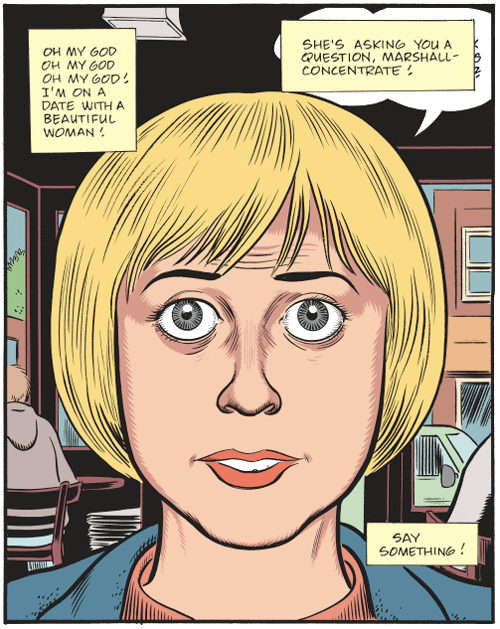
Correspondent: As a fellow gentleman who also has the male pattern baldness, I feel compelled to ask you about bald spots. In Wilson, his physical form changes from set to set to set. He’s often chunkier. He’s often muscular. He’s receding in different places each time. And I noticed in Mr. Wonderful, when you expand to one of these large panels, we do in fact see this silver of a bald spot.

Clowes: He has a bald spot throughout, I think.

Correspondent: Yeah. But we don’t really see it so much in some of the smaller panels.

Clowes: No. It looks weird if you have this little dot of flesh in a small panel.

Correspondent: To wrestle with the idea of bald spots in comics, is it really just a matter of liking to draw these?

Clowes: I’m trying to support our community.

Correspondent: Oh yes. Exactly. You meet in the secret halls as well as I do.

Clowes: Yes. Yes.

Correspondent: They don’t know how much we are…

Clowes: Again, I’m trying to normalize our ilk for the rest of the world.

Correspondent: What about the six panel approach of Wilson? I mean, sometimes we see….

Clowes: There’s seven or eight.

Correspondent: Sometimes we see at the very bottom of the row, we see three there. But I’m curious if that formalism caused you to shift Wilson’s appearance. I was always curious about why. Was it just a matter of trying to have almost every type of reader reading this finding her version of Wilson in the actual…?

Clowes: That was — that was part of the intent. We all see ourselves very differently from day to day. And I was trying to capture all the various ways that Wilson sees himself and feels about himself. And each one of those looks gives something specific to each of the strips. And I wanted each of them to have their own identity. They exist in this, as you say, very severe structure where it’s six, seven, and eight panel gag strips. And so I wanted them to have that, but also to have this way where they’re drastically differentiated from each other.

Correspondent: Sure. I mentioned Marshall eating a French fry earlier. And I did tell you that I had a followup question. I had a rather elaborate one.

Clowes: Bring it on.

Correspondent: I have — and this might just be an expression of my obsessions — but I have been very interested in the notion of depicting eating in visual mediums. You see a film sometimes. And often they’ll go to a restaurant or a diner or a bar or a cafe and nobody will eat. Similarly, I have noticed in your work that there is a reticence — especially in the early work, although we’re increasingly seeing more of a development in terms of depicting characters eating. Although I should point out that in the film of Ghost World, there’s a great moment where Bob Balaban is eating that toast.

Clowes: There’s lots of eating in that film.

Correspondent: Yeah, there’s lots of eating.

Clowes: Zwigoff enjoys eating.

Correspondent: Yes.

Clowes: Often, if he can’t think of anything else, he would just tell an actor, “Just put a bagel in your mouth and do the line that way.”

Correspondent: But in Ghost World the comic, we don’t actually see Enid and Rebecca eating. We see Josh eating.

Clowes: They’re too busy talking, I think.

Correspondent: They aren’t too busy talking. People talk and eat. They talk and eat in Ghost World the movie.

Clowes: It looks weird though. It makes someone look sort of vulgar if they’re talking and eating. And so you have to be careful with things like that. There are very subtle little things in comics. You have just this one panel to express something. And it confuses the audience if you’re not…you know.

Correspondent: Well, have you tried to get more eating? For example, the hospital in Mr. Wonderful, where incidentally Marshall feels more comfortable there than in the diner. Suddenly, Clowes feels more comfortable depicting picking at food and actual eating. I was reading this, championing the characters eating.

Clowes: Well, I think he’s relaxed. Before, he’s sort of taking a little bite and he’s not even thinking about eating. If you show someone eating, they seem at ease. And so I wanted to show that he’s given up. He’s totally relaxed. And he’s free to just eat his French fries.
Correspondent: Well, have you agonized over depicting eating moments over the years at all?

Clowes: It’s all intuitive. You don’t think about the details of it. You’re thinking about how to get across the performance of the character and how best to do that. Drawing table settings is really difficult. It’s one of the more difficult things you can do. Because you have to draw plates and perspectives and you have to kind of keep everything in the right place. You know, people don’t consciously notice if a glass moves from one side of the table to the other. But they unconsciously know that something’s off. And so it’s not at all easy. So I try not to write around that. I try to do my work and get it in there.

Correspondent: So being a script supervisor for your own work, it would seem, is part of the perfectionist in you.

Clowes: Table settings are famously the script supervisor’s nightmare.

Correspondent: Is there anything more difficult for you for the comics than table settings? In terms of getting things consistent?

Clowes: Oh yeah. I mean, there are many things that I have written around. I can’t imagine drawing a detailed battle scene. I mean, if I had to do it, I would. But it’s not my idea of fun, you know? It would be a chore. Or to draw people riding horses is the one I’ve tried a few times. And my horses look very weird. I’d have to spend three weeks just working on the horses and get some way to do that down before I could do a Western I think.

Correspondent: In the Ghost World special edition, there is a reference photo that you provide indicating that this is the model for the Ghost World hardcover photo. This leads me to ask, since we were talking about panel size before, how much reference you actually need. In the case of horses, I’m wondering if part of the difficulty has been getting enough horses to model for you or to be photographed.

Clowes: There’s certainly plenty of reference nowadays on the Internet. And as it’s gotten more and more available, I’ve tried to use less and less of it. Because I find that I can look back at my work and say, “Oh, I just looked at a photograph of a pay phone.” There’s something much stronger about trying to remember what a pay phone looks like. And that way you capture both the essence of a pay phone and you also capture what your vision of a pay phone is. And so I try and only use reference if it’s something where I just can’t get a clear picture in my head. I mean, that reference of my wife for the back cover of Ghost World, that was for doing a very specific kind of detailed painting. I wanted it to look like an old pinup painting. And so I wanted it to have that kind of phony posed look. And so I would use a photo for something like that. But I would almost never, for a person, use a photo.

Correspondent: At what point, do you just simply draw a gesture without reference? Some people say that you can tell when a cartoonist is coming into a room. You immediately know who he is. Because that’s exactly like the drawings. Is there a similar predicament in just wanting to be off the reference altogether and just using your imagination to get something a little unreal? What do you do in a situation like that?

Clowes: I try to always go in that direction. I’m much more interested in making things up. It doesn’t always work out. And then you have to go back and fix it. But very often it’s much truer than if you’re fussing over it too much and trying to get things perfect.

Correspondent: But when you’re talking about capturing the essence of a pay phone, if you fuss over it too much, is it going to have an impact on capturing the essence?

Clowes: No. I mean, if you fuss over it too much, it pulls it out of the rest of the world, which is not fussed over. I try to draw as naturally as I can. Which took me forever. You know, my early work, I look at it and it makes my hand ache from thinking how agitated I was trying to get everything a certain way and not getting there. It was just constantly frustrating. And I was always throwing pages out the window and starting over and whiting out entire faces and pasting things on. And it was never pleasurable. And in the last five or six years, I’ve gotten to the point where I can feel good about without absolute agony. Or at least I know how to fix it at this point. I know that everything is fixable.

The Bat Segundo Show #394: Daniel Clowes (Download MP3)

This text will be replaced
BAMcinématek: Hal Ashby

I don’t know if Hal Ashby is in serious danger of being forgotten. But judging by the scant attendance at two recent press screenings for an ongoing retrospective at the Brooklyn Academy of Music (now playing through May 24th), I suspect that the cineastes are tired of talking him up. And that’s really a goddam shame. I certainly don’t know anybody under 40 who speaks of Hal Ashby with the same gusto devoted to such active 1970s directors as Brian De Palma, Martin Scorsese, Stanley Kubrick, or even William Friedkin and Walter Hill. (They’re certainly not going to bring up Joan Micklin Silver or Gillian Armstrong. But I’ll save comments on this regrettable gender disparity for another essay.) But like Alan J. Pakula, the recently departed Sidney Lumet, and Bob Rafelson, Hal Ashby often gets taken for granted.

Ashby began his career as an editor, winning an Oscar for his work on In the Heat of the Night in 1967. Three years later, Norman Jewison told Hal Ashby that he was a director. Jewison produced Ashby’s first feature, The Landlord — an iconoclastic, hard-to-find, zany, and one-of-a-kind satire written by Bill Gunn in which a Southern gentleman (Beau Bridges) becomes the landlord of a tenement building (in the now gentrified Park Slope) and has an affair with one of his tenants. (Her boyfriend is involved with the black power movement.)

The Landlord is filled with scenes (starting at around the 0:50 mark in the above clip) where the wild premise, which deals with race, white guilt, and false notions of entitlement, is topped by something out of left field. In this case, the kid not only blackmails Bridges’s milquetoast landlord for two dollars, but, after securing the two bucks, he offers the landlord a cigarette and lights up one for himself. Yet Ashby stages the scene so innocuously — complete with the kid ordering, “Home, landlord!” — that it deflates any potential discomfort and allows the audience to confront and enjoy the behavior.

Ashby’s third film, The Last Detail, continues in this vein. The film follows two US Navy sailors played by Jack Nicholson and Otis Young, escorting the young sailor Randy Meadows (Randy Quaid) to a naval prison. Meadows has received a harsh eight-year sentence for the minor crime of stealing $40. So the two sailors decide to show Meadows a good time. Ashby decided to direct Robert Towne’s razor-sharp and beautifully profane script in chronological order, traveling the same route as the sailors. This not only allowed the inexperienced Quaid and Young to get their sea legs over the course of the production, but it encouraged the magnetic naturalism that we see in the moment above. Watch the way Ashby neatly aligns the sailors by height or the way Nicholson slaps himself on the side of the head, foreshadowing the great explosive moment.

To some degree, you could call Hal Ashby a faithful chronicler of very recent history. Bound for Glory, his faithful biopic of Woody Guthrie, is his only real period piece, but it’s also the first movie to use the Steadicam. But Ashby was very concerned with recent events. Consider the way in which 1975’s Shampoo reckons with 1968’s sexual politics or the manner in which 1978’s Coming Home approaches the same year from the vantage point of the Vietnam War, taking the interesting step of casting Jane Fonda (who protested the war) as a very believable military wife who sees her world change when she meets a disabled Vet played by Jon Voight. It’s possible that The Social Network‘s recent success had much to do with similar revisitations of recent history. But is there any director working today capturing the last ten years the way that Ashby did?

Ashby worked so close with his actors that he often had them work on the scripts. Warren Beatty co-wrote Shampoo. No doubt his womanizing added some authenticity to the hairdresser juggling numerous paramours. 1982’s Lookin’ to Get Out, in which Ashby fought the studios for final cut, was co-written by Jon Voight. The original version of this film, as cut by Hal Ashby and as discovered in 2009, is playing as part of the retrospective. While there’s a gripping showdown in a casino club room, and some thespic chemistry between Voight and Burt Young (including one great early moment where Voight plays the scene spooning soup from a can as his character confesses losing a great deal of money), the film suffers from an implausible storyline and too many incoherent moments.

Did Hal Ashby lose his artistic chops in the Reagan era? I don’t think so. The above confrontation between Jeff Bridges and Andy Garcia in 1986’s 8 Millions Way to Die (this underrated film has become so maligned over the years that I was truly shocked to see it in the BAM lineup) demonstrated that Ashby could take something as innocuous as snow cones and turn it into a quirky tension builder. It’s the little tics that build this scene: Garcia moving to straighten his tie, Garcia’s lieutenant hovering in the back, and Bridges curling his fingers just after taking a bite. But when Garcia explodes at Bridges, the moment is especially startling because of how tightly framed the three men are, along with the overlapping chatter. I also love the way Garcia dispenses with his snow cone (similar to the way he kills the cigarette at the beginning of the scene; this is a character who always needs to have something in his hands to destroy). Oliver Stone’s dialogue in this scene is a bit silly (“My fault. I’m sorry. I didn’t get laid today.”), but can one imagine such blocking and gestures in movies today? Every time I see this juicy scene, I want to tear every goddam kid away from making CGI movies on his computer and force them to work with the nuts and bolts of human nuance.

Ironweed (Modern Library #92)

(This is the ninth entry in the The Modern Library Reading Challenge, an ambitious project to read the entire Modern Library from #100 to #1. Previous entry: The Magus)

[Only months after writing this essay, we were extremely honored to interview William Kennedy for The Bat Segundo Show. That conversation runs 64 minutes and gets into Kennedy’s entire career.]

“Anybody who doesn’t have an idea about what it is to be homeless, or on the road or lost and without a family, really hasn’t thought very much at all.” — William Kennedy, Interview with The Paris Review

William Kennedy was in his mid-fifties when all of his novels went out of print. While he remained a working journalist, his latest manuscript about a scuffed up drifter named Francis Phelan — a minor character from his 1978 novel, Billy Phelan’s Greatest Game — had been rejected by thirteen publishers. Ironweed had come comparatively quicker than his previous novels. Kennedy wrote eight versions of Legs over six years. He devoted two years to Billy Phelan. But he wrote Ironweed in seven months. Still, this unanticipated celerity was of null solace to publishers studying Kennedy’s then sketchy sales record.

Kennedy was hardly a stranger to such uncertainty on the fiction front. In his initial fiction efforts, he wrote 30 stories These were all rejected. As he told Penny Maldonado in a 1969 interview, it was a rejection slip from The Atlantic reading “You write with a facility that has held our attention” that kept him going for ten more years. Saul Bellow, whom Kennedy met while in Puerto Rico, had urged the young Kennedy to carry on with his fiction writing. But Kennedy, banging away late into the night after a long day, would fall asleep at 2AM in the middle of a sentence. He felt he did not know his hometown of Albany, New York. So he moved back. Bellow continued to encourage him, even helping him secure an agent. Indeed, without Bellow, Ironweed would not have been published at all. It was Bellow’s direct intervention with Viking Press which ensured that Kennedy’s best known novel was published. The book would go on to win the Pulitzer Prize. Kennedy would be awarded a $264,000 tax-free MacArthur fellowship and he would use this money to establish what is now known as the New York State Writers Institute. Ironweed would be included on the Modern Library list, where, years later, some wild-eyed bastard in Brooklyn with a ridiculously ambitious reading project would finally get around to it.

* * *

I had not read Kennedy before, but I am glad that I did. Like Iris Murdoch’s Under the Net, I read the book twice, thought about it for a while, and found myself very tempted to read additional volumes. Fortunately, I was halted from such ambition after taking a look at Benedict Giamo’s The Homeless of Ironweed, a dry and overanalytical tome written by one of those insufferable academics who can never see beyond their blinkered and not especially interesting perspectives. I realized that I’d be on firmer ground confining my modest insights to just one book in Kennedy’s multi-volume Albany Cycle.

Ironweed opens on October 31, 1938. Francis Phelan, a former major league ballplayer bouncing around for twenty-two years, sees dead people. Thankfully, by every artistic standard, William Kennedy is a superior writer to M. Night Shyamalan. The dead, which include Francis’s expired relatives and a few men he’s killed mostly in self-defense, observe him as he labors at Saint Agnes Cemetery. They haunt him in buses and boxcars. Is Francis hallucinating? Do these visions emerge from his drinking problem? Over the years, there has been a temptation among some critics to cite this facet of Ironweed as “magical realism.” But because Ironweed is such a human novel, I think that the ghosts can more sufficiently identified as part of Francis’s perspective. After all, if we wish to accept and understand troubled souls, then we must often acknowledge what seems real to them. (It’s worth observing that in a 1983 interview with Larry McCaffery, Kennedy pointed out that the ghosts “probably came more from Our Town and Dickens than from Marquez.”)

We learn in the book’s masterful first chapter that Francis has suffered great grief. Years before, Francis accidentally dropped his infant son Gerald onto the hard tile floor of a saloon, killing him only thirteen days after his birth.* “Francis left his family, drowned his sorrows in drink, and took up with another woman named Helen. Yet learn, in 1930, that Francis lost his job at a fixit shop through no fault of his own and he could not land another job. Back then, he left Helen too. He stays with her still, but the relationship has attenuated.

What causes Francis to run? Does Francis’s transiency transform him into an impatient and violent figure? Well, it’s complicated. Here is a man who, upon returning to his family home on All Saints’ Day with a turkey, says “I don’t want no fights, rile up the family.” And it would seem that he’s the type to avoid conflict. Yet only moments before, after an aggressive effort to collect payment from a ragman, Francis says, “And I ain’t really a bad sort once you get to know me.” But when a shady figure name Little Red tells him to shut up in a flophouse, Francis instantly resorts to violence.

Undoubtedly, being identified as a bum hasn’t exactly put Francis’s grief on the fast track. Late in the book, Rudy (a kind of quasi-Lenny to Francis’s George Milton) tells Francis that people call downtrodden figures bums because they feel better when they say it. But is being a bum such a cut and dry term of disparagement? Not exactly. When Francis works for a ragman named Rosskam, Rosskam regularly amends his assessment of the former Washington Senators ballplayer turned sandwich-eating “bum” with modifiers (“tidy,” “impatient,” “sensitive”), whenever Francis requests something or ventures a philosophical thought. Yet during one moment, the act of physical labor triggers a revelatory self-assessment:

He rubbed his hands together. Where they the enemies? How could a man’s hands betray him? They were full of scars, calluses, split fingernails, ill-healed bones broken on other man’s jaws, veins so bloated and blue they seemed on the verge of explosion. The hands were long-fingered, except where there was no finger, and now, with accreting age, the fingers had thickened, like the low-growing branches of a tree.

If Francis’s hands are an accumulative road map of nasty nicks and sad crannies, then why isn’t there any indication here of Francis’s past as a ballplayer or a family man? Even accounting for the fact that this period in Francis’s life came before Rowdy Dick took off “two thirds of a right index finger” with a cleaver (a curiously exact phrase), surely the complete portrait would value this period as much as the epoch that involved “ill-healed bones broken on other man’s jaws.” On the other hand, Francis doesn’t entirely accept his physical form, for he views his hands as independent entities. “They don’t need me,” he tells Rosskam, “They do what they goddam please.” (This is another inverted nod to Steinbeck’s Depression novel. Lennie may not know his own strength, but the hard truth is that Francis does. It’s also worth noting that, in a 1989 New York Times Book Review essay, Kennedy would confirm his great admiration for Steinbeck, with a sly nod to Francis’s digits: “I look around and try to find other American writers whose work has meant as much to me, and I count them on one hand. Maybe one and a half.”) On the other hand, Francis uses his hands for labor and is willing to obtain compensation by any means necessary. When Rosskam makes a move to cheat Francis, Francis says, “Dead men took their last ride on their hand. You get me?”

Are Francis’s hands just as dead as the phantoms who haunt him? Is Francis’s life “long-lived, except when there was no life?” Labor as a form of salvation crops up throughout the book during unusual moments. For example, when Francis and Rudy meet a tubercular man named Moose in a flophouse, Moose says, “Probably ain’t nothin’ wrong with you work won’t cure.” Yet Ironweed‘s vagrants can work as hard as they want or even discover ten dollar bills that “grow on trees,” but they are still at the behest of raiders who bust up shantytowns, a reverend who won’t provide shelter to anyone who drinks (this policy causes a woman to die), and cruel “goblins” who rip off hard-earned money.

Yet Kennedy is careful to suggest that within societal dichotomies lie additional distinctions. (There’s something especially plaintive in Francis “seeing” the dead when he is perceived as “dead” by others.) “Some people,” says Rosskam, “they don’t know junk. It ain’t garbage. And garbage, it aint’ junk.” And as an early conversation between Francis and Rudy about an alcoholic named Sandra reveals, labels are all about aesthetic perception:

“She’s a bum or just on a heavy drunk?”
“She’s a bum.”
“She looks like a bum.”
“She’s been a bum all her life.”
“No,” said Francis. “Nobody’s a bum all their life. She hada been somethin’ one.”

The last line from Francis, with its sandwiched As and its dropped Gs, shows off one of the novel’s subtle strengths. From the vantage point of 2011, it’s difficult to corroborate the way in which the homeless talked in 1938. Yet within the context of the book, the vernacular here feels authentic — even when a kind librarian offers an overly formalistic command to Helen: “But you may stay as long as you like, my dear, if you choose to read.” (Can we truly imagine a librarian saying a sentence constructed like that today?)

But Francis and his ilk may as well be Martians to most of the world. This xenophobia is backed up by several oblique references to Orson Welles’s radio adaptation of The War of the Worlds. When Francis returns home, he says, “It ain’t one of them fellas from Mars.” An early colloquy between Francis and Rudy discussing the recently transmitted hysteria has Francis proposing a solution to the claims that Martians landing in Grovers Mill, New Jersey: “Anybody sees a Martian oughta jump out two windows.” But at least one learned man in Albany — specifically, Dr. Benjamin Ross of Dudley Observatory — points out, “Earth is a very small target and in all probability a Martian space ship would miss it altogether.”

If seeing someone as lesser and/or foreign is the only way for these characters to survive, then this may explain Francis’s protest during a trolley strike in 1901. Francis’s involvement starts off fairly innocuously, lighting kerosene-soaked sheets on an electrical wire. But upon sighting a scab conductor named Harold Allen, he uses his pitching prowess to lob a stone at his skull. Harold becomes “the first man Francis Phelan ever killed.” When the dead Harold starts questioning Francis’s logic, all Francis can say is “I got arguments. I got arguments.”

Twenty-eight years later, Francis beats a charge of political corruption (voting for Democrats twenty-one times at five dollars a pop) on a technicality. The man who persuaded Francis’s lawyer to go easy with the bill is Martin Daugherty, a former neighbor and a newspaper columnist, who has written articles about Francis’s family. Indeed, we learn near the end of the book that one of Daugherty’s relatives, Edward, has written a left-wing play called The Car Burns lionizing Francis’s actions. This suggests that Francis’s actions matter more than he realizes, especially because they are memorialized by writers. The famous line from The Man Who Shot Liberty Valance (“When the legend becomes fact, print the legend”) certainly applies. On the other hand, two graveside names that Francis sees toiling at Saint Agnes are DAUGHERTY and KENNEDY. Even those who print the legends eventually die. If death unites all of us, why do we spend so much of our times erecting boundaries? Even in a gloomy novel like Ironweed, there’s a moment in which everybody comes together in a bar to experience “unnatural sociality.” The name of the bar? The Gilded Cage. “Where the old Gayety Theater used to be.”

* — Kennedy describes Gerald’s corpse in the cemetery as one with “a protective web which deflected all moisture, all moles, rabbits, and other burrowing creatures.” Additionally, Gerald’s “ability to communicate and to understand was at the genius level among the dead.” Is there some genius contained within Francis’s scions? Billy Phelan, Francis’s quite living son, says late in the book, “How could I know anything? I’m a goddam genius.” “Genius” may be just as useless a label as “bum.”

Next Up: Erskine Caldwell’s Tobacco Road!

Review: The Beaver (2011)

When it comes to neglected narrative subjects, there’s no better figure than the middle-aged white male with disposable income and psychological problems. At least that’s the attitude a regressive moviegoer might have had in 1976, the year Jodie Foster appeared on screen as two altogether different characters using their bodies for altogether different purposes: Taxi Driver’s Iris, a teenage prostitute, and Freaky Friday‘s Annabel Andrews, whose body was occupied by her mother. Thirty-five years later, Jodie Foster has now directed a film called The Beaver that takes this dysmorphic approach to drama much further.

One morning, Walter Black (Mel Gibson), a depressed man who has run his toy company into the ground, begins speaking to his workers through a hand puppet. The voice is that of an apparent beaver, somewhere between Cockney and Australian. We are told that this is experimental puppet therapy, although nobody in the film considers Googling it. (Even assuming that these people are technologically illiterate, you’d think that the human resources manager or the insurance people would at least make a few phone calls when the CEO starts disseminating a dubious card. Given the film’s lack of logic, it’s almost as if this was set in….well, 1976. Which makes the appearances of Matt Lauer and Terry Gross in this film that much weirder and that much funnier.) We hear the beaver’s voice for the first time just after Black tries to kill himself in a hotel room.

Madness appears to run in the family. Walter’s son Porter (played by the excellent Anton Yelchin) is also something of an impostor, although he doesn’t require a hand puppet to uphold his craziness. He ghost-writes high school papers so that he can save up for a cross-country road trip to find himself before attending Brown University. But Porter also has this tendency to bang his head repeatedly against the wall. In one of the film’s many heavy-handed metaphors, Porter hides the hole with a map. In another heavy-handed metaphor, we see that the Black home contains numerous leaks. Walter’s wife Meredith (played by Foster) seems to accept all this without so much as a bat of the eyelash. I presume that her neglect has something to do with the fact that she is some kind of a structural engineer for rollercoasters. But this is rather spurious logic. I have known seemingly hippie mothers irresponsible in matters beyond the family who have stopped everything to repair a decaying home or take care of their children. And they have done this with meager income. Yet The Beaver isn’t quite brave enough to pursue this blatant hypocrisy. And that’s because, when it comes to women, this odd and creepy movie is also stuck in the 1970s, adopting the Diana Trilling position in Town Bloody Hall.

Women have two choices in this film.

(1) They remain quiet nurturers waiting for the men to relinquish their positions (such as Walter Black’s Vice President, played by Cherry Jones, who agrees to Black’s crazy plans without question, much like a glorified administrative assistant). They say absolutely nothing when men do stupid and crazy and reckless things. They are even willing to give up their bodies to men as they do stupid and crazy and reckless things, as we see during a sex scene in which Walter bangs Meredith in bed and in the shower while wearing the puppet.

(2) They must wait for the right moment to express some minor and only slightly fulfilling moment of rebellion. Meredith may think that she’s a “rebel” by designing rollercoasters, but it’s worth pointing out that we only see her doing this on her own time, when Walter is away. Likewise, Norah (Jennifer Lawrence) is a student who hires Porter to write her paper. Porter discovers that she was once a graffiti artist. But Norah has seen her younger brother OD. Crippled by grief, she is denied the ability to commit a rebellious act of artistic expression. She is understandably upset when Porter pushes her into tagging a building. But it is ultimately Porter’s grief that causes Norah to become the “rebel.” But if Meredith and Norah’s acts of “rebellion” are related to patriarchal encouragement, are they really acts of rebellion? In committing “rebellion,” aren’t they in fact doing so to nurture the men?

As a man who considers himself to be modestly enlightened, I believe this false dichotomy to be an unacceptable position in the 21st century. That this narrative worldview comes with psychiatrists and psychotherapists out of the picture is also strangely suspicious, more reminiscent of a Scientologist training video or a batshit circular disseminated by Jenny McCarthy. It’s certainly something you don’t anticipate from the seemingly wise mind who directed the not bad Little Man Tate and the astutely observed Home for the Holidays.

On the other hand, The Beaver is fairly entertaining as failed art. The movie is a curious blend between Lawrence Kasdan’s greatly underrated Mumford, in which an alleged psychologist moves to a small town and becomes popular just by listening to people, and Hal Ashby’s* Being There, in which a man becomes a media sensation by simply making the rounds. When Walter becomes a hit on the talk show circuit, and a toy product involving using one’s hands to construct wood becomes momentarily popular, the film shows a brief flash of sinewy satirical muscle. Unfortunately, because the film’s philosophy is so muddled, it never quite flattens the flab.

Part of this may have something to do with the privileged feel of the movie. I realize that I’ve spent a good deal of time railing against the film’s strange anti-women slant, but I should point out that I only developed such indignation after thinking about the film for a good week and a half. Still, when I saw the movie, it didn’t feel especially dangerous to me.

Even so, The Beaver does make you feel embarrassed for Mel Gibson, who, never mind the psychotic telephone conversations, doesn’t seem to understand that his day is now over. Earlier this year, Julie Klausner and Natasha Vargas-Cooper served up one of the best explanations for why this kind of man should no longer be depicted in present cinema. Klausner noted quite rightly that, viewed within the context of 2011, Warren Beatty is “a semi-soft erection of a towering skyscraper.” It’s too bad that Klausner hasn’t seen The Beaver. To jump off from Klausner’s metaphor, Mel Gibson can’t even get it up after downing five bottles of Viagra. He’s lucky that he still has friends like Jodie Foster, who seem to have no idea that they are closet enablers.

* — I feel compelled to point out that there is a Hal Ashby retrospective playing at BAMcinĂ©matek between now and May 24th. An essay on why Hal Ashby is important and why you should see him on the big screen is forthcoming, but I’m slightly behind on film coverage, largely because I am preparing for a 32 mile walk around Manhattan’s perimeter. Because the good folks at BAM were kind enough to let me sample some of the goods, I hope that this notice will suffice in the meantime. For the moment, I hope you will take my word that this is indeed a cool thing.