A High Wind in Jamaica (Modern Library #71)

(This is the thirtieth entry in the The Modern Library Reading Challenge, an ambitious project to read the entire Modern Library from #100 to #1. Previous entry: A House for Mr. Biswas.)

Richard Hughes’s A High Wind in Jamaica is the wild and bracing corrective to William Golding’s Lord of the Flies (forthcoming at ML #41) that I never knew I needed. Truth be told, the two books I am least looking forward to revisiting during the course of this ridiculously ambitious and time-consuming project are J.D. Salinger’s A Catcher in the Rye (forthcoming at ML #64) and Lord. Both novels meshed with me when I was an impressionable high school kid who didn’t know any better, but I have assiduously avoided rereading both volumes as an adult — much in the way that you hang down your wiser and more mature head over some of the dodgier cartoons you advocated as a child. (For the record, in my adulthood, I still abide by The Rocky & Bullwinkle Show, the decades-long catalog of Warner Brothers cartoons, and — if you get me on the right day — Robotech and Star Blazers.)

Thankfully, I had no such qualms with High Wind; in large part because, unlike Golding, Hughes isn’t so obsessed with plugging in values — the novel as a Sudoku puzzle? — to uphold his Great AllegoryTM (and thus literary posterity). The older you get as a reader, the more you welcome the fresh shock of the visceral: those exotic and sometimes unsettling voices you may not encounter in the real world.

Hughes was twenty-five years ahead of Golding when it came to writing a novel about children losing their civilized patina as they travel deeper into the wild and aberrant vales of anarchism (in this case, by dint of a ragtag gang of pirates). But his exquisite command of atmosphere shows that he was arguably more subtler than Golding, permitting the transformation of his children to become something of a shock in part due to the great care he took with his prose. High Wind was one of only four novels that Hughes wrote. (And aside from High Wind, I especially recommend In Hazard.) He was more of a playwright, a poet, and a journalist than a fiction writer — in large part because the lapidary approach he took with his sentences significantly slowed him down. But despite his bradykinetic progress, High Wind proved to be such a literary sensation that it turned Hughes into a notable figure saddled with controversy, literary renown, and even a modestly burgeoning financial cushion.

The novel’s setup involves the Bas-Thornton children, who flirt with feral wonders in the Jamaican wild when not relishing their privileged comforts at a plantation named Ferndale. A storm devastates their idyllic paradise. And as they sail back home to England, the children are scooped up by pirates.

When the pirates do board the ill-fated Clorinda (complete with Captain Narpole sleeping through the whole imbroglio, saving face later with a devastatingly bleak letter of lies), Hughes is crisply fastidious about describing these interlopers against type:

With this second boatload came both the captain and the mate. The former was a clumsy great fellow, with a sad, silly face. He was bulky; yet so ill-proportioned one got no impression of power. He was modestly dressed in a drab shore-going suit: he was newly shaven, and his sparse was pomaded so that it lay in a few dark ribbons across his baldish head-top. But all this shore-decency of appearance only accentuated his big splodgy brown hands, stained and scarred and corned with his calling. Moreover, instead of boots he wore a pair of gigantic heel-less slippers in the Moorish manner, which he must have sliced with a knife out of some pair of dead sea-boots. Even his great spreading feet could hardly keep them on, so that he was obliged to walk at the slowest of shuffles, flop-flop along the deck. He stooped, as if always afraid of banging his head on something, and carried the backs of his hands forward, like an orangutan.

Much as Knut Hamsun seemed to anticipate the hardboiled existential feel of Jim Thompson and James M. Cain in 1890 (thank you also, late and great translator Sverre Lyngstad!), so too does Hughes depict the professional working-class criminal just before the gaudily garbed grunt became a staple of noir. These pirates do make a perfunctory effort to look presentable (the captain — later revealed to be a Danish German-speaking ruffian named Jonsen — has gone to the trouble of shaving and pomading what is left of his hair), but they are also makeshift in their sartorial choices. Hughes’s beautiful choice of “dead sea-boots” suggests something vitiated and unholy at work here. (Indeed, one of the buyers who unloads the booty is a vicar, described as “less well shaved than he would have been in England.” Later, a warped nativity play is performed to entertain the pirates. Even later, the song “Onward, Christian Soldiers” is evoked in creepy fashion.) And Jonsen’s desperate attempt to keep his fancy bespoke slippers on — coupled with the telltale pocks of his aloof hands, which resemble a spastic animal — is just one of many examples of the dry exacting comedy that Hughes doles out gently throughout this deranged adventure tale. There’s also a mysterious first-person narrator serving almost as a cosmic god offering mordant asides. Indeed, the standoff between Marpole and these thugs reminded me of the “civilized” exchange between Barry and the highwayman in Kubrick’s Barry Lyndon. (In Barry Lyndon, Kubrick also had a sardonic narrator in the form of Michael Hordern’s arch commentary, which also dished up bone-dry asides on how we are all barely disguised animals beneath the human sheen. Was Kubrick familiar with Hughes? We may never know, although it is worth noting that a young Martin Amis did appear as one of the kids in the 1965 film adaptation of Hughes’s novel.)

Yet the look of these pirates is enough to ignite a modest crush within Margaret, one of the children, who marvels at their beauty. In an age in which television shows like Euphoria and high school cinematic classics like Fast Times at Ridgemont High or Ferris Bueller’s Day Off are heralded for using transgressive behavior to depict teens as “adults” (one can likewise see this approach nimbly executed in Megan Abbott’s more recent novels, which have used this storytelling device by framing kids through the subcultures of ballet, cheerleading, and hockey), it’s impossible to overstate the big risk that Hughes took here in 1929. During the hurricane that plagues Jamaica, Hughes also foreshadows how living in a state of nature can inevitably subsume anyone — even a child — by having a domesticated pet named Tabby ruthlessly chased by wildcats.

You will, alas, have to contend with the novel’s appalling and off-putting racism (“there is, after all, a vast difference between a negro and a favorite cat,” writes Hughes when both die after a hurricane and there is a cruel treatment of a monkey on the high seas, which suggests an unsettling metaphor). But the sheer weirdness that forms the backbone of this sweeping story swiftly atones for these hoary and horrendous “cultural values.”

High Wind is also the first recorded instance of the Hangman’s Blood, a cocktail later favored by Anthony Burgess. Seventeen years ago, I persuaded a bartender in the Upper Haight to make me this famous libation. It was, I am sad to report, quite ghastly. I never tried it again. Hughes himself also understood what a hideous mix it was, describing it as possessing “the property of increasing rather than allaying thirst, and so, once it has made a breach, soon demolishes the whole fort.”

Subconsciously, too, every one recognizes they are animals — why else do people always laugh when a baby does some action resembling the human, as they would at a praying mantis?

The children adapt to their new life much like many of today’s bored kids stare into the vacuity of their digital screens for constant stimulation. When one of their number dies, Hughes eerily notes how quickly accustomed they become to an empty bed. When Jonsen withholds the “three Sovereign Rules of Life” on the basis of their youth, Edward replies, “Why not? When shall I be old enough?” Indeed, reading High Wind in 2022 is rather eldritch, particularly in the shock of recognizing such everyday behavior among children today. Hughes does not shy away from how boredom can turn kids unruly and mischievous quite fast. Margaret speaks “with an eagerness that even exceeded the necessities of politeness in its falsity.” When the first mate attempts to inveigle the kids by mentioning a famous pirate named Rector of Roseau, the children quickly see through the superficiality of the apocryphal origin story, puncturing the first mate’s plot holes faster than the Comic Book Guy on The Simpsons. And the children strike back, with Hughes even describing a corporeal awakening among Emily.

I certainly don’t want to spoil how the kids transform. But it is subtly disconcerting, with a clever nod to the Flying Dutchman. We are left to wonder whether this particular group of kids was fated to turn out this way, even if the pirates had never kidnapped them, or if feral circumstances shaped their transmutation. Hughes, to his credit, lets the reader off the hook somewhat with this aside, pointing to how children are regularly underestimated:

Grown-ups embark on a life of deception with considerable misgiving, and generally fail. But not so children. A child can hide the most appalling secret without the least effort, and is practically secure against detection. Parents, finding that they see through their child in so many places the child does not know of, seldom realize that, if there is some point the child really gives his mind to hiding, their chances nil.

Given how problem children have been a pain in the ass for so many parents over the years, it’s rather surprising that it took so long for literature to point this out. Hughes’s immaculately written masterpiece — complete with its alligators and earthquakes as odd forms of fierce incitement and its wry asides about our assumptions about children — was one of the first major works of fiction to interrogate this discomfiting truth. And, even today, A High Wind in Jamaica is a bold and welcome reminder that kids are not to be underestimated. In an epoch in which moronic milquetoasts ban Maus from classrooms for the most arbitrarily intransigent concerns (just read the meeting minutes), High Wind — complete with its chilling final sentence — is a swift kick in the ass to the cowardly and unadventurous sensibilities that prevent us from being honest about what anyone is capable of becoming and how so many of these disturbing possibilities hide in plain sight.
Next Up: Lawrence Durrell, The Alexandria Quartet!

A House for Mr. Biswas (Modern Library #72)

(This is the twenty-ninth entry in the The Modern Library Reading Challenge, an ambitious project to read the entire Modern Library from #100 to #1. Previous entry: The Day of the Locust.)

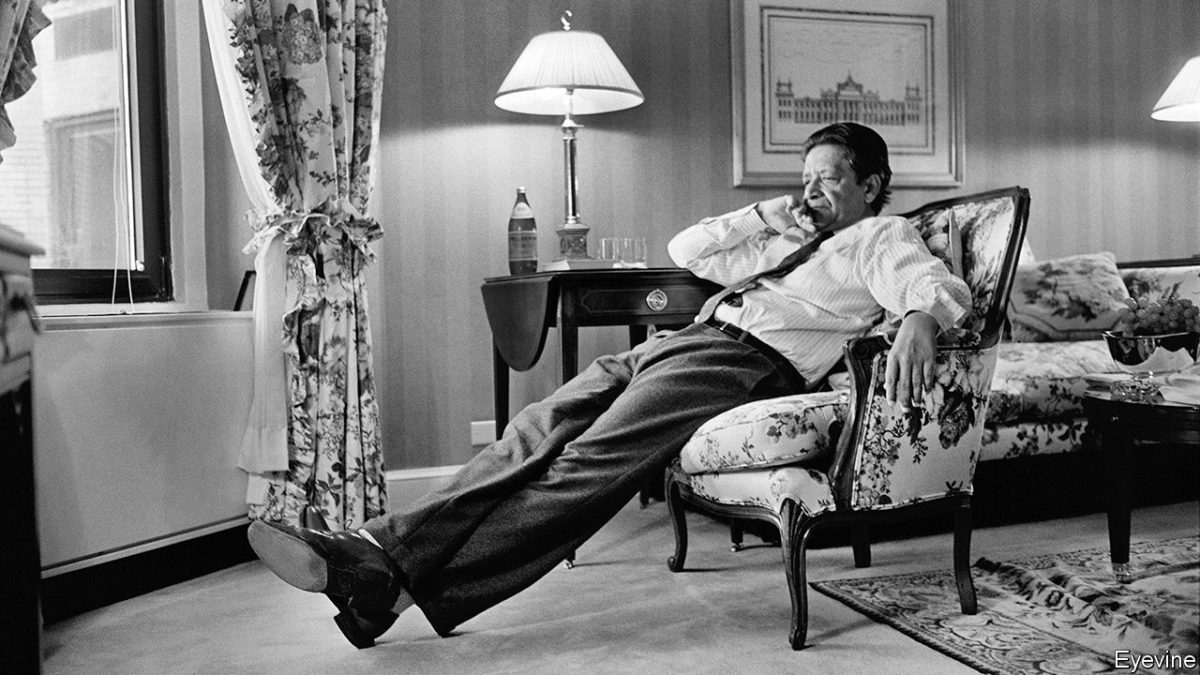
I have to be honest. V.S. Naipaul’s literary work is so abominably heartless that I would be greatly tempted to fire bottlerockets all night from my Brooklyn rooftop while wearing nothing more than a male monokini if his scabrous worldview and his pointless head games were permanently erased from the canon. He is surely the most overrated writer of the 20th century.

I’ve delivered variations of these sentiments over the phone to amused literary friends, who, when they weren’t laughing their asses off over my five minute anti-Naipaul soliloquies, were good enough to urge me to forgo the semi-scholarly format of this ridiculous years-long project and simply speak from the heart. I shall do my best to be as thoughtful as I can about my Naipaul bellicosity, which is, alas, the only way to move forward with this project. I can tell you this much. Not even Finnegans Wake, which took me five years to read and eventually write about, made me feel as frustrated as I was with A House for Mr. Biswas. Even the books on the list that I haven’t cared for all that much (The Old Wives’ Tale, the wildly overrated Ragtime, the failings of Kim) still contained something essential or interesting. You could see why a bunch of old white dudes decided to canonize the books even if they seemed to be speaking a hoary language — even accounting for the folkways and mores of 1998. But A House for Mr. Biswas was a joyless chore during the two times I read it. It is a reactionary monument to imperialistic ugliness that isn’t so much a thoughtful examination of colonialism as it is an author catching mice in a glue trap and watching them squirm their way into a slow and painful death instead of putting them out of their misery with a hammer.
In his life and his work, Naipaul was a sadistic bully, a narcissistic tyrant, and a mean-spirited man who used his powers to punch down. The only quality that distinguishes Naipaul from Donald Trump is his descriptive acumen and his honed prose. There is a moment in A House for Mr. Biswas in which Naipaul has a mother snap off branches from a hibiscus bush to discipline her child and it represents that brilliant exactitude. But that’s pretty much it. There isn’t a single Nobel laureate who basks in repugnancy like this simply because he can. Knut Hamsun was a terrible person (who later turned Nazi), but his masterpiece Hunger actually made you feel something about the down-and-out impoverished wretch at the center of the novel. The late great Toni Morrison, inexplicably omitted from the Modern Library canon, used ugly imagery to reveal the deep humanity within victims of racism and oppression. But what does Naipaul offer other than pointless cruelty? James Wood offered the hamfisted theory that Naipaul adopted the dual role of the colonizer and the colonized to adopt “a cool, summary omniscience that he uses to provoke our rebellious compassion.” But I personally could not feel any compassion for Biswas, in large part because I was constantly aware of the manipulative way that Naipaul had rigged the game. Naipaul, in other words, is an old school bully lulling and gaslighting the reader into a phony empathy. Having no empathy to offer, Naipaul leaves such overanalytical and generous critics as Wood to mine the gelid prose and do the work that Naipaul himself couldn’t be bothered to do. That Naipaul was able to play this game of three-card monte on so many says a great deal about how the literary establishment has a knack for propping up bona-fide sociopaths. Even progressive-minded naifs like Teju Cole stumped for this novel, claiming House to be “a masterwork of realism,” but largely on the basis of its itemized lists and of the way that the book encumbers the reader with its turgid pace. Both Wood and Cole acknowledge that it falls upon the reader to provide the munificence that Naipaul himself cannot. But they refuse to acknowledge that the faults of House‘s thin characterizations very much fall on Naipaul’s shoulders. If a writer isn’t committed to depicting the human, then why even bother praising the writer?

For the Spainards, Mr. Biswas knew, had surrendered the island one hundred years before, and their descendants had disappeared; yet they left a memory of reckless valour, and this memory had passed to people who came from another continent and didn’t know what a Spainard was, people who, in their huts of mud and grass where time and distance were obliterated, still frightened their children with the name of Alexander, of whose greatness they knew nothing.

I don’t gainsay Naipaul’s command at the sentence level, such as the measured passage above. At times, Naipaul comes across as the holistic sage reminding us that all of our lives are mired in historical cycles in which we often forget the final festoons of the previous arc. But grifters often talk in cant that suggest a larger tapestry. If you speak in ways that suggest larger cosmic contours, many people are going to assume that there’s something more to your tale than a mean monodimensional character who treats his family badly and who spends most of the goddamned novel writhing in anger and resentment simply because he never has the guts to make a real decision. I suspect Naipaul has bamboozled so many otherwise cogent minds because this kind of pedestrian toxic masculinity, especially in an older book, can be easily excused as a “sign of the times.” But even with Wuthering Heights‘s Heathcliff, named by Bustle‘s Charlotte Ahlin as the “most toxic male character in all of literature,” we can still understand why he forces his son Linton to marry. Heathcliff grows nastier as the novel continues. But he’s still tormented by Catherine’s ghost and the dregs of being bullied and locked in an attic. Mr. Biswas, by contrast, loses his father Raghu early on in the book after Mr. Biswas, entrusted to take care of a neighbor’s calf, falls into a stream and drowns. Mr. Biswas hides beneath his bed in shame. Raghu dives in for the missing calf and his own son. Raghu dies. Emily Bronte had the smarts to connect Heathcliff’s psychology to the past, which makes him more than merely a “toxic male character.” We want to understand why he behaves as he does. But, with Naipaul, the drowning incident is rarely referenced again in the novel. So Mr. Biswas is a man flung into misfortunes in the present without really acknowledging his past. Does this make him as much of a dope as any other ostensible cipher living out a failed life on a former Spanish colony? Apparently.

But there’s something much seedier at work here. As I pointed out with A Bend in the River, Naipual’s bad faith portrayal of low-caste types has always felt supererogatory. He isn’t taking potshots in an interesting or bona-fide punk rock way that challenges the audience. He revels in filth and ugliness and he chooses targets who are just too easy to flambee. You may recall my love for Erskine Caldwell’s Tobacco Road, which featured some wild and outlandish depictions of degeneracy, but Caldwell used his broad caricatures to implicate his audience for their generalizations about the poor. It’s clear to me that Naipaul doesn’t have any such grand game afoot here, other than reveling in his hideous hubris. He’s happy to see his inventions rot. The man lived to hurl unpleasant observations about unpleasant people, both in his life and in his fiction. And I say this as a huge fan of unlikable characters. Naipaul’s ensemble isn’t terribly interesting or dimensional. For all my complaints about Evelyn Waugh, at least that reactionary clown was committed to some kind of beauty. A throwback beauty that came from a repressed Catholicism, but a beauty nonetheless. What do we get with Naipaul? Hari “humming from some hymn book in his cheerless way.”

While I commend Naiapul’s prose powers (his description of a box imprinted with the circles of condensed milk cans and his evocation of gods for the Tulsi house are two of many examples of what make him a commendable stylist), I really don’t see why Mr. Biswas deserves such an expansive volume. He is mean, arrogant, cowardly, and an altogether predictable specimen of 20th century masculinity. He possesses no empathy for the people who surround him, looking at his future wife Shama not with compassion as she is berated by a customer, but “as a child.” He expresses flights of wild behavior that might be characterized as bipolar. He throws fits, feels as if he is entitled to a job. Even in describing Mr. Biswas in the way I am here, I fear that I am making him more interesting he deserves to be portrayed. Naipaul doesn’t give us a real reason for Mr. Biswaa’s ego or his cruelty — despite the fact that we are constantly surrounded by his family, which include in-laws who are too numerous to track without notes. He would prefer to wallow in ugliness — both in the ramshackle aesthetic of rural Trinidad and the boorish behavior of his many side characters. There are unlikable characters and villains in literature who deserve our attention because we want to know how they came to be who they are. But with Mr. Biswas, I never felt any strong pull to know him any further. Mr. Biswas is an unremarkable reader, a mediocre sign-painter, and a ham-fisted writer who never has anything especially interesting to say, but always has an especially monstrous act to mete out to anyone in his surrounding orbit.

So I’m quite happy to be rid of Naipaul. I will never read him again. There are people who still swear by Naipaul. Robert McCrum once declared Naipaul to be “the greatest living writer of English prose.” But what’s the point of picking up the pen when you don’t have a pulse?

Next Up: Richard Hughes, A High Wind in Jamaica!

The Day of the Locust (Modern Library #73)

(This is the twenty-eighth entry in the The Modern Library Reading Challenge, an ambitious project to read the entire Modern Library from #100 to #1. Previous entry: A Farewell to Arms.)

December 22, 1940 may be literature’s answer to July 4, 1826, the day in which John Adams rasped his last words on his deathbed. “Thomas Jefferson still survives,” he gasped, not knowing that Jefferson himself had passed away only five hours before. One hundred and fourteen years later, two towering literary titans, far more obscure in their time than Adams and Jefferson had been in theirs, met their end at a needlessly early age. On December 21, 1940, F. Scott Fitzgerald collapsed inside a ground-floor apartment not far from the Sunset Strip at the age of 44. The alcohol had finally caught up with him. He believed himself a failure. He would never know that his tragically brief life and his coruscating work would be rediscovered only a handful of years later — not long after 155,000 copies of The Great Gatsby were distributed to World War II servicemen. The next day, about two hundred miles southwest of Fitzgerald’s home, Nathanael West and his wife Eileen McKenney (whose sprightly spirit would be immortalized by her sister Ruth in a series of light but amusing New Yorker pieces later turned into a wildly successful stage show called My Sister Eileen) would be killed instantly in a car collision on their way back from Mexico. West was, by all reports, a notoriously awful driver and he was even younger than Fitzgerald. Just thirty-seven.

Both men had turned to screenwriting to stay afloat during the Great Depression. Both men had much to say about the traps and illusions of American life. But it would take longer for West to be reassessed and appreciated — in large part because he was arguably fiercer than Fitz with his fiction. He had his finger firmly on the troubling pulse of feral American life and he wasn’t afraid to use it with the other nine at his typewriter. In a short essay called “Some Notes on Violence,” West pointed to the idiomatic violence that had permeated every corner of printed media: “We did not start with the ideas of printing tales of violence. We now believe that we would be doing violence by suppressing them.” His razor-sharp satire featured philandering dwarves, skewered the hideous contradictions of gaudy Hollywood spectacle, and, in just one of many enthralling flashes of his grimly hilarious invention, depicted a dead horse serving as au courant decor at the bottom of a swimming pool. (In an age in which urine-drinking is prescribed as a COVID remedy and reality star Stephanie Matto makes $200,000 selling her farts in a jar, one wonders why the present fictional landscape doesn’t reflect our scabrous realities and why 85% of today’s gatekeepers are so hostile to such a necessary dialogue between fiction and life. But then this is the same universe in which Hanya Yanagihara’s excellent, quite readable, and wildly ambitious new novel, To Paradise, is framed by The New York Times in belittingly racist and sexist terms, assuaging an increasingly unadventurous bourgeois readership: “Can an Asian American woman write a great American novel?” (Well, of course, she can. Why even summon the rhetoric?))
West’s high point as a novelist was arguably The Day of the Locust — just as compact as Gatsby in its length and sentences, but more wryly surreal than ethereal. And he had a genius for fusing this talent with a theatrically visceral and often bleakly comic strain revealing the FOMO and desperate collective belonging at any vicious cost that one sees prominently among numerous Instagram influencers today. Consider this scene at a funeral:

He knew their kind. While not torch-bearers themselves, they would run behind the fire and do a great deal of the shouting. They had come to see Harry buried, hoping for a dramatic incident of some sort, hoping at least for one of the mourners to be led weeping hysterically from the chapel. It seemed to Tod that they stared back at him with an expression of vicious, acrid boredom that trembled on the edge of violence.

This is followed not long after by an old woman who shows up with “a face pulled out of shape by badly-fitting store teeth” whispering to “a man sucking on the handle of a home-made walking stick.” This close attention to background characters making do with either the remaining scraps they could cobble together or the insufficient products on sale at a store obviously sprang from the Great Depression and West’s own experience working at a hotel, where he undoubtedly observed a motley array of eccentrics and strange outliers. (Jay Martin’s excellent biography, Nathanael West: The Art of His Life, covers quite a bit of these hotel days and reveals West to be an impeccable bullshit artist in his life, wheeling deals to help other writers land rooms and constantly reinventing the details of his life to negotiate a failing capitalist system.) But West’s panoramic description also feels unsettlingly close to our present time, in which inflation, the supply chain, and an inept framework increasingly leaving Americans out in the cold produces the same plausible character types. And in another eerie parallel to the present, The Day of the Locust also includes a dismal romantic rival named Homer Simpson. The only song Homer knows is the national anthem

The novel follows Tod Hackett, an artist who has moved to Hollywood to find inspiration for what he hopes will be his masterwork painting, “The Burning of Los Angeles.” (I casually wondered if Rage Against the Machine’s album The Battle of Los Angeles took titular inspiration from West. But sadly no interviewer appears to have asked Zack de la Rocha and company this.) He swoons for Faye Greener after seeing her in the hall at a dismal complex called San Berdoo. But Faye can “only love a handsome man and would only let a wealthy man love her.” Tod harbors disturbingly intense and violent fantasies towards Faye. Is Tod mentally unbalanced? Or is this the inevitable byproduct of trying to find inspiration in a landscape of contradictions? West smartly leaves these questions open for the reader to infer.

One reads this masterpiece in 2022 greatly saddened by the possibilities of what West could have become. Would he have floundered like Erskine Caldwell or soured into a bitter reactionary like Evelyn Waugh? I don’t think he would have. West was committed to grim playful truth right out of the gate — as his scatologically driven first work, The Dream Life of Balso Snell, made abundantly clear. It says quite a lot about the bleak tenor of the prewar Depression period that so many wild and dark comic novelists flourished. Much as one reads the fiction published just before World War I and marvels at the flowing frankness that just preceded Hemingway permanently altering the English language with his declarative sentences, so too does one approach Tobacco Road, Scoop, and The Day of the Locust with a sense of what might have been in literature if the Second World War had never happened. One then turns to our present pandemic age and wonders why most of today’s contemporary fiction writers remain so spineless, so dully vanilla and offensively weak-kneed and uninventive, so hostile to serving up appropriate pushback against our present devil’s bargain of late-stage capitalism and all of its concomitant horrors.

West would have been canceled quite swiftly if he were starting out today. Joe Woodward’s biography of Nathanael West, Alive Inside the Wreck, points to a fascinating review from Ben Abramson that appeared in Reading and Collecting in which he suggested that West’s books should be reviewed two or three years after publication so that they could be reviewed on “merits” rather than “merchandise.” Indeed, it is the mercantile thrust of vapid careerist “critics” on social media these days — the type epitomized by so many mediocre Twitter addicts who wouldn’t know, appreciate or stump for bona-fide punk rock even if they traveled back in time and became desecrated by excrement while standing in the front row of a GG Allin show — that motivates their own sham criteria and their head-in-the-sand approach to our societal ills. But eighty-three years after The Day of the Locust‘s publication — well past Abramson’s prescription for proper consideration — The Day of the Locust says more about the eternal and seemingly unfixable ailments of American life than most of today’s writers can summon over the course of a career. Despite being cut down in his prime, Nathanael West still survives.

Next Up: V.S. Naipaul’s A House for Mr. Biswas!

The City in History (Modern Library Nonfiction #76)

(This is the twenty-fifth entry in The Modern Library Nonfiction Challenge, an ambitious project to read and write about the Modern Library Nonfiction books from #100 to #1. There is also The Modern Library Reading Challenge, a fiction-based counterpart to this list. Previous entry: Battle Cry of Freedom.)

I’ve been a city man all my life. Certainly all of my adult life. At the age of twenty, I escaped from the dour doldrums of suburban Sacramento — the kind of hideous Flintstones-style recurring backdrop that seems to encourage broken dreams, angry tears, and rampant abuse behind model home replica doors — for the bright foggy beauty and the joyful pastels of San Francisco.

That gorgeous place from the not so distant past — with the co-op movie theatres playing weirdass indie flicks you couldn’t find on video or teevee, the cafes pattering with political idealism and the streets rattling with the chatty pugnacious jingle of strange conceptual punks, the crumbling encyclopedic bookstores and the boldly strange dive bars of the Tenderloin, and the wonderful mariachi players serenading Valencia Street taquerias for a quick buck, a Mexicoke, and a smile — was exactly the urban realm I needed at the time. Only real souls committed to an increasingly rarefied inclusiveness like Michelle Tea and William T. Vollmann knew how to capture these meat-and-potatoes freak-friendly details in their novels. What I didn’t know, as San Francisco became an unaffordable playground invaded by elitist and not especially perspicacious techbro affluents, was that this coastal metropolis was no longer a place for weirdos like me. I was outpriced and outmatched, like so many who bolted to Oakland, Los Angeles, and elsewhere. It was an all-too-common tale of gentrification and migration, of a city permanently regurgitating its most promising inhabitants and falling victim to an influx of wealth that forever altered its essence. Like any foolish romantic, I fell in love with someone who was absolutely wrong for me and became seduced by the Brooklyn brownstones, the skyscrapers spiring along the rivers, and the giddy pace of a megacity demanding all of its inhabitants to make something of themselves. I’ve been in New York City now for fourteen years — most of my thirties and all of my forties. I hope to continue to live here. But like anything in life, it’s largely the luck of the draw, hoping that the law of averages will work out in your favor. Especially in this age of mass unemployment and pandemic uncertainties and anybody who doesn’t make more than $200,000 a year left in the cold and declared the enemy.

I mention these bona-fides in advance of my thoughts on the great Lewis Mumford to give you a sense of why his amazing book, The City in History, took me much longer to read than I anticipated. The problem with an encyclopedic smartypants like Mumford is that he’ll drop a casual reference that is supremely interesting if you are even remotely curious. One paragraph will send you down an Internet rabbit hole. The next thing you know, you’ve just spent hours of your life trying to find any information on the ancient Greek artisans who hustled their goods in the agora and why slavery was simply accepted as a part of city life for centuries. An email correspondent, learning that I was taking a deep dive into Mumford, urged me to plunge into the four volumes kick-started by Technics and Civilization. And I have to say, given the many months I spent not so much reading The City in History but taking in the many references orbiting its scholarship, I will probably have to wait until perhaps my seventies — should I live that long — for such an enormous undertaking. I could easily see myself as an old bachelor on a beach — filling in crossword puzzles, tendering stories about my misspent youth to any sympathetic ear, respectfully flirting with any lingering divorcĂ© with the decency to not see me as invisible, and carrying along the four Mumford volumes with me (along with whatever will then pass for a tablet to look up all the references) in a satchel.

This is my roundabout way of saying that Lewis Mumford’s The City in History is a wonderfully robust and often grumbly tome from a dude who spent most of his years considering how cities thrive through technological and architectural development. One of the book’s charms is seeing Mumford gradually becoming more pissed off as he gets closer to the modern age. It’s almost as if he resents what the city transformed into in the twentieth century. For example, in a weird aside, Mumford complains about the increased number of windows in residential buildings after the seventeenth century, bemoaning the lack of privacy with a touch of principle rarely remembered by people who grew up with nothing but the Internet’s exhibitionistic cadences. He also has a healthy aversion to the “often disruptive and self-defeating” nature of constant growth. It is, after all, possible for a city or a small town to develop too much. Once cities ditched their walls, there were no longer any physical boundaries to how far any teeming area could spread while arguably become lesser the further it rolled along. (See, for example, the anarchic sprawl of Texas today. Everyone from the likes of the Manhattan Institute’s Michael Hendrix to James Howard Kuntsler has spoken, in varying degrees of horror, about this endless expansion.) On this point, Mumford pushes back against the myth of the medieval town as a place of static boredom. He points to religious edifices somehow transforming these clusters where, for the first time in history, “the majority of the inhabitants of a city were free men.” Even when mercantile centers dried up as trade died, Mumfurod points to the limitless evolution of the countryside. Feudalism subsided for a stabler and more available food supply and new forms of home-spun industry that made many of these smaller villages special. Textile industries flourished in northern Italy and not only resulted in innovations such as the spinning wheel, but some healthy revolutionary pushback against tyrants — such as the weavers rebelling against the ruling elite in 1370-1371. In short, Mumford argues that a reasonably confined city was capable of nearly anything.

But what of the modern metropolis? The cities that called to people like me as a young man? Mumford’s view was that the enormity of a place like Paris or Rome or London or New York City wasn’t merely the result of technological progress. As he argues:

…the metropolitan phase became universal only when the technical means of congestion had become adequate — and their use profitable to those who manufactured or employed them. The modern metropolis is, rather, an outstanding example of a peculiar cultural lag within the realm of technics itself: namely, the continuation by highly advanced technical means of the obsolete forms and ends of a socially retarded civilization.

Well, that doesn’t sound too nice. So the punks who I jammed with in Mission District warrens and the scrappy filmmakers piecing together stories and the bizarre theatre we were putting on while eating ramen and Red Vines were cultural atavists? Gee, thanks, Lewis! Would Mumford apply this same disparaging tone to the CBGB punk crowd and artists who flourished in the East Village and arguably altered the trajectory of popular music? Or, for that matter, the 1990s hip-hop artists who flourished in Bed-Stuy and Compton? This is where Mumford and I part ways. Who are any of us to dictate what constitutes cultural lag? In my experience, obsolete forms tend to square dance with current mediums and that’s usually how the beat rolls on. Small wonder that Jane Jacobs and Mumford would get involved in a philosophical brawl that lasted a good four decades.

It’s frustrating that, for all the right criticism Mumford offers, he can be a bit of a dowdy square. He’s so good at showing us how the office building, as we still know it today, initiated in Florence thanks to Giorgio Vasari. It turns out that this amazing Italian Renaissance man wasn’t just committed to corridors. He designed an interior with an open-floor loggia — those reception areas that can now be found in every damned bureaucratic entity. We now have someone to blame for them! Mumford offers us little details — such as the tendency of early cities to repave streets over the layers of trash that had been thrown over the past twenty years. This resulted in developments such as doorways increasingly becoming lower — often submerged beneath the grade entirely — as history carried on. There are very useful asides in Mumford’s book on the history of multistory buildings. We learn how Roman baths and gymnasiums did make efforts to accommodate the rabble, despite the rampant exploitation of humans. Calvino was only scratching the surface. As long as cities have been around, humans have created new structures and new innovations. For all we know, the Coronavirus pandemic could very well lead to some urban advancement that humankind had hitherto never considered.

Because of all this, I can’t square Mumford’s elitism with the beautiful idealism that he lays down here:

The final mission of the city is to further man’s cautious participation in the cosmic and the historic process. Through its own complex and enduring structure, the city vastly augments man’s ability to interpret these processes and take an active, formative part in them, so that every phase of the drama it stages shall have, to the highest degree possible, the illumination of consciousness, the stamp of purpose, the color of love. That magnification of all the dimensions of life, through emotional communion, rational communication, technological mastery, and, above, all, dramatic representation, has been the supreme office of the city in history. And it remains the chief reason for the city’s continued existence.

Who determines the active and formative development of the city? Do we leave it to anarchy? Do we acknowledge the numerous forces duking it out over who determines the topography? I can certainly get behind Mumford railing against mercantilism. But who establishes the ideal? One of the most underrated volumes contending with such a struggle between social community and the kind of “high-minded” conservative finger-wagging that Mumford too often espouses is Samuel R. Delany’s excellent book, Times Square Red, Times Square Blue, a brilliant portrait of the undeniable “color of love” practiced in the Times Square adult movie theatres through the mid-1990s — until Mayor Giuliani declared war on what he deemed unseemly. In a sidebar, Delany, buttressing Jane Jacobs, observes that the problem here is that this sort of idealism assumes two conditions: (1) that cities are fundamentally repugnant places and that we must therefore hide the poor and the underprivileged and (2) the city is defined by the big and the monumental.

The sheer amount of suffering undergone by the impoverished is something that Mumford, to his credit, does broach — particularly the unsanitary conditions that those in London and New York lived in as these cities expanded. (For more on the working stiffs and those who struggled, especially in New York, I highly recommend Luc Sante’s excellent book Low Life.) But while Mumford is willing to go all in on the question of bigness, he’s a little too detached and diffident on the issue of how the have nots contribute to urban growth, although he does note how “the proletariat had their unpremeditated revenge” on the haves as New York increasingly crammed people like sardines into airless cloisters. And, as such, I found myself pulling out my Jane Jacobs books, rereading passages, and saying, with my best Mortal Kombat announcer voice, “Finish him!”

But maybe I’m being a little too hard on Mumford. The guy wasn’t a fan of architect Leon Battista Alberti’s great rush for suburban development, with this funny aside: “one must ask how much he left for the early twentieth-century architect to invent.” Mumford had it in for Le Corbusier and his tower-centric approach to urban planning (which is perhaps best observed in Chandigarh, India — a place where Le Corbusier was given free reign), but he was also a huge fan of Ebeneezer Howard and his “Garden City” movement, whereby Howard suggested that some combination of city and country represented the best living conditions. Even if you side with Jane Jacobs, as I do, on the whole Garden City question, believing that there can be some real beauty in staggering and urban density, you can’t help but smile at his prickliness:

For the successor of the paleotechnic town has created instruments and conditions potentially far more lethal than those which wiped out so many lives in the town of Donora, Pennsylvania, through a concentration of toxic gases, or that which in December 1952 killed in one week an estimated five thousand extra of London’s inhabitants.

Oh, Mumford! With endearingly bleak observations like this, why couldn’t you be more on the side of the people?

Next Up: Paul Fussell’s The Great War and Modern Memory!

The Rise of Theodore Roosevelt (Modern Library Nonfiction #79)

(This is the twenty-second entry in The Modern Library Nonfiction Challenge, an ambitious project to read and write about the Modern Library Nonfiction books from #100 to #1. There is also The Modern Library Reading Challenge, a fiction-based counterpart to this list. Previous entry: Studies in Iconology.)

One of many blistering tangerines contained within Mark Twain’s juicy three volume Autobiography involves his observations on Theodore Roosevelt: “We have never had a President before who was destitute of self-respect and of respect for his high office; we have had no President before who was not a gentleman; we have had no President before who was intended for a butcher, a dive-keeper or a bully, and missed his mission of compulsion of circumstances over which he had no control.”

He could just as easily have been discussing the current doddering charlatan now forcing many otherwise respectable citizens into recuperative nights of heavy drinking and fussy hookups with a bespoke apocalyptic theme, but Twain’s sentiments do say quite a good deal about the cyclical American affinity for peculiar outsiders who resonate with a populist base. As I write these words, Bernie Sanders has just decided to enter the 2020 Presidential race, raising nearly $6 million in 24 hours and angering those who perceive his call for robust social democracy to be unrealistic, along with truth-telling comedians who are “sick of old white dudes.” Should Sanders run as an independent, the 2020 presidential race could very well be a replay of Roosevelt’s Bull Moose Party run in 1912.

Character ultimately distinguishes a Chauncey Gardner couch potato from an outlier who makes tangible waves. And it is nearly impossible to argue that Teddy Roosevelt, while bombastic in his prose, often ridiculous in his obsessions, and pretty damn nuts when it came to the Rough Riders business in Cuba, did not possess it. Edmund Morris’s incredibly compelling biography, while subtly acknowledging Teddy’s often feral and contradictory impulses, suggests that Roosevelt was not only the man that America wanted and perhaps needed, but reminds us that Roosevelt also had the good fortune of being in the right place at the right time. Had not Vice President Garret Hobart dropped dead because of a bum ticker on November 21, 1899, and had not a sour New York Republican boss named Tom Platt been so eager to run Teddy out of Albany, there is a good chance that Roosevelt might have ended up as a serviceable two-term Governor of New York, perhaps a brasher form of Nelson Rockefeller or an Eliot Spitzer who knew how to control his zipper. Had not a Russian anarchist plugged President McKinnley two times in the chest at the Temple of Music, it is quite possible that Roosevelt’s innovative trust busting and his work on food safety and national parks, to say nothing of his crazed obsession with military might and giving the United States a new role as international police force, would have been delayed altogether.

What Roosevelt had, aside from remarkable luck, was a relentless energy which often exhausts the 21st century reader nearly as much as it fatigued those surrounding Teddy’s orbit. Here is a daily timetable of Teddy’s activities when he was running for Vice President, which Morris quotes late in the book:

7:00 A.M. Breakfast 
7:30 A.M. A speech
8:00 A.M. Reading a historical work
9:00 A.M. A speech
10:00 A.M.  Dictating letters
11:00 A.M. Discussing Montana mines
11:30 A.M. A speech
12:00 Reading an ornithological work
12:30 P.M. A speech
1:00 P.M. Lunch
1:30 P.M. A speech
2:30 P.M. Reading Sir Walter Scott
3:00 P.M. Answering telegrams
3:45 P.M. A speech
4:00 P.M. Meeting the press
4:30 P.M. Reading
5:00 P.M. A speech
6:00 P.M. Reading
7:00 P.M. Supper
8-10 P.M. Speaking
11:00 P.M. Reading alone in his car
12:00 To bed

That Roosevelt was able to do so much in an epoch before instant messages, social media, vast armies of personal assistants, and Outlook reminders says a great deal about how he ascended so rapidly to great heights. He could dictate an entire book in three months, while also spending his days climbing mountains and riding dozens of miles on horseback (much to the chagrin of his exhausted colts). Morris suggests that much of this energy was forged from the asthma he suffered as a child. Standing initially in the shadow of his younger brother Elliott (whose later mental collapse he callously attempted to cover up to preserve his reputation), Teddy spent nearly his entire life doing, perhaps sharing Steve Jobs’s “reality distortion field” in the wholesale denial of his limitations:

In between rows and rides, Theodore would burn off his excess energy by running at speed through the woods, boxing and wrestling with Elliott, hiking, hunting, and swimming. His diary constantly exults in physical achievement, and never betrays fear that he might be overtaxing his strength. When forced to record an attack of cholera morbus in early August, he precedes it with the phrase, “Funnily enough….”

Morris is thankfully sparing about whether such superhuman energy (which some psychological experts have suggested to be the result of undiagnosed bipolar disorder) constitutes genius, only reserving the word for Roosevelt in relation to his incredible knack for maintaining relations with the press — seen most prominently in his fulsome campaign speeches and the way that he courted journalistic reformer Jacob Riis during his days as New York Police Commissioner and invited Riis to accompany him on his nighttime sweeps through various beats, where Roosevelt micromanaged slumbering cops and any other layabout he could find. The more fascinating question is how such an exuberant young autodidact, a voracious reader with preternatural recall eagerly conducting dissections around the house when not running and rowing his way with ailing lungs, came to become involved in American politics.

Some of this had to do with his hypergraphia, his need to inhabit the world, his indefatigable drive to do everything and anything. Some of it had to do with deciding to attend Columbia Law School so he could forge a professional career with his new wife Alice Hathaway Lee, who had quite the appetite for social functions (and whose inner life, sadly, is only superficially examined in Morris’s book). But much of it had to do with Roosevelt regularly attending Morton Hall, the Republican headquarters for his local district. Despite being heckled for his unusual threads and side-whiskers, Roosevelt kept showing up until he was accepted as a member. The Roosevelt family disapproved. Teddy reacted in anger. And from moment forward, Morris writes, Roosevelt desired political power for the rest of his life. Part of this had to do with the need for family revenge. Theodore Roosevelt, Sr. suffered a swift decline in health (and quickly died) after Roscoe Conklin and New York State Republicans set out to ruin him over a customs collector position.

These early seeds of payback and uncompromising individualism grew Roosevelt into a fiery oleander who garnered a rep as a fierce and feisty New York State Assemblyman: the volcanic fuel source that was to sustain him until mortality and dowdiness sadly caught up with him during the First World War. But Roosevelt, like Lyndon B. Johnson later with the Civil Rights Act (documented in an incredibly gripping chapter in Robert A. Caro’s Master of the Senate), did have a masterful way of persuading people to side with him, often through his energy and speeches rather than creepy lapel-grabbing. As New York Police Commissioner, Roosevelt upheld the unpopular blue laws and, for a time, managed to get both the grumbling bibulous public and the irascible tavern keepers on his side. Still, Roosevelt’s pugnacity and tenacity were probably more indicative of the manner in which he fought his battles. He took advantage of any political opportunity — such as making vital decisions while serving as Acting Secretary of the Navy without consulting his superior John Davis Long. But he did have a sense of honor, seen in his refusal to take out his enemy Andrew D. Parker when given a scandalous lead during a bitter battle in New York City (the episode was helpfully documented by Riis) and, as New York State Assemblyman, voting with Democrats on March 7, 1883 to veto the Five-Cent Bill when it was discovered to be unconstitutional by then Governor Grover Cleveland. Perhaps his often impulsive instincts, punctuated by an ability to consider the consequences of any action as it was being carried out, is what made him, at times, a remarkable leader. Morris documents one episode during Roosevelt’s stint as Assistant Secretary of the Navy in which he was trying to build up an American navy and swiftly snapped up a Brazilian vessel without a letter. When the contract was drafted for the ship, dealer Charles R. Flint noted, “It was one of the most concise and at the same time one of the cleverest contracts I have ever seen.”

Morris is to be praised for writing about such a rambunctious figure with class, care, and panache. Seriously, this dude doesn’t get enough props for busting out all the biographical stops. If you want to know more about Theodore Roosevelt, Morris’s trilogy is definitely the one you should read. Even so, there are a few moments in this biography in which Morris veers modestly into extremes that strain his otherwise eloquent fairness. He quotes from “a modern historian” who asks, “Who in office was more radical in 1899?” One zips to the endnotes, only to find that the “historian” in question was none other than the partisan John Allen Gable, who was once considered to be the foremost authority on Teddy Roosevelt. Morris also observes that “ninety-nine percent of the millions of words he thus poured out are sterile, banal, and so droningly repetitive as to defeat the most dedicated researcher,” and while one opens a bountiful heart to the historian prepared to sift through the collected works of a possible madman, the juicy bits that Morris quotes are entertaining and compelling. Also, to be fair, a man driven to dictate a book-length historical biography in a month is going to have some litters in the bunch.

But these are extremely modest complaints for an otherwise magnificent biography. Edmund Morris writes with a nimble focus. His research is detailed, rigorous, and always on point, and he has a clear enthusiasm for his subject. Much of Morris’s fall from grace has to do with the regrettable volume, Dutch, in which Morris abandoned his exacting acumen and inserted a version of himself in a biography of Reagan. This feckless boundary-pushing even extended into the endnotes, in which one Morris inserted references to imaginary people. He completely overlooked vital periods in Reagan’s life and political career, such as the Robert Bork episode. Given the $3 million advance and the unfettered access that Morris had to Reagan, there was little excuse for this. Yet despite returning valiantly to Roosevelt in two subsequent volumes (without the weirdass fictitious asides), Morris has been given the Wittgenstein treatment (“That whereof we cannot speak, thereof we must remain silent”) by his peers and his colleagues. And I don’t understand why. Morris, much like Kristen Roupenian quite recently, seems to have been needlessly punished for being successful and not living up to a ridiculous set of expectations. But The Rise of Theodore Roosevelt, which rightfully earned the Pulitzer Prize, makes the case on its own merits that Morris is worthy of our time, our consideration, and our forgiveness and that the great Theodore Roosevelt himself is still a worthwhile figure for contemporary study.

Next Up: Martin Luther King’s Why We Can’t Wait!